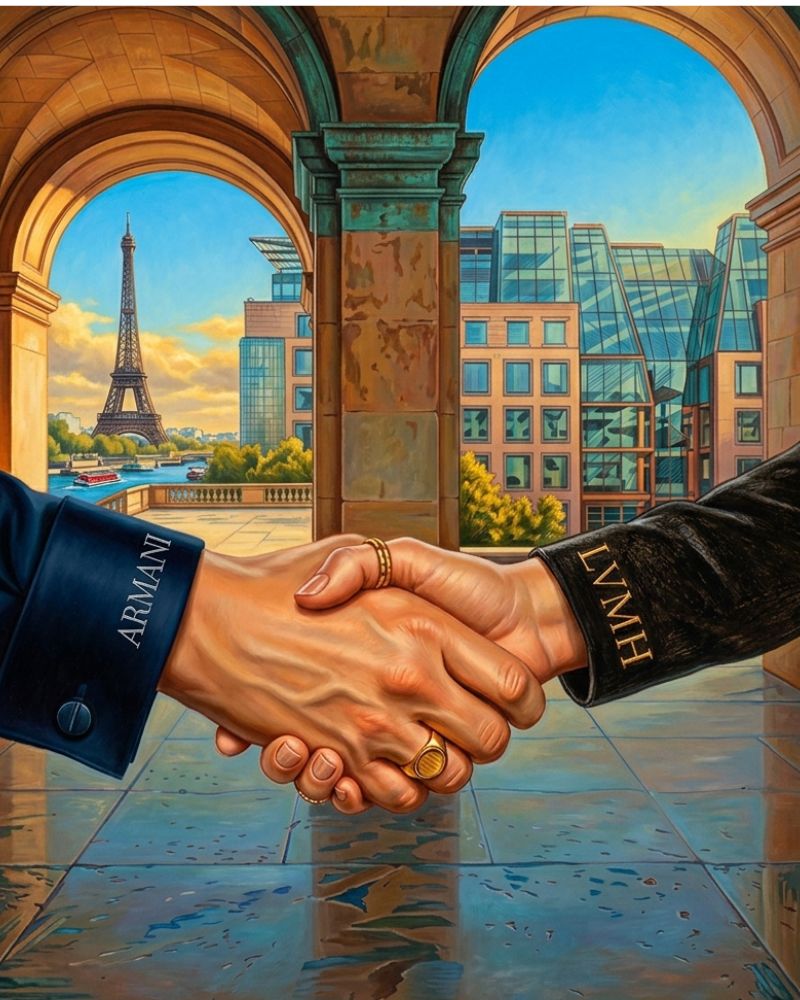




Armani LVMH deal rumours are no longer just industry chatter. They’re starting to look like a signal of where luxury power is heading.
For decades, Giorgio Armani played a different game from the rest of luxury. While fashion houses were being swallowed by conglomerates and turned into global machines, Armani stayed stubbornly independent with no frantic logo battles, no viral gimmicks and no overexposure spiral. Just razor-sharp tailoring, controlled expansion, and a brand identity so disciplined it almost felt untouchable.
Quiet luxury before quiet luxury had a name which is exactly why the latest Armani–LVMH deal rumours feel less like industry gossip and more like a power shift in motion. According to reports cited by Reuters via Economic Times, Armani could reportedly split a 15% stake between LVMH, L’Oréal, and EssilorLuxottica.
And suddenly, luxury is paying attention in full because this isn’t just a deal but a potential reshaping of who controls fashion’s future.
Why everyone suddenly wants Armani?
The timing for the Armani LVMH deal is no coincidence. Luxury is no longer in its boom era. Growth is slowing and pricing fatigue is real. Plus, aspirational shoppers are hesitating. Even giants like LVMH are navigating a more cautious, recalibrated market after years of aggressive expansion.
And in this climate, Armani stands out for being disciplined. While many luxury brands chased virality through constant drops, influencer saturation, and overextended collaborations, Armani did the opposite. It expanded quietly into beauty, interiors, hotels, and lifestyle without diluting its core aesthetic.
That restraint is now its biggest asset. Reports suggest the Armani Group generated around €2.3 billion in revenue in 2024, holding steady even as parts of the luxury sector cooled.
LVMH, L’Oréal, Armani: The deal that makes too much sense
What makes this story even more layered is how interconnected these players already are. L’Oréal already operates Armani Beauty. EssilorLuxottica handles Armani eyewear. And LVMH? It’s the most dominant luxury conglomerate in the world, home to Louis Vuitton, Dior, Fendi, and Celine. So if LVMH steps further into Armani’s universe (even partially) the symbolism is huge.
But here’s the twist: Armani isn’t reportedly handing control to a single empire. Instead, splitting influence across multiple giants could allow the brand to stay structurally independent while securing long-term stability and scale. In today’s luxury landscape, that hybrid model is becoming the new power move.
Luxury is entering its succession era
Zoom out, and this isn’t really just an Armani story. Luxury is quietly entering its succession phase. While founder-led empires are aging, ownership transitions are no longer theoretical. And suddenly, the most valuable brands aren’t just the loudest or the trendiest, but the ones with decades of cultural credibility baked in.
At the same time, consumers are shifting. They’re tired of overexposure, and of endless “newness.” The new desire is for restraint, and consistency far removed from the Emily in Paris trope of Pierre Cadault being pushed into commercial collaborations just to stay culturally visible.
Ironically, Armani never had to make that compromise.
What the Armani LVMH deal rumours really signal for the future of luxury power?
If these rumours materialise, the Armani–LVMH–L’Oréal triangle won’t just be a business story but will signal something bigger about where luxury is heading.
Fashion today isn’t just about clothes anymore. It’s about ecosystems: beauty, eyewear, hospitality, retail, media visibility, and global infrastructure all working in sync. And the brands that can own all of it without losing their identity are becoming the most powerful players in the room.
Which is why, suddenly, everyone wants a piece of Armani.
FAQ
What exactly is the Armani–LVMH deal?
It refers to Armani’s succession plan, where a 15% stake in the company is expected to be sold to strategic luxury players like LVMH, L’Oréal, or EssilorLuxottica within 12–18 months of Giorgio Armani’s passing.
Is Armani being fully acquired?
Not immediately. The first step is a minority 15% stake sale. However, the structure allows the eventual buyer to potentially increase its holding over time, depending on agreements with the foundation.
Why would Armani split the stake among multiple buyers?
Splitting the stake helps maintain balance and avoids giving one company early control. It also ensures multiple strategic partners stay invested in the brand’s future direction.