


The Dubai luxury beauty market is no longer about products alone. Dior, Chanel, and Hermès are winning the Middle East by turning beauty into status, theatre, and power.
Dubai doesn’t sell beauty but refines it in public, under very good lighting
Spend enough time inside a flagship beauty hall in Dubai and the spectacle begins to reveal its structure. What appears indulgent at first glance is, in reality, highly systemised. Customers arrive informed, conversations move quickly beyond persuasion, and purchases feel considered rather than impulsive.
This is what makes the Dubai luxury beauty market such a critical testing ground for global brands. It is not just a high-spend environment. It is one of the most closely watched markets, where performance, experience, and cultural relevance are evaluated simultaneously, particularly given the region’s outsised influence on premium beauty consumption.
Dubai luxury beauty market: The numbers suggest growth
The global beauty industry continues to expand steadily, with projections placing it beyond the $800 billion mark by the end of the decade, driven by consistent demand across skincare, fragrance, and personal care.
The Middle East, meanwhile, is seeing accelerated growth in premium beauty, supported by a young, high-spending population and increasing demand for high-performance and culturally relevant products.
Dubai sits at the centre of this momentum, acting as both a retail hub and a gateway for international brands entering the region. What distinguishes it is the speed at which consumer feedback loops operate. Products that resonate tend to gain traction quickly, while those that do not often struggle to maintain relevance in an intensely competitive landscape shaped by both residents and global travellers.
Three brands, one city, and very different approaches
Dior – Scaling with consistency
Dior’s strategy in Dubai appears to focus on expanding presence while maintaining a consistent brand experience across high-traffic destinations such as The Dubai Mall, one of the world’s largest retail environments and a key luxury distribution hub.
Its emphasis on skincare and fragrance aligns with broader regional demand, where these categories dominate due to climate conditions and cultural preferences.
The brand’s ability to balance visibility with execution suggests a model built on operational discipline, where scale does not come at the cost of experience.
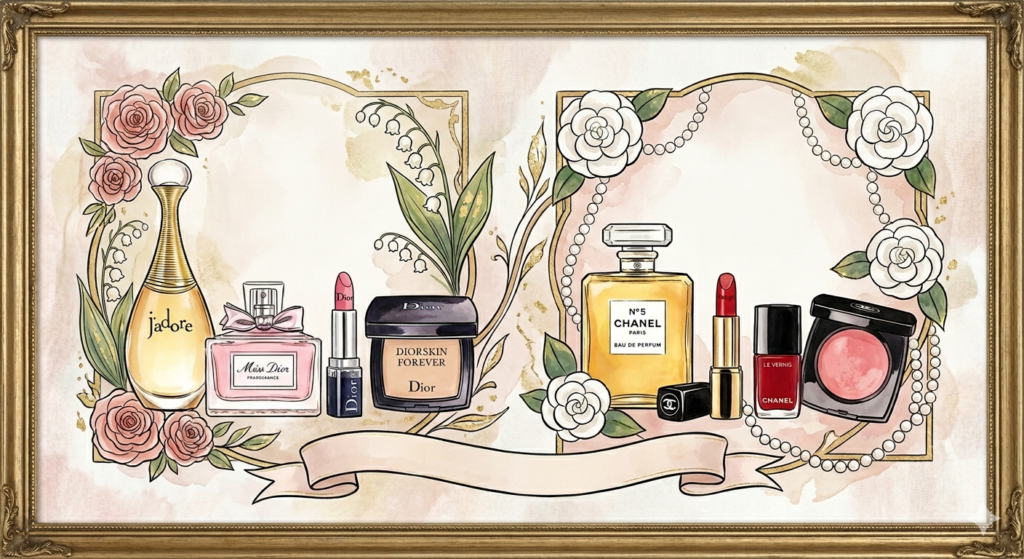
Chanel – Cultural alignment through fragrance
Chanel’s strength in the region is closely tied to fragrance, a category that holds deep cultural significance in the Middle East, where scent layering and personal fragrance rituals are part of everyday life.
Rather than aggressively expanding across all segments, the brand appears to maintain a focused approach, reinforcing its position through consistency and controlled distribution, a strategy often highlighted in luxury market analyses as key to sustaining desirability in mature markets.
Hermès – Restraint as a strategic choice
Hermès operates differently, with a slower and more selective approach to beauty, reflecting its broader brand philosophy of controlled growth and craftsmanship-led positioning.
Limited product releases and selective distribution create a sense of exclusivity that contrasts with the scale-driven strategies of other brands, particularly in a market like Dubai where abundance is often the norm.
What the Dubai luxury beauty market reveals?
According to Euromonitor International, the Middle East beauty market is increasingly shaped by performance expectations, cultural relevance, and frequent product usage, with skincare and fragrance leading growth.
This means brands are no longer competing on product alone, but on how effectively they align product performance, retail experience, and cultural understanding within a single market environment.
The takeaway
While Dubai does not produce a single winner, It highlights different strengths. Where Dior demonstrates the potential of scale with consistency, Chanel reinforces the importance of cultural alignment, and Hermès illustrates the value of restraint.
(Image credit: foxtly/Instagram)