
Let’s start with what actually happened at Venice Biennale 2026, because no one could have written this.
Koyo Kouoh, Cameroonian-Swiss curator, founded RAW Material Company in Dakar, led Zeitz MOCAA in Cape Town, and stood as one of the most influential voices in contemporary art globally, when she was appointed artistic director of the Venice Biennale 2026 in November 2024. She became the first African woman to hold the role. But six months later, cancer took her life at 57. She never saw a single wall go up.
And yet, In Minor Keys, the exhibition she conceived for the 61st International Art Exhibition at La Biennale di Venezia, opened on May 9, 2026, exactly as she had planned it. Every artist, every spatial decision, every banner remained hers. What unfolded in the months between her death and that opening is the story the art world now needs to sit with.
So, who was Koyo Kouoh?
If her name is new to you, that is part of the point. Koyo Kouoh spent decades building cultural infrastructure in places the Western art world often overlooked. RAW Material Company, which she founded in Dakar in 2008, became a vital platform for contemporary African art, driven by excellence rather than recognition.
Meanwhile, at Zeitz MOCAA in Cape Town, she centred Global South perspectives in Africa’s largest museum of contemporary art. In addition, her curatorial work, including Still (the) Barbarians at the Irish Biennial and Dig Where You Stand at the Carnegie International, pushed Western institutions to confront what they had long ignored. In 2020, she received the Meret Oppenheim Grand Prize.
Subsequently, her appointment to La Biennale di Venezia marked a rare institutional shift at the highest level of global art. Thereafter, on April 8, 2025, she submitted her full curatorial vision to the Biennale, down to the banners, catalogue, and spatial design. Everything was in place.
And yet, just weeks later, she died.
What happened after Koyo Kouoh’s death? Venice refused to replace her vision
When Kouoh died, the Biennale had three choices: replace her, absorb her vision into another name, or step aside. Ultimately, they stepped aside.
Instead, they worked with five people she had chosen: la squadra di Koyo Kouoh. Gabe Beckhurst Feijoo, Marie Hélène Pereira, Rasha Salta, Siddhartha Mitter, and Rory Tsapayi. Five cities. Five continents. One custodial team. Earlier, just weeks before her death, they had been with her in Dakar at RAW Material Company, finalising every detail together, with nothing left open or unresolved.
Then, in February 2026, they presented the project together and then stepped back completely. There was no individual authorship, and no single front-facing curator stepped forward to claim it. Instead, only one line remained: Koyo Kouoh’s Venice Biennale 2026.
In an industry built on credit, they chose absence.
What In Minor Keys actually means?
The title isn’t just poetic, it makes a point. In Minor Keys are about emotion without resolution. They don’t land cleanly, and that is exactly what Kouoh wanted. Across the Giardini and Arsenale, she brought together 111 artists and collectives to hold that kind of space, where nothing is forced into a neat conclusion.
The exhibition begins in the Sala Chini with two dedicated spaces for Issa Samb and Beverly Buchanan, artists who treated art as something living, not something to be owned or neatly defined. Starting here sets the tone immediately.
From there, the show moves through what her team calls “undercurrent priorities,” ideas like movement, rest, memory, displacement, and the body. There is a poetry procession inspired by her journey from Dakar to Timbuktu in 1999, and a Creole garden in the Arsenale where everything coexists without hierarchy.
People describe the experience the same way: generous.
Kouoh’s quiet vision collides with a very public Biennale
In Minor Keys asked for quiet, but Venice 2026 did not stay quiet. The Biennale opened amid geopolitical tension, including Russia’s return after its absence since 2022, prompting criticism from several EU states and a temporary freeze of EU funding. The jury resigned before the opening, objecting to awarding prizes to nations whose leaders face ICC charges, leaving awards suspended.
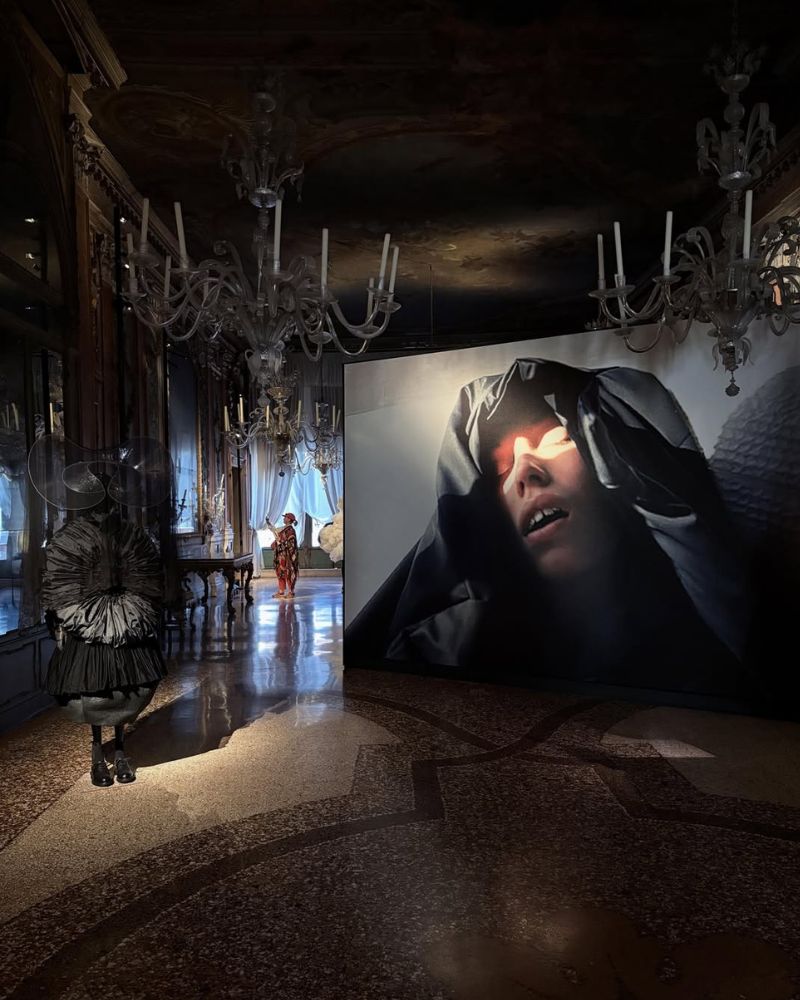
South Africa withdrew its pavilion after a government dispute, while its work was later shown independently in Venice. Meanwhile, major fashion and luxury houses activated across the city through large-scale partnerships and exhibitions, amplifying commercial presence around the Biennale.
The result is a Biennale defined by contrast between Kouoh’s reflective curatorial vision and an unusually loud political and commercial environment.
The debate nobody in the art world wants to have
Koyo Kouoh spent her career arguing that the global art world needed to stop centring itself in the same Western cities, markets, and definitions of value. In Minor Keys is not just a theme, it is a structural position.
And yet, the Venice Biennale 2026 has unfolded as one of its most commercially activated and geopolitically charged editions in recent memory. The question now is whether that contradicts her vision or confirms it.
Because what is striking is not just the noise, but who is making it. Bulgari’s leadership has framed its partnership as a response to AI, positioning art as something only human imagination can produce. Dries Van Noten’s foundation is grounded in the same language of craft, material, and slowness that runs through Kouoh’s thinking. Even the Vatican pavilion, with Brian Eno, FKA Twigs, and Precious Okoyomon, is asking a version of her question about attention, meaning, and repair in a fractured world.
Seen this way, In Minor Keys is not being drowned out but is being surrounded by echoes of its own premise and that is the real debate this Biennale opens up.
However, what remains beyond debate is the exhibition itself. Built by five collaborators across five cities for a curator who never saw it open, it is already being described as one of the most humane and necessary Biennales in recent memory.
Tell us: is the Venice Biennale 2026 a tribute to Koyo Kouoh or has the art world made her vision its most elegant alibi? We want to hear it.
Venice Biennale 2026: In Minor Keys runs May 9 – November 22, 2026, across the Giardini, Arsenale and locations throughout Venice.
(Feature image credit: abuktt/Instagram)
At The Pillar Edit, we cover the cultural moments that shape how the world’s most influential brands think, create and connect. If this story sparked something, share it, debate it, or explore more.
FAQ
Who was Koyo Kouoh?
Koyo Kouoh (1967–2025) was a Cameroonian-Swiss curator and the first African woman appointed to lead the Venice Biennale. She founded RAW Material Company in Dakar in 2008 and served as Executive Director of Zeitz MOCAA in Cape Town. She was awarded the 2020 Meret Oppenheim Grand Prize and was widely considered one of the most influential voices in contemporary art globally.
What is In Minor Keys at the Venice Biennale 2026?
In Minor Keys is the title of the 61st International Art Exhibition at La Biennale di Venezia, conceived entirely by Koyo Kouoh before her death in May 2025. It features 111 artists, collectives and organisations across the Giardini and Arsenale in Venice, running from May 9 to November 22, 2026.
What happened to the Venice Biennale 2026 after Koyo Kouoh died?
La Biennale di Venezia chose not to appoint a replacement curator. Instead, five collaborators Kouoh had personally selected — Gabe Beckhurst Feijoo, Marie Hélène Pereira, Rasha Salti, Siddhartha Mitter and Rory Tsapayi — completed the exhibition exactly as she had designed it, operating collectively as la squadra di Koyo Kouoh.