



For decades, luxury travel operated on an unspoken contradiction. Travellers would fly across the world in search of untouched beaches, pristine coral reefs, remote islands, and landscapes that felt blissfully disconnected from modern life. Yet behind the scenes, many of those same destinations relied on diesel generators, energy-intensive cooling systems, and resource-heavy infrastructure to deliver the comforts guests expected. For much of the industry’s history, that reality remained largely invisible. Today, however, sustainability has moved from the margins to the mainstream. Travellers are becoming increasingly conscious of the environmental footprint behind the experiences they consume, prompting luxury hospitality brands to rethink not just what they offer, but how they operate.
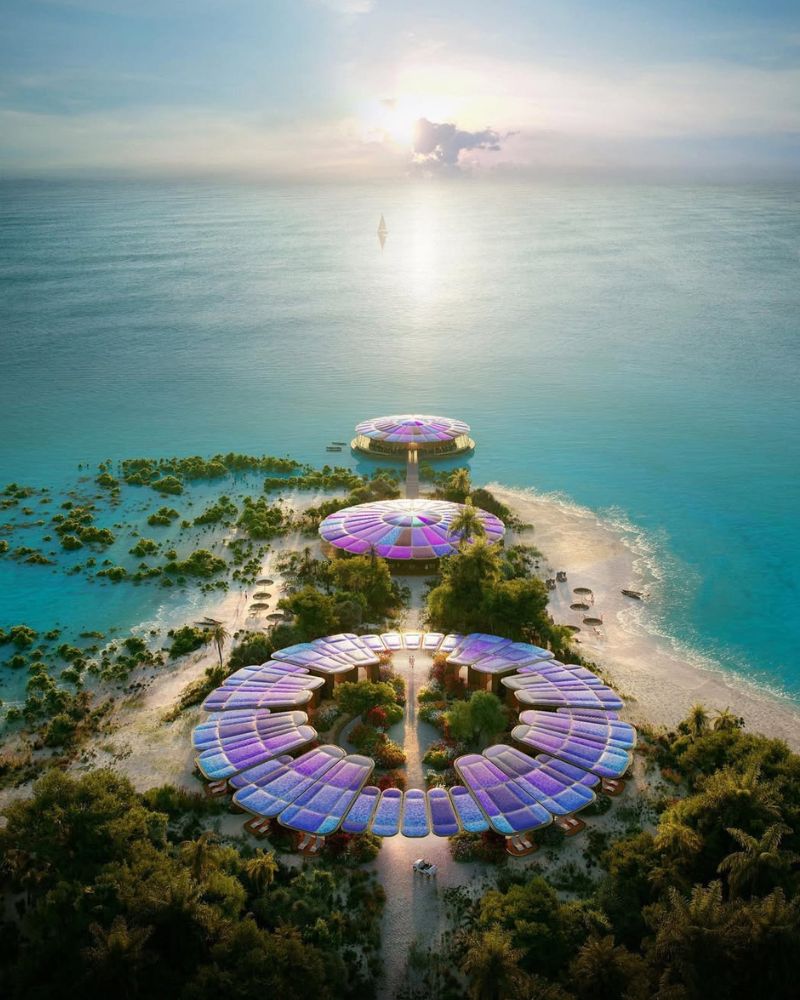
Today, a new generation of solar-powered resorts is challenging that assumption. Along Saudi Arabia’s western coastline, one of the world’s most ambitious tourism developments is proving that ultra-luxury hospitality can operate on a radically different model. Instead of relying on conventional power networks, The Red Sea destination has been designed around renewable energy from the outset, creating a blueprint that could influence the future of luxury travel far beyond the Middle East.
How Saudi Arabia is building the future of luxury travel
Stretching across approximately 28,000 square kilometres along the Red Sea coast, The Red Sea is one of the largest tourism developments currently underway anywhere in the world. Developed by Red Sea Global, the destination spans more than 90 islands, mountain canyons, dormant volcanic landscapes, and vast stretches of coastline.
According to Red Sea Global, the destination will eventually be home to around 50 resorts and up to 8,000 hotel rooms. However, what truly sets The Red Sea apart is not the scale of its luxury offering but the infrastructure beneath it. Designed to operate independently of Saudi Arabia’s national power grid, the destination runs on a renewable-energy network powered by more than 760,000 solar panels and backed by large-scale battery storage.
The development sits at the centre of a broader transformation taking place across Saudi Arabia luxury tourism. Under Vision 2030, the Kingdom is investing heavily in hospitality, culture, wellness, and sustainable tourism as it seeks to diversify its economy and establish itself as a global travel destination.
Unlike many destinations that are attempting to retrofit sustainability measures onto existing infrastructure, several projects driving Saudi Arabia luxury tourism are being built around renewable energy from day one.
The engineering behind the world’s most ambitious solar-powered resorts
Most travellers rarely think about where their electricity comes from because luxury is designed to feel effortless. The air conditioning works, the pools stay perfectly heated, and restaurants remain open long after sunset. Meanwhile, villas are illuminated throughout the night, creating the impression that comfort simply exists. Yet behind that seemingly seamless experience sits an enormous amount of infrastructure, much of which remains invisible to guests.
Yet for solar-powered resorts, energy is the story. According to Red Sea Global, more than 760,500 solar photovoltaic panels have been installed across the destination, generating renewable electricity that powers hotels, staff accommodation, utilities, transportation systems, and guest facilities. The network is supported by a battery-storage system with a capacity of approximately 1.2 GWh, allowing energy generated during daylight hours to be stored and used after sunset.
This is what makes The Red Sea unique among large-scale solar-powered resorts. Rather than relying on diesel generators as backup, the destination has been designed to operate continuously using renewable energy and battery storage.
The implications extend far beyond Saudi Arabia. Around the world, island resorts face a common challenge. They are often located in environmentally sensitive regions but depend on carbon-intensive energy systems to function. If large-scale solar-powered resorts can operate successfully in one of the world’s harshest climates, the model could influence tourism development from the Maldives to the Caribbean.
Who is powering The Red Sea’s big bet on sustainability?
Behind the infrastructure is an effort to redefine what tourism can look like in the coming decades. One of the most visible figures behind the project is John Pagano, Group CEO of Red Sea Global. Pagano has consistently framed the destination around the concept of regenerative tourism rather than traditional sustainability.
In 2026, while discussing the company’s conservation framework, Pagano described the ambition as creating a model that delivers positive outcomes for both people and the environment while demonstrating how tourism can contribute to ecological restoration.
That philosophy is increasingly shaping the conversation around Saudi Arabia luxury tourism. The goal is no longer limited to reducing environmental impact. Instead, developers are asking whether tourism can actively improve ecosystems over time.
The Red Sea luxury resorts leading the charge
For travellers, sustainability is often experienced through design. Among the most notable Red Sea luxury resorts is Nujuma, a Ritz-Carlton Reserve, the first Ritz-Carlton Reserve property in the Middle East. Opened in 2024, the resort features 65 villas positioned across the Ummahat Islands and draws inspiration from celestial navigation and the natural forms of seashells.
Then there is Shebara Resort, perhaps the most photographed addition to the destination. Designed by the architecture firm Killa Design, its mirrored stainless-steel villas appear to float above the water like futuristic silver spheres, reflecting the sea and sky around them.
Another standout among the emerging Red Sea luxury resorts is Desert Rock Resort. Rather than imposing itself on the landscape, the resort has been integrated into ancient granite mountains, creating a striking relationship between architecture and nature.
Visitors can also stay at The St. Regis Red Sea Resort and Six Senses Southern Dunes, both of which reflect the destination’s emphasis on sustainability, wellness, and immersive design.
Together, these Red Sea luxury resorts represent a shift in what defines luxury hospitality. The focus is no longer solely on exclusivity or scale. Increasingly, it is about how intelligently a destination operates behind the scenes.
Solar-powered resorts: Why conservation matters as much as comfort
The Red Sea story is not only about renewable energy. According to Red Sea Global, approximately 75 per cent of the destination’s islands will remain untouched for conservation purposes. For a tourism project of this scale, that commitment is unusual.
Long before construction began, scientists worked alongside planners to map coral reefs, seagrass meadows, mangrove forests, and ecologically sensitive habitats. Research conducted in collaboration with experts from King Abdullah University of Science and Technology helped determine which areas could accommodate development and which should remain protected.
This scientific approach has become central to the destination’s identity. Red Sea Global has publicly committed to achieving a 30 per cent net conservation benefit by 2040 through habitat restoration, biodiversity protection, mangrove regeneration, and marine conservation initiatives.
Those goals are helping redefine expectations for solar-powered resorts around the world. Sustainability is no longer being measured solely through energy efficiency. Biodiversity, ecosystem health, and long-term conservation are becoming equally important benchmarks.
What the future holds for solar-powered resorts
The hospitality industry is entering a period of profound change. Climate concerns, evolving traveller expectations, and advances in renewable-energy technology are forcing destinations to rethink how they operate. Increasingly, guests want reassurance that exceptional travel experiences are not coming at the expense of fragile ecosystems. This is where solar-powered resorts become particularly important.
They demonstrate that renewable energy can support not only boutique eco-lodges but also large-scale luxury developments. They show that five-star hospitality and off-grid infrastructure can coexist. Most importantly, they challenge the long-standing assumption that sustainability requires compromise. The emergence of projects like The Red Sea suggests that the future of luxury travel may look very different from its past. The next generation of travellers may judge destinations not only by their beaches, restaurants, or architecture but also by how responsibly they operate.
For decades, oil helped define the Middle East’s place in the global economy. There is something fitting about the fact that some of the region’s most ambitious tourism developments are now helping define what comes next. At destinations like The Red Sea, guests see overwater villas, turquoise lagoons, dramatic desert landscapes, and impeccable service. What they do not see is the network of solar farms, battery systems, conservation scientists, architects, and environmental planners working behind the scenes. That invisible infrastructure may ultimately become the most important luxury amenity of all.
And if these solar-powered resorts succeed, they may do more than transform Saudi Arabia luxury tourism. They could redefine how the entire hospitality industry thinks about luxury in the decades ahead.
The Red Sea’s solar-powered resorts may be shaping the future of luxury travel today, but they are only the beginning. For travellers seeking more eco-conscious stays, a growing number of destinations are demonstrating that exceptional hospitality and environmental responsibility can coexist, offering a glimpse of where luxury travel is headed next.
(Image credit: redseaproject/Instagram)
FAQ
What are solar-powered resorts?
Solar-powered resorts are hospitality properties that generate a significant portion of their electricity through solar energy systems. Many combine solar panels with battery storage technology to provide power around the clock while reducing dependence on fossil fuels.
Why is The Red Sea considered a leader among solar-powered resorts?
The Red Sea is one of the world’s most ambitious renewable-energy tourism developments. According to Red Sea Global, the destination operates independently of Saudi Arabia’s national power grid using more than 760,000 solar panels and a large-scale battery storage system that enables 24-hour renewable energy operations.
Which luxury resorts are located at The Red Sea?
Some of the most notable Red Sea luxury resorts include Nujuma, a Ritz-Carlton Reserve, Shebara Resort, Desert Rock Resort, The St. Regis Red Sea Resort, and Six Senses Southern Dunes. Each property combines luxury hospitality with sustainability-focused design and operations.
How does The Red Sea generate electricity at night?
The destination stores excess solar energy generated during the day in a battery storage system with a capacity of approximately 1.2 GWh. This stored energy is then used to power hotels, transportation, and guest facilities after sunset.