



Why can’t you buy Chanel online? Not from Chanel. Not directly, not easily, not from your sofa at midnight with a glass of wine and an unresolved longing. And that, is entirely the point.
While every other maison, from Gucci to Dior to the perennially ice-cool Hermès, has quietly surrendered to the algorithm and opened its virtual doors, Chanel stands apart. Magnificent, unmoved, and $18.7 billion richer for it. If you want the Classic Flap, the slingbacks, the tweed jacket that made Coco Chanel a revolutionary, you will dress yourself, leave the house, and walk into a boutique like a grown-up who understands that some things cannot be delivered.
First, let’s answer why can’t you buy Chanel online
Let’s settle this, because the answer for ‘why can’t you buy Chanel online’ is more nuanced than a flat no, and you deserve the full picture.
What Chanel sells online:
- Fragrances (including No. 5, Coco Mademoiselle, Chance)
- Makeup and skincare
- Eyewear
- Selected beauty accessories
What Chanel does NOT sell online:
- Ready-to-wear clothing
- Leather goods (including the Classic Flap, Boy Bag, 19 bag)
- Fine jewellery and watches
- Shoes and accessories
The brand also launched Lipscanner, an app allowing virtual try-ons for its beauty range, and has tip-toed into selective third-party collaborations on platforms like Net-a-Porter. But the jewels of the house, the pieces everyone actually wants? Boutique only. Everywhere, from Bond Street in London to DLF Emporio in New Delhi, from Rodeo Drive in Los Angeles to The Dubai Mall.
If you are Googling “where to buy a Chanel bag online,” the answer Chanel wants you to have is simple: you don’t. You go in.
Chanel knows something the internet doesn’t: Desire needs distance
Here is what Bruno Pavlovsky, Chanel’s president of fashion, said in 2020 and nothing since has made him retract a syllable of it. E-commerce, in his view, reduces luxury to “a few clicks and products that are flat on a screen.”
Now, you could dismiss this as the self-serving rationalisation of a man whose entire professional world is built on physical retail. Or you could consider that he is describing something fundamentally true about desire. A Chanel bag is not a product but a transformation. The moment you walk into a boutique, whether you are in Mumbai’s Taj Mahal Palace, Singapore’s Marina Bay Sands, or the original on Rue Cambon in Paris, something shifts. The temperature drops a degree. The noise disappears. Someone is already moving toward you with the specific intention of making you feel like the most important person in the room. That is commerce at its highest register.
Moreover, the bag you eventually carry out is not just a bag. It carries the memory of the afternoon you bought it. It carries the weight of having chosen it in person, having felt the quilting under your fingers, having watched the chain catch the light. None of that survives a checkout page.
Chanel is not selling leather goods. It is selling the experience of acquiring leather goods. And that experience requires your physical presence.
The economics of saying no: $18.7 billion reasons to believe it
Sceptics will point to the numbers and call it a gamble. Let’s talk numbers, because they are considerably more persuasive than the sceptics. And they make a compelling case for why you can’t buy Chanel online.
Between 2021 and 2023, Chanel’s revenues grew from $15.6 billion to $19.7 billion, a 16% rise in a single year by the end of that period. Its operating profit in 2023 reached $6.4 billion. For a privately held company that discloses only what it must, these are not small figures. These are figures that make publicly listed competitors with their quarterly earnings calls and their digital pivot announcements look rather ordinary.
2024 was harder, in fairness. Revenue slipped 4.3% to $18.7 billion, while operating profit fell to $4.5 billion, a 30% decline. As a result, China slowed and the global luxury market hit a wall. Consequently, virtually every luxury house reported pain. And yet Chanel’s response was to invest, not retreat. In fact, capital expenditure jumped 43% to a record $1.76 billion, directed entirely at its physical world. New boutiques. New flagship stores for watches and fine jewellery in New York and Taipei. Additionally, a new Maison de Beauté in Paris, a minority stake in Swiss watchmaker MB&F, and the freehold of its Avenue Montaigne boutique. By year-end, it had 644 boutiques globally, up from 612.
When the going gets difficult, Chanel builds more rooms to stand in. Global CEO Leena Nair, speaking to the press in May 2025: “As a 100-year brand, we expect ebbs and flows. Our philosophy has always been to act with a long-term view.”
View this post on Instagram
Why the no-e-commerce strategy hits differently across global markets
Here is where it gets genuinely interesting and where the geographic intelligence of this strategy reveals itself most clearly.
In India, where the luxury market is growing at a pace that makes European executives visibly excited, Chanel’s boutique-only approach creates aspiration on an almost mythological scale. The Classic Flap is not something you stumble upon. It is something you plan a trip to Paris, Singapore or Mumbai for.
In Dubai and the UAE, where luxury retail is a primary leisure activity and The Dubai Mall alone receives more visitors annually than any other retail destination on earth, Chanel’s boutique strategy plugs directly into a culture of destination shopping. The in-store experience is the occasion. Its boutiques in Dubai are staffed, designed, and curated for a clientele that treats shopping as an event rather than an errand.
In the UK and Europe, where online luxury shopping has the highest penetration globally, Chanel’s refusal is its most pointed statement. Every other house is chasing the sofa consumer and the Mount Street or Bond Street boutique feels, correctly, that they have done something most people have not.
Why can’t you buy Chanel online in China? Because in a market where Chanel faces its greatest headwinds including slowing aspirational spend, grey-market competition, and a younger consumer whose relationship with brands is complicated, the boutique strategy is simultaneously its greatest risk and its greatest insurance. But the moment a customer buys in-store, in Chengdu, in Shanghai, in the new city boutiques Leena Nair specifically mentioned, they own something the grey market cannot replicate.
The anti-e-commerce moat: Why controlled access is the new scarcity
Let’s name the mechanism properly, because it deserves to be named. Why can’t you buy Chanel online is not an accident of technology or a failure of ambition. What Chanel has built, deliberately and consistently over decades, is a luxury moat through controlled scarcity of access. This is distinct from product scarcity, which means making fewer bags, or price scarcity, which means making bags expensive. It is distribution scarcity: making the act of purchase itself something that requires effort, intention, and presence.
Furthermore, consider the data on brand loyalty. According to a 2024 paper on strategic brand management, Chanel achieves brand loyalty by reinforcing its identity through strong visual codes, consistency in product quality, and emotional storytelling. Critically, the paper notes that its boutique-only distribution model “helps preserve exclusivity and creates a controlled, premium customer experience.”
What this strategy signals for luxury
Why can’t you buy Chanel online in 2026? Because the luxury market is recalibrating in ways that should make Chanel look prescient rather than stubborn.
The pandemic-era boom, when pent-up desire and stimulus money sent handbag prices into orbit, has levelled considerably. China is slower. The aspirational middle is being squeezed. Brands that over-indexed on digital accessibility during the boom years are now quietly pulling back, raising prices, tightening distribution, and trying to remember what exclusivity actually felt like.
As a result, what we are likely to see in the next phase of luxury’s evolution is other houses moving toward Chanel’s model rather than Chanel moving toward theirs. The direction of travel is boutique-first, experience-first, exclusivity-first. LVMH executives have said as much. Kering is restructuring toward it. The industry is, in its slow and continental way, coming around to the position Chanel staked out and refused to abandon.
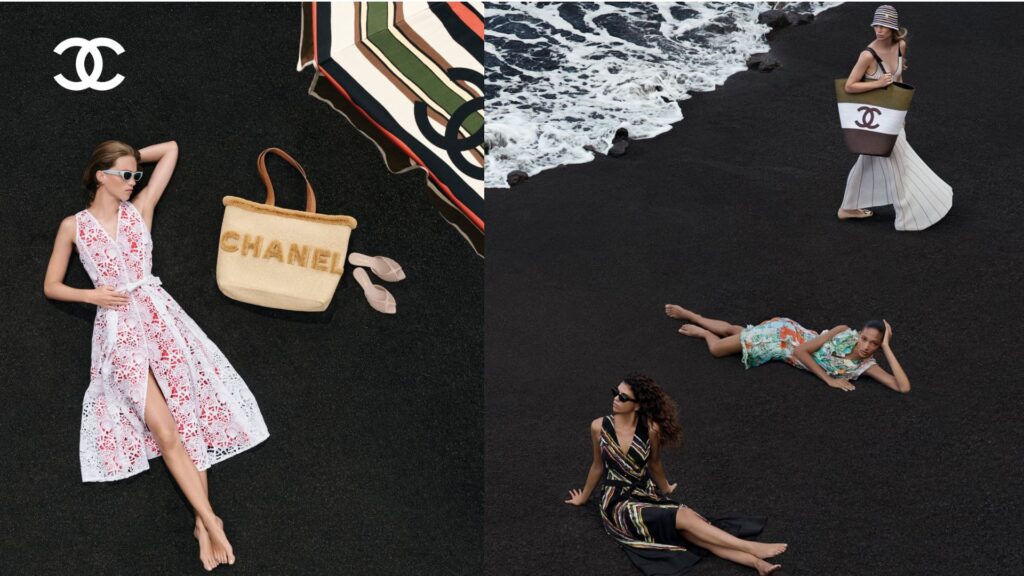
What is clear is this: in 2026, with $18.7 billion in annual revenue and 644 boutiques on six continents, Chanel’s refusal to sell its most desirable products online is not a failure of modernity. It is a masterclass in understanding that desire requires distance. Coco Chanel once said, and she was right about almost everything, that in order to be irreplaceable, one must always be different. Why can’t you buy Chanel online is, in the end, the same answer she gave a century ago.
You want the bag? You know where to find it.
Data sourced from Chanel’s 2024 annual financial results, released May 2025.
(Image credits: chanelofficial/Instagram)