


Every year, the luxury industry produces 7.5 million tonnes of carbon emissions, uses 32.3 million square feet of leather and sells a narrative of timelessness to a world that is running out of time. Somewhere inside that contradiction sits one of the most important questions in business right now: can the world’s largest luxury group genuinely lead on environmental responsibility, or is every commitment just another layer of beautiful packaging? The LVMH LIFE 360 strategy is the most serious attempt to answer that question the luxury industry has produced.
Launched in 2021 and built around five pillars, Creative Circularity, Biodiversity, Climate, Traceability and Transparency, and Stakeholder Engagement, it sets hard deadlines for 2023, 2026 and 2030 across 75 Maisons, from Louis Vuitton and Christian Dior to Hennessy, Bulgari and Sephora. By 2024, LVMH had already cut its direct greenhouse gas emissions by 55 percent against a 2019 baseline, hitting its 2026 target two full years early. The harder work, the 97 percent of emissions that live in the supply chain, in raw materials, in transport, in the factories and farms that LVMH does not own or control, is what this story is actually about.
What LVMH LIFE 360 actually is and why it matters
LVMH LIFE 360 stands for LVMH Initiatives For the Environment. It the third iteration of an environmental strategy that began in 1992, when LVMH first made formal environmental commitments, before sustainability was a boardroom agenda item in any industry, let alone luxury.
The original LIFE programme launched in 2012. LIFE 2020 followed in 2016, structured around four objectives shared by all Maisons: improve the environmental performance of all products, apply the highest standards across procurement chains, improve site-level environmental indicators and reduce CO2 emissions. LVMH achieved and sometimes exceeded all four.
LVMH LIFE 360 launched in 2021 with three key deadlines, 2023, 2026 and 2030, and five strategic pillars. The name reflects the ambition: a full 360-degree view of environmental impact, from the raw material sourced in a field to the product repaired in a workshop to the packaging recycled by a customer.
The structural detail that matters most is how LVMH distributes responsibility across its 75 Maisons. Each Maison sets its own operational plans within group-level targets. Progress flows from dozens of independent teams working the same problems in different contexts, then circulating solutions laterally through a network of more than 150 environmental correspondents across the group.
Helene Valade, Group Environment Development Director at LVMH, described the momentum precisely: “The results of the LIFE 360 programme, the environmental strategy we rolled out four years ago, reflect the mobilisation of our Maisons around what has become a pillar of their business models.”
The five pillars of LVMH LIFE 360 explained
Creative circularity
Circularity in luxury is a more complex proposition than in most industries. A luxury product is designed to last. The question LVMH LIFE 360 asks is whether that designed longevity is actually being realised, or whether it is simply a marketing claim.
The evidence suggests it is being realised with increasing specificity. Louis Vuitton repairs 600,000 products per year. Berluti’s leather products are 79 percent repairable. RIMOWA offers a lifetime guarantee on all its luggage and bags. Le Bon Marche has introduced an alterations service and watch and shoe repair programmes. Dior Parfums won a LIFE 360 Award for systematically replacing virgin fossil-based plastics with recycled, bio-based or alternative materials across its packaging range.
The 2026 target under this pillar is the elimination of virgin fossil-based plastic from all client-facing packaging. LVMH has acknowledged this is the one 2026 target it is most likely to miss, and has reinforced its action plan accordingly. That acknowledgement matters. A group that admits which targets it is struggling to hit is more credible than one that reports uniform success.
The 2030 target is more ambitious: 100 percent of new products designed according to eco-design principles, and environmental management systems implemented across 100 percent of production and logistics sites.
Biodiversity
LVMH sources raw materials from ecosystems under significant pressure. Leather from cattle, cotton from agricultural land, cashmere from goats grazing fragile steppe and cognac grapes from vineyards that depend on soil health. The biodiversity pillar of LVMH LIFE 360 is built around the recognition that these ecosystems are the foundation of the group’s supply chain, and that their degradation is a business risk as much as an environmental one.
The group has committed to the protection and regeneration of natural habitats, with 3.8 million hectares of natural habitats preserved and regenerated to date. LVMH’s partnership with UNESCO through the Man and Biosphere programme supports the protection of ecosystems in regions where the group sources key materials.
Moet Hennessy’s Living Soils, Living Together programme received the special jury prize at the inaugural LIFE 360 Awards in 2025. Chateau Galoupet, a Cru Classe Cotes de Provence acquired by LVMH in 2019, has been certified organic since 2023 and now operates a full regenerative viticulture model: cover crops on 100 percent of the vineyard, 2.6 kilometres of agroforestry hedgerows, regenerative hydrology structures, increased soil organic matter and extensive biodiversity shelters across the estate.
Louis Vuitton has a dedicated regenerative agriculture programme for leather sourcing, which also won a LIFE 360 Award. The goal is to actively contribute to soil health and ecosystem function in the regions where cattle are raised.
Climate
The climate pillar of LVMH LIFE 360 is where the most dramatic headline progress has been made and where the most significant challenge remains unresolved.
The group set a target to halve its Scope 1 and 2 emissions by 2026 against a 2019 baseline. By the end of 2024, it had already achieved a 55.1 percent reduction, surpassing its goal two years ahead of schedule. For a conglomerate of this scale, that level of overperformance demands an explanation.
Part of the explanation is the internal carbon pricing mechanism that LVMH introduced in 2015, which has been reshaping capital allocation at Maison level for a decade. When carbon has a price inside a business, it changes which investments get approved. Renewable energy projects that would once have competed unfavourably with conventional alternatives become clearly the right choice. By 2024, the share of renewable energy across LVMH had increased from 8.7 percent in 2015 to more than 71 percent, including 93 percent renewable electricity.
Christian Dior Couture installed photovoltaic panels on the roof of its logistics site in Blois, producing 1.3 GWh of electricity annually and avoiding approximately 1,000 metric tons of CO2 equivalent each year. A joint logistics partnership between Louis Vuitton, Christian Dior Couture and RIMOWA, awarded a LIFE 360 Award under the name One Route, pools transport across the three Maisons in the United States to reduce emissions. Moet Hennessy has reduced transport-related CO2 emissions by 37 percent since 2019 and is targeting a 50 percent reduction by 2030.
Then there is Scope 3. This is where the climate story gets harder and more honest. Scope 3 emissions, the indirect emissions from LVMH’s supply chain, from the farms that raise the cattle, the factories that process the materials, the trucks that carry the finished products, account for 97 percent of the group’s total carbon footprint. And those emissions are the ones LVMH does not directly control.
By 2024, LVMH had achieved a 33 percent reduction in Scope 3 emissions per unit of value against a 2019 baseline, against a 2030 target of 55 percent. Progress is real. But closing that gap from 33 percent to 55 percent will require something the first 33 percent did not: genuine transformation in how suppliers operate, not just how LVMH operates.
Antoine Arnault, Director of Image and Environment at LVMH, addressed this directly at the 2025 LIFE 360 Awards: “We are sourcing our materials differently than we did five years ago, paying much greater attention to the impact on nature. Achieving our targets for 2026 and 2030 requires further hard work.”
Traceability and transparency
The traceability pillar of LVMH LIFE 360 is the one that will matter most to regulators and consumers over the next five years. From 2027 onwards, the European Union’s Ecodesign for Sustainable Products Regulation will require a Digital Product Passport for textiles, documenting composition, origin, durability and recyclability across the supply chain. LVMH has been building toward this requirement since before it was a legal obligation.
By 2024, the country of origin for diamonds, wool and leather was known for 95 to 100 percent of products across the group. The 2026 target is complete traceability across all strategic raw materials. Bulgari has already introduced Digital Product Passports for its jewellery, a LIFE 360 Award winner, providing customers and regulators with full documentation of a product’s provenance and material composition.
Dior has developed a raw material traceability platform, also a LIFE 360 Award winner, that tracks the origin of materials from field to finished product across the Parfums Christian Dior supply chain. They are operational infrastructure that makes the group’s supply chain legible in a way it has never been before.
For the luxury industry, traceability is also a brand asset. Provenance and authenticity have always justified premium prices. A group that can prove where every material came from, and what happened to it along the way, has a competitive advantage that is difficult to replicate quickly.
Stakeholder engagement
The fifth pillar of LVMH LIFE 360 is the one that extends the strategy beyond the group’s own operations and into the wider ecosystem of suppliers, partners, employees and communities that make luxury possible.
The LIFE Academy at La Milliere, an immersive training facility on 30 hectares near Paris, delivered over 73,000 hours of environmental training globally in 2024. By 2025, nearly 60 percent of LVMH employees had completed environmental training, up from 38 percent in 2024. The 2026 target is 100 percent. The gap between 60 percent and 100 percent sits in the hardest places: smaller suppliers in regions with weaker regulatory pressure, materials where certification standards are still maturing, retail employees in high-turnover roles where training retention is lowest.
In 2025, LVMH opened the LIFE Academy to its suppliers for the first time, with 400 strategic suppliers participating in climate-focused training. The rationale is straightforward. Scope 3 emissions account for 97 percent of LVMH’s carbon footprint. Those emissions come from suppliers. A supplier that has never had access to credible environmental training is a supplier that cannot reduce its emissions regardless of the targets set for it. The LIFE 360 Business Partners programme treats supplier capability as a group-level strategic asset rather than a compliance checkbox.
The 2025 LIFE 360 Awards: what they reveal about the strategy
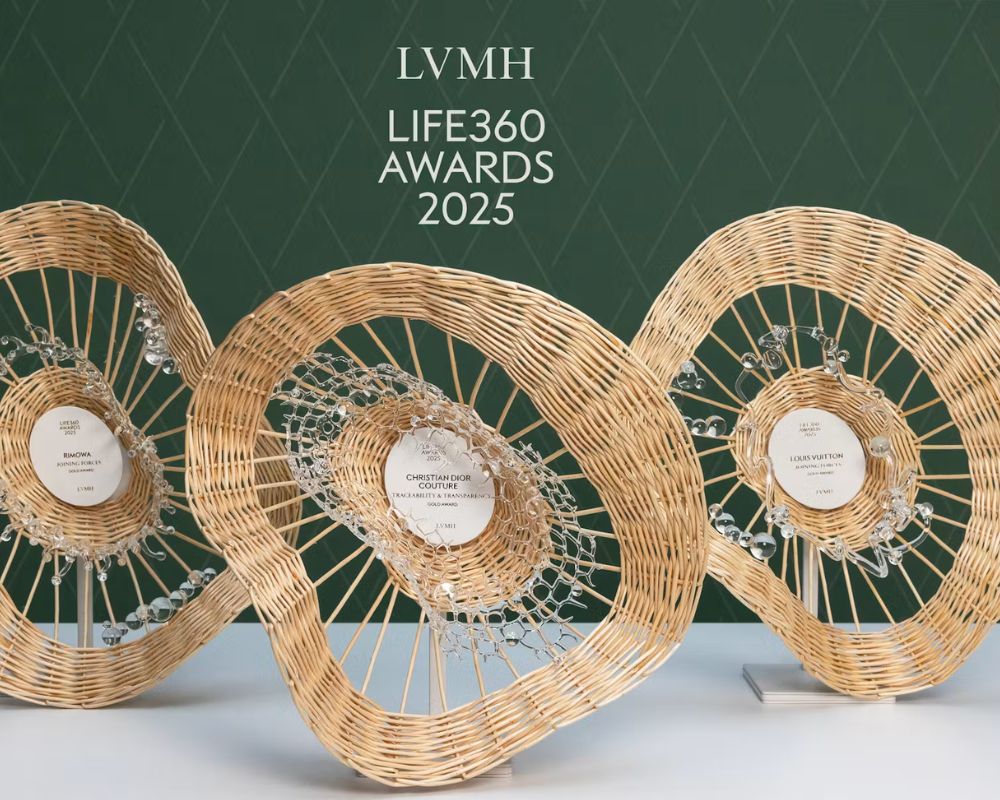
In December 2025, LVMH held its inaugural LIFE 360 Awards at the group’s global headquarters on Avenue Montaigne in Paris. The awards attracted 187 submissions from 41 Maisons, with just 13 initiatives recognised. Winning teams represented the breadth of the group’s global footprint, from Tiffany & Co. in New York and Chandon in São Paulo to Loro Piana in Milan and the champagne houses of Épernay.
The awards reveal something important about how LVMH LIFE 360 actually functions. The winning initiatives span the entire breadth of the group’s operations: Louis Vuitton’s regenerative agriculture programme for leather, Dior’s raw material traceability platform, Bulgari’s digital product passports, Hennessy’s water management strategy, the One Route logistics collaboration, Celine’s integration of ESG criteria into executive performance evaluations, and Tiffany’s community solar project in Botswana, which will provide more than 1,000 people with reliable electricity and fresh water.
That breadth is intentional. LVMH LIFE 360 is designed as a way of working across 75 brands in which environmental performance is a shared metric, a source of internal competition and a reason for celebration rather than compliance. The awards formalise what was already happening informally: the circulation of best practice across Maisons that would otherwise operate in isolation from each other.
The same week as the awards, LVMH received a CDP triple A rating across climate, forests and water simultaneously. Only a handful of companies globally hold this rating across all three categories. It is the most rigorous independent assessment of corporate environmental performance available.
The honest question: is LVMH LIFE 360 enough?
A 55 percent reduction in direct emissions. A CDP triple A rating. 3.8 million hectares of natural habitat preserved. More than 600,000 Louis Vuitton products repaired each year. Over 400 suppliers engaged in climate training. These represent measurable change.
And yet Scope 3 emissions, which account for 97 percent of LVMH’s carbon footprint, remain the defining challenge. The group does not own the farms, tanneries or logistics companies that make up much of its value chain, nor can it dictate the pace at which they decarbonise. It can train suppliers, establish standards, share expertise and apply an internal carbon price. But achieving meaningful reductions ultimately depends on thousands of independent businesses investing in costly operational changes, often in regions where the regulatory and financial incentives to do so remain limited.
Helene Valade acknowledged this plainly at the LIFE 360 Awards: “Scope 3 emissions account for more than 90 percent of our environmental footprint and arise primarily from the impacts of raw materials and transport. This is why these emissions are the most difficult to reduce.”
That honesty may be the most important feature of LVMH LIFE 360. A strategy that acknowledges where progress is difficult creates room for improvement. One that claims uniform success rarely reflects reality.
The group has already achieved its biggest 2026 target, but several others remain works in progress. Its goal to eliminate virgin fossil-based plastics is under pressure, while the target of training 100 percent of employees requires closing a 40-point gap in less than 12 months. The Scope 3 emissions target presents an even greater challenge, demanding operational change across thousands of independent suppliers throughout its value chain.
What LVMH LIFE 360 has demonstrated conclusively is that environmental performance and business performance are not in conflict. The 55 percent reduction in direct emissions did not happen despite business growth. It happened alongside it. That is the argument the rest of the luxury industry needs to understand and the case that LVMH, more than any other group, has now made credibly.
What LVMH LIFE 360 means for the rest of the luxury industry
The Deloitte Global Powers of Luxury 2026 report confirms that 68.3 percent of luxury companies now offer repair or refurbishment services, 53.8 percent operate certified pre-owned or trade-in programmes and 44.5 percent have partnered with resale platforms. Three years ago those numbers were a fraction of what they are today.
LVMH LIFE 360 accelerated the shift. When the world’s largest luxury group commits publicly to specific targets with specific deadlines and reports against them transparently, every other group in the industry is forced to respond. The floor rises.
The EU Ecodesign for Sustainable Products Regulation, which bans the destruction of unsold textiles for large companies from July 2026 and introduces Digital Product Passports for textiles from 2027, is the regulatory floor rising to meet the standard that LVMH has been building toward voluntarily. The brands that treated sustainability as optional are now finding that the regulation is catching up with what LVMH started doing a decade ago.
Read next: Water is at the heart of how LVMH sources its most critical raw materials. Read how LVMH Gaïa and Parfums Christian Dior are protecting water, luxury’s most precious ingredient.
Also worth reading: Louis Vuitton just dropped its biggest climate bet yet with Regeneration 2030.
(Image credit: LVMH)