

There is a version of this story where Erling Haaland boards a flight back to Manchester with nothing more than a quarter-final exit and a winner’s medal that never was. In that version, the conversation around Erling Haaland brand deals never changes. Norway’s remarkable run ends against England, undone by Jude Bellingham’s brace. Haaland leaves the tournament with seven goals in four matches, a dead leg aggravated by Miami’s punishing 100-degree heat, and the lingering image of watching the final 15 minutes from the bench as his teammates desperately searched for an equaliser.
But that isn’t the story the world remembers.
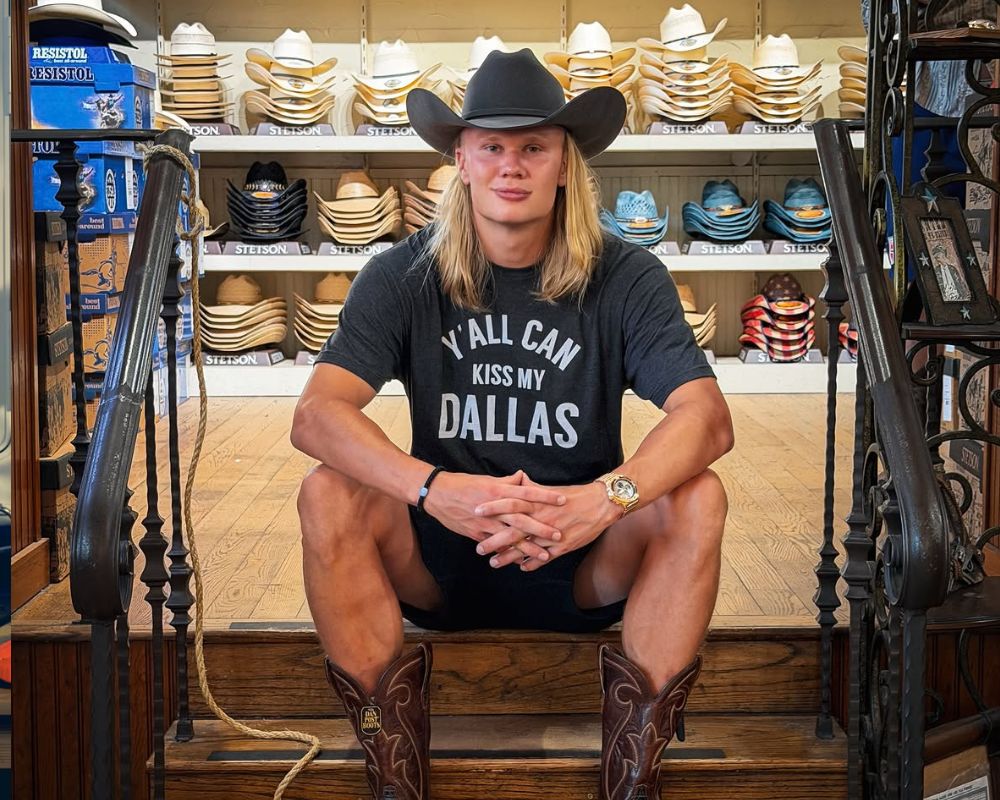
What happened instead was something no brand strategist could have scripted. Erling Haaland landed in Oslo carrying a taxidermied raccoon he bought in Texas, two stuffed squirrels dressed in cowboy hats and a can of Budweiser. It was an absurd collection of souvenirs that somehow became the defining image of his summer. More importantly, he returned with the kind of cultural momentum that athletes spend entire careers, and brands spend millions, trying to create.
According to sources close to his camp, social media platforms are now actively prioritising Haaland-related content because audience demand has surged so dramatically. Industry observers have likened his explosion in the United States to the moment Travis Kelce began dating Taylor Swift, when the Kansas City Chiefs’ commercial value and mainstream appeal soared almost overnight.
Erling Haaland brand deals were already impressive before any of this happened. They are now, one of the most interesting commercial stories in sport.
What Erling Haaland brand deals actually look like in 2026
Let’s start with the numbers. Haaland’s net worth in 2026 is estimated at approximately $00 million by Forbes. His annual earnings sit somewhere around $80 million in total, combining a Manchester City base salary of $33.5 million per year, performance bonuses that can push his weekly earnings to $1.1 million and off-field commercial income of approximately $20 million annually.
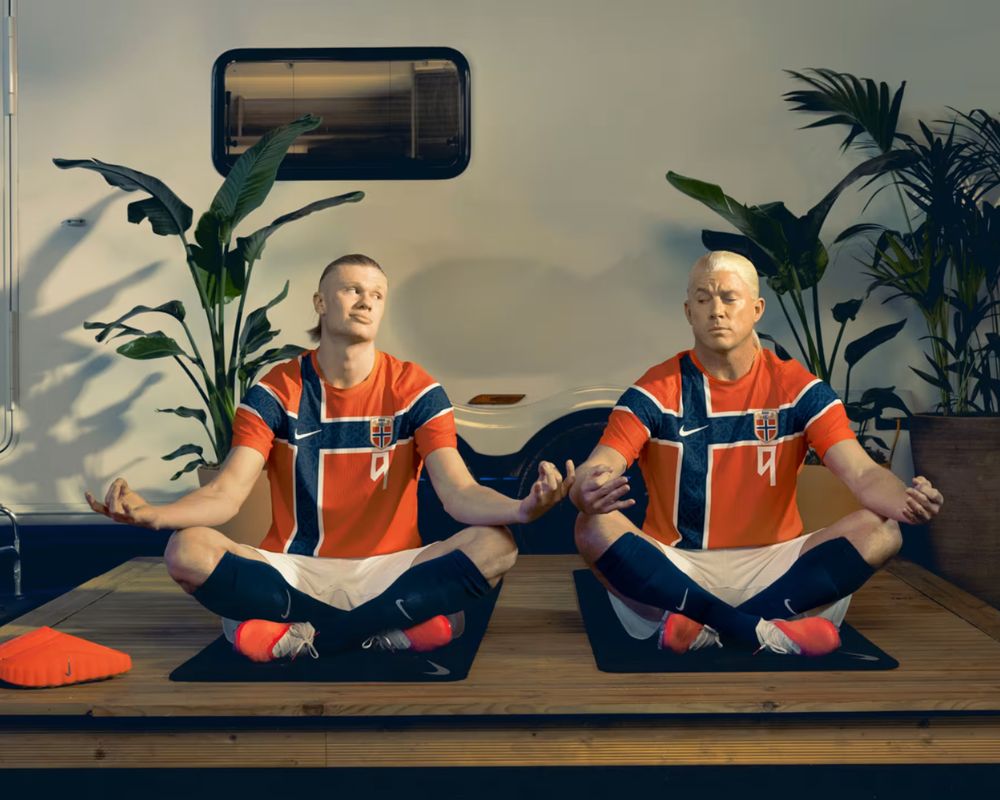
The anchor of Erling Haaland brand deals is Nike. In 2023, he signed a ten-year partnership worth approximately $20 to $24 million per year, one of the most valuable football boot contracts ever signed. The deal eclipsed Neymar’s contract with Puma and set a new benchmark for what brands will pay a footballer outside the Messi and Ronaldo bracket. Nike’s calculation was straightforward: Haaland is the face of football’s next decade and locking him in for ten years is the most efficient way to own that future.
Beyond Nike, Erling Haaland brand deals are deliberately eclectic, spanning sport, finance, hospitality, fashion, consumer electronics and home appliances. It includes Breitling watches, Beats by Dre headphones and Budweiser, where he stars alongside former Liverpool manager Jürgen Klopp in the Let It Pour campaign for the FIFA World Cup 2026. He also fronts Marriott Bonvoy and Visa’s For Fans Everywhere World Cup campaign with Vinícius Júnior, represents Chinese herbal tea brand WALOVI, the international name for Wanglaoji, leads Revolut’s Welcome to My Bank campaign, and partners with home appliance giant Midea.
For us, however, one partnership stands above the rest: Dolce & Gabbana. It is says most about about where Erling Haaland brand deals are headed, and why luxury houses now see him as far more than a footballer.
Erling Haaland brand deals and the luxury question
A Dolce and Gabbana relationship is one of the most specific and culturally loaded luxury partnerships an athlete can hold. The house is defined by a very particular idea of masculinity, physicality and Southern European excess that sits in deliberate tension with Haaland’s Nordic minimalism and complete indifference to fashion convention.
That tension is precisely the point.
What makes Erling Haaland’s luxury partnerships remarkable is not their volume, but their rarity. For a footballer of his commercial stature, the absence of luxury fashion endorsements was a story in itself. Kylian Mbappé has Louis Vuitton. Neymar partnered with Diesel. Jude Bellingham has steadily cultivated a reputation within fashion through both his personal style and brand collaborations.
Haaland, until Dolce & Gabbana, had largely stayed outside that world. He wears what he likes rather than what fashion expects. He turns up to post-match press conferences in tracksuits. He buys a taxidermied raccoon in Texas and carries it home on a plane. In an industry built on carefully managed image-making, that refusal to perform luxury may have been exactly what made him so attractive to it.
This reads, on the surface, like commercial negligence. In reality it is, whether by design or instinct, the most sophisticated brand positioning available to an athlete of his stature.
Luxury brands already have plenty of athletes who know how to perform luxury. What they are increasingly searching for is something far rarer: authenticity that cannot be manufactured. The raccoon is authentic. The squirrel in the cowboy hat is authentic. The Budweiser tucked into its paw is authentic. They are the unfiltered souvenirs of a 25-year-old from Bryne, Norway, who scored seven goals at a World Cup and returned home with taxidermy simply because he thought it was funny.
That effortless authenticity is precisely what luxury brands struggle to create through campaigns, however lavish the production or the budget. It cannot be scripted, styled or focus-grouped. It can only be found. And when a personality like Haaland embodies it so naturally, luxury houses are willing to pay a premium to be associated with it.
The Breitling collaboration: What it reveals about Erling Haaland brand deals
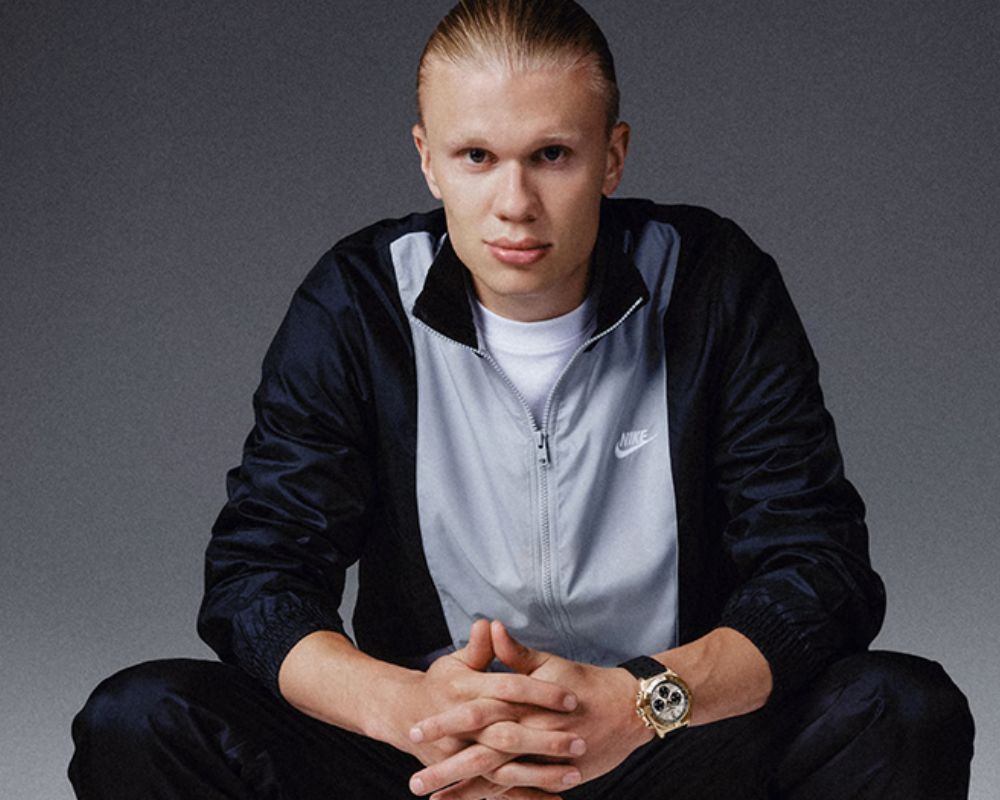
The most revealing of Erling Haaland brand deals from a luxury perspective is the Breitling partnership, and specifically the limited edition Chronomat collection released in 2026.
Haaland and Breitling have been partners for three years. For the 2026 World Cup, they deepened that relationship with a co-designed limited edition collection built around one extraordinary material: dials cut from the Muonionalusta meteorite, which landed in Haaland’s home region of Scandinavia approximately one million years ago.
Haaland was deeply involved in the design process, and the meteorite connection was his own idea. The material has a distinctive Widmanstatten pattern, a crystalline structure that forms over millions of years and is entirely unique to each piece, meaning no two dials are identical. The connection to Scandinavia, to his home and to a specific piece of geological history is personal in a way that most athlete watch collaborations simply fail to be.
Rather than lending his name to an existing watch, Haaland understood what makes a luxury object meaningful and contributed something specific and unrepeatable to the process. The Muonionalusta meteorite has been travelling through space for a billion years, and Haaland found a way to make that relevant to a Swiss watch company’s 2026 World Cup campaign. That is a creative instinct that most luxury brand managers spend entire careers trying to develop.
Why the raccoon moment matters more than any campaign
On July 13, 2026, a photograph appeared on social media of Erling Haaland arriving in Oslo from Texas carrying a taxidermied raccoon. His Snapchat story showed the full collection: two stuffed squirrels, one in a cowboy hat and one holding a miniature can of Budweiser.
The internet responded immediately, and it did not move on. Haaland was compared to Majin Buu from Dragon Ball Z. Barstool Sports declared him an honorary American. An Instagram exchange with Vinícius Júnior about recreating a scene from White Chicks spread rapidly across social media. Across major platforms, Haaland-related content began dominating feeds as engagement surged, with algorithms responding to the sheer volume of audience interest.
For Erling Haaland brand deals in luxury, this moment carries more value than any campaign Dolce and Gabbana or Breitling could have planned in advance. The reason comes down to how luxury brand ambassadorship actually works.
Luxury brands exist in a permanent tension between aspiration and accessibility. They want to be desired by everyone and owned by few. The athlete ambassador is the primary mechanism through which luxury brands navigate that tension, making the brand feel simultaneously human and aspirational. The risk, however, is always that the athlete becomes too polished, too managed and too clearly performing the luxury lifestyle rather than living one.
Haaland eliminates that risk entirely. Someone who buys a taxidermied raccoon in Texas and posts it on Snapchat is performing absolutely nothing. He is simply himself. And the luxury brands smart enough to be in a relationship with him get to inherit that authenticity without having to ask for it.
The Haaland effect is rewriting luxury’s sports partnership playbook
The comparisons to Travis Kelce are instructive but incomplete. Kelce’s commercial explosion was driven by a relationship with a pop star and the visibility that came with it. Haaland’s is driven by something considerably harder to engineer: a personality so specific and so genuine that it generates its own commercial gravity.
Erling Haaland brand deals going into the second half of 2026 are being constructed in the context of a potential Real Madrid transfer that would move him from the English Premier League to La Liga and from Manchester City’s audience to the largest football club in the world. A candidate in the Real Madrid presidential election has staked his entire campaign on signing Haaland for an estimated 150 million euros. Whether the transfer happens or remains speculation, the conversation itself extends and amplifies his commercial moment.
For luxury brands watching from the sidelines, the opportunity is difficult to ignore. Haaland is only 25. He has just delivered the defining individual performance of his career at a FIFA World Cup watched by the largest audience in the tournament’s history. His popularity in the United States is soaring. His social media reach continues to accelerate as platforms respond to surging engagement. His next club move is likely to dominate global headlines. And through partnerships with Breitling and Dolce & Gabbana, he has shown that he can enter the world of luxury in a way that feels credible, intentional and authentic, rather than purely transactional.
The window for a first major luxury partnership is open. The brands that move now will be buying in before the price reflects what Haaland is actually worth to them.
The most valuable luxury asset is authenticity
At their best, Erling Haaland brand deals reflect someone who has never confused commercial value with personal identity. Nike gave him global scale. Breitling showcased creativity. Dolce & Gabbana proved he could step into luxury without compromising who he is. Even his Budweiser campaign succeeds because it feels genuine rather than performed.
The raccoon remains the perfect symbol of that authenticity. It came from a souvenir shop in Texas after a World Cup quarter-final, where Haaland bought something that genuinely amused him. Luxury brands understand the value of moments like these. In a world of carefully curated personas, authenticity has become one of the rarest and most valuable assets of all.
Found Erling Haaland brand deals interesting? Lamine Yamal’s brand deals and the new rules of luxury sports partnership is worth reading.