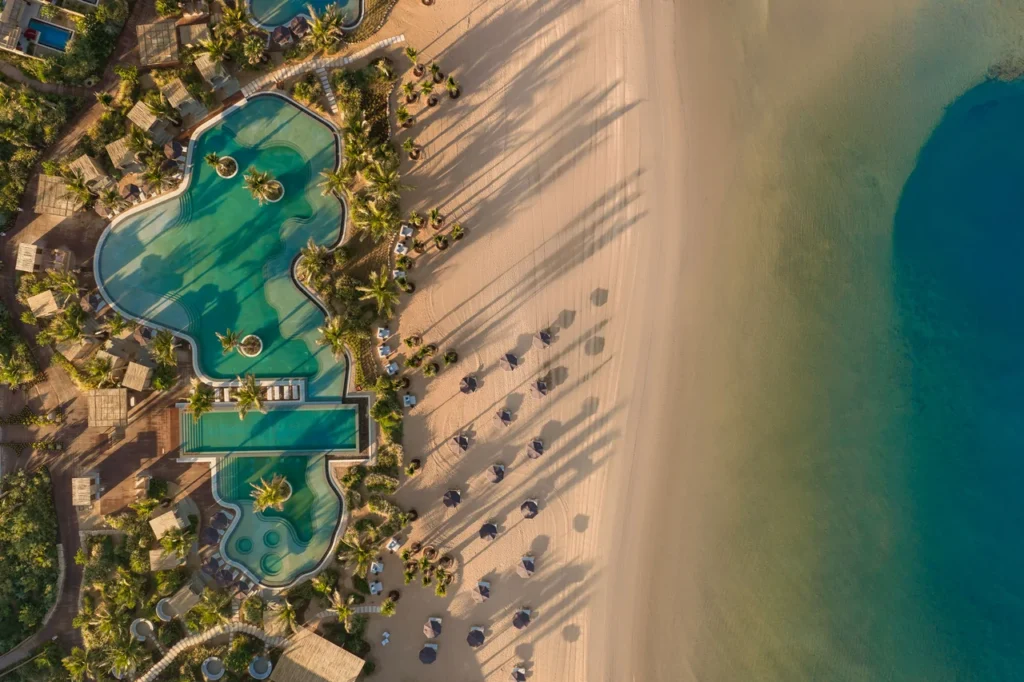
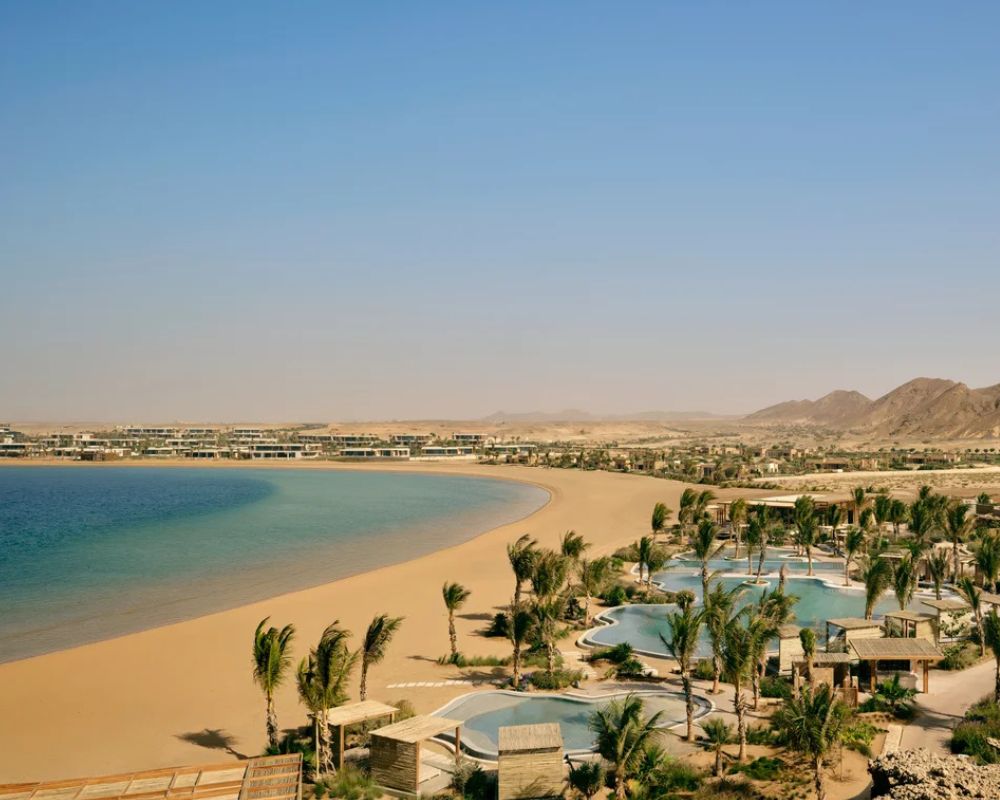


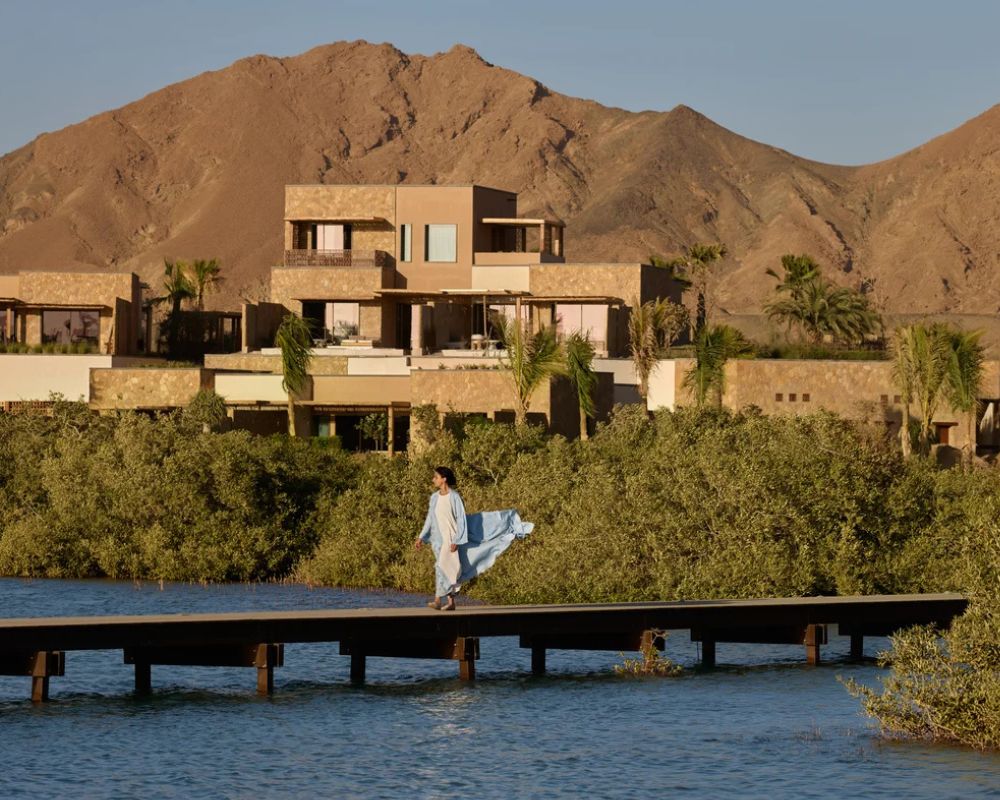
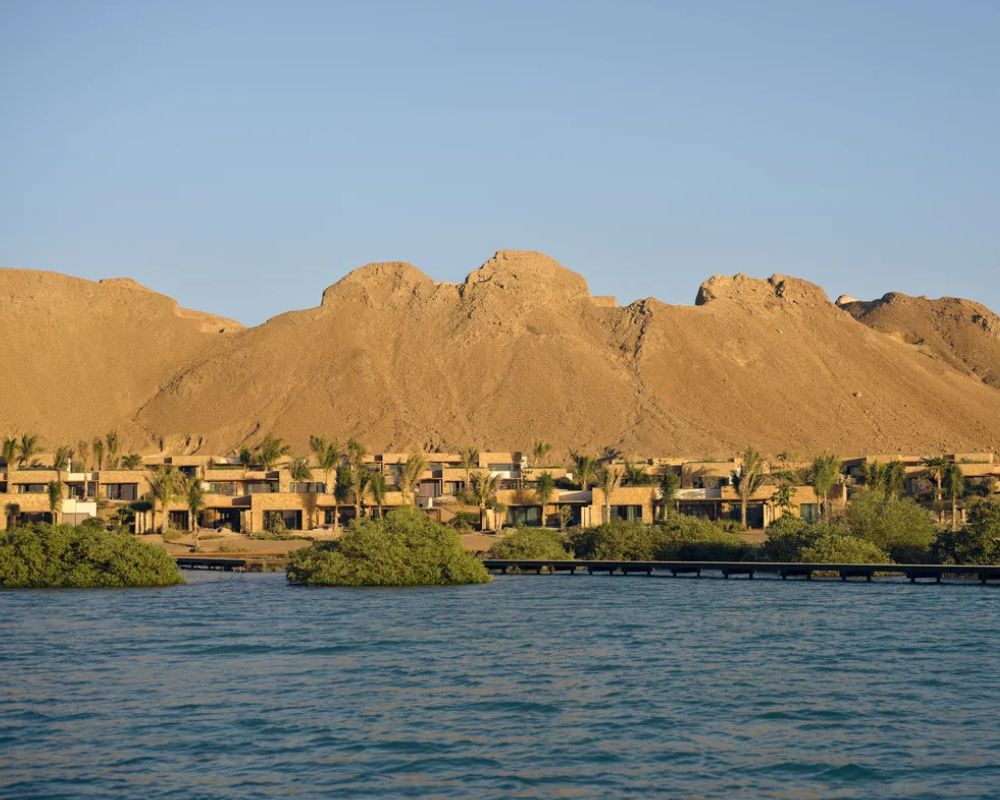
On July 15, 2026, guests checked into Six Senses AMAALA for the first time. The resort sits between a mangrove-fringed lagoon and a striking clifftop mesa on Saudi Arabia’s northwestern Red Sea coast, surrounded by 1,600 square miles of protected coastline where ancient desert peaks meet coral reefs that scientists describe as among the most resilient marine ecosystems on the planet.
Inside, a Longevity Centre, a Biohacking Recovery Lounge, a Watsu pool, a sound dome, and cryotherapy facilities welcome guests alongside three signature restaurants, an artisan bakery, and a coffee roastery. Woven into the landscape using traditional Saudi coastal architecture, the resort houses 100 suites and villas and 25 branded residences, and it is, in every meaningful sense, just the beginning of what is being built at AMAALA. Six Senses AMAALA is the most specific and dateable example of a much larger shift happening in luxury hospitality right now, and understanding it tells you a great deal about where the entire industry is heading.
The location that turns Six Senses AMAALA into a global wellness destination
Six Senses AMAALA sits within AMAALA Triple Bay, a luxury wellness destination covering more than 4,000 square kilometres of Saudi Arabia’s Red Sea coast. Red Sea Global, the developer behind the project and a company owned by Saudi Arabia’s Public Investment Fund, describes AMAALA as the world’s first fully integrated wellness destination. That is a bold claim, and the numbers behind it give it considerable weight.
The entire destination runs on 100% renewable energy, eliminating an estimated 350,000 tonnes of CO2 equivalent annually. It has been designed to accommodate a maximum of 500,000 visitors per year, a deliberate cap to protect the environment and preserve the quality of the experience at the same time.
Red Sea Global has committed to a 30% net conservation benefit to local ecosystems by 2040, a target backed by active coral nursery programmes, a 5,015-square-kilometre Fishery Management Area in the adjacent Al-Wajh Lagoon, and a mangrove planting programme targeting 50 million mangroves by 2030. Scientific modelling from Red Sea Global suggests that protected fishing zones could increase reef fish populations by 113%, sharks and rays by 72%, and marine mammals by 24%.
At the heart of the destination sits the Corallium Marine Life Institute, a world-class research and exhibition facility whose building was designed to mirror the form of Red Sea coral. It houses a 40-metre-long, 10-metre-deep artificial reef described as among the largest in the world, alongside an interactive coral regeneration facility where guests and researchers can observe coral reproduction techniques including IVF and fragging in real time.
Six Senses AMAALA guests have direct access to this institute as part of the resort experience. The Junior Mangrove Ecologist programme runs alongside the longevity spa, giving families with children a hands-on way to engage with the science behind the destination’s conservation commitments. The Eat With Six Senses dining philosophy sources locally and is designed around the same wellness principles built into every other part of the resort. Taken together, Six Senses AMAALA was conceived from the beginning as a place where the sustainability infrastructure and the wellness offering are the same thing, reinforcing each other rather than running as parallel tracks that occasionally intersect.
The nine resorts turning AMAALA into the most competitive wellness address on earth
Six Senses AMAALA opened on July 15, 2026. Four Seasons Resort and Residences at AMAALA Triple Bay opened the month before. Daraah Resort followed shortly after. Red Sea Global has confirmed that six further resorts are scheduled to open across 2026, and the full first phase will deliver more than 1,267 rooms across nine resorts at the destination. Looking at who is opening there tells us everything about how the global luxury hospitality industry views this stretch of the Red Sea right now.
Six Senses AMAALA is the wellness anchor of the entire destination. Sleep-optimised design, personalised longevity protocols, biohacking recovery, Watsu therapy, sound healing, and three restaurants built around the Eat With Six Senses philosophy define the experience. Six Senses is IHG’s flagship wellness brand and has spent decades building its identity around science-backed longevity programming. Its presence at AMAALA confirms the destination’s positioning more persuasively than any marketing campaign could.
Four Seasons Resort and Residences, AMAALA at Triple Bay holds the longest stretch of beach in the development. With 202 rooms and 25 residences, five pools, six open-air dining venues, a spa with an organic garden, and the brand’s signature Kids For All Seasons programme, Four Seasons brings the broadest appeal of any brand in the portfolio. It draws families and multigenerational travellers who want genuine luxury alongside their wellness experience, and it anchors the destination for guests who arrive at AMAALA by way of the Four Seasons name rather than the wellness category.
Equinox Resort AMAALA is the performance play and one of the most architecturally striking properties at the destination. Designed by Foster and Partners, the 128-room property brings Equinox’s fitness-as-a-lifestyle philosophy to the Middle East for the first time. Its offer includes a rooftop magnesium salt pool, a subterranean spa grotto, hyperbaric chambers, personalised IV therapies, and an Equinox Fitness Club. For a brand that has built its entire identity around the idea that high-performance fitness is the luxury product, an AMAALA resort is a natural and significant strategic step.
Rosewood AMAALA centres its offer around Asaya, the brand’s holistic wellness concept, and takes a distinctly different approach from its neighbours. Private treatment pavilions surround a protected green oasis. Sea-inspired therapies, an Arabian Apothecary where guests create bespoke botanical blends, breathwork and sound baths, and a daily Sukun Hour of collective stillness define the rhythm of the stay. Rosewood’s positioning sits between ritual, privacy, and a strong sense of place, making it the property for guests who want immersive restoration rather than clinical intervention.
Clinique La Prairie Health Resort, AMAALA brings Swiss longevity science to the Red Sea and will be the brand’s first destination outside Europe when it opens in 2027. The 52-room, 13-villa property is organised around a central Longevity Plaza and structured around four scientific pillars: medical care, nutrition, movement, and wellbeing. It will be the most clinically intensive offer at the destination and the one most closely connected to the medical wellness tradition that has defined Clinique La Prairie’s reputation in Montreux for over 90 years.
Nammos Resort AMAALA is the most interesting outlier in the entire lineup. Nammos is a Mykonos-founded brand known for Mediterranean dining, beach culture, and social luxury rather than longevity science. Its presence at AMAALA is a deliberate and smart signal that Red Sea Global is building a wellness destination for guests who want the option of transformation rather than a retreat that demands it. That distinction matters enormously from a brand strategy perspective, and it is what separates AMAALA from every other wellness destination currently being developed anywhere in the world.
What Six Senses AMAALA tells us about the direction of luxury hospitality
Every major luxury hotel group in the world is currently working through the same fundamental question: what does the word wellness actually mean when every brand in the market is using it? When Marriott, Hilton, and IHG are all offering sleep programmes and Peloton bikes, what genuinely differentiates a property built around wellness from one that has added a spa menu and rewritten its marketing language?
Six Senses AMAALA offers a specific and considered answer. The resort is built around the idea that wellness at its most meaningful is structural rather than supplementary. Sleep optimisation begins with the architecture of the villa, the orientation of the windows, and the materials in the bedding, long before a guest books a treatment at the spa. The food philosophy informs every menu across the resort rather than offering a wellness section alongside a standard one. The sustainability of the destination is inseparable from the wellness offer, because the coral reef, the mangrove lagoon, and the marine institute are part of what guests are there to experience and, in small but tangible ways, to protect.
That structural approach is precisely what separates the properties that will define luxury hospitality over the next decade from the ones that will be remembered as trend followers. The Global Wellness Tourism market reached $990 billion in 2025 and is projected to climb to $2.4 trillion by 2035. The brands building for that market by integrating wellness into every design decision rather than layering it on at the end are the brands whose guests return because they felt genuinely different when they left. Six Senses has understood this longer than almost anyone else in the industry. AMAALA is the most ambitious context it has ever been given to demonstrate it.
The sustainability question that deserves a serious answer
AMAALA is genuinely impressive in its environmental commitments. The renewable energy infrastructure, the coral conservation science, the visitor cap, and the mangrove programme are all substantive and independently verifiable. Red Sea Global has been recognised by the Global Wellness Institute as one of the world’s leading wellness-focused developments specifically because of this framework, and the science behind the fishery management area and the coral nurseries is real, peer-reviewed, and meaningful.
At the same time, the question of whether a destination of this scale, with nine luxury resorts, a yacht club, an international airport, and a long-term pipeline of 3,000 hotel rooms across 30 hotels, can genuinely deliver a net conservation benefit to a protected marine environment is one that the industry and its guests are right to hold openly.
Red Sea Global’s answer is that the destination was designed from the outset with conservation at its centre, that 95% of the AMAALA area is reserved for natural habitats, and that the scientific monitoring programmes will track ecosystem health throughout both the development and operational phases. The Corallium Marine Life Institute, the coral nurseries, and the Fishery Management Area represent infrastructure investments in active conservation, carrying considerably more weight than communications claims alone.
Whether that framework holds as the destination scales toward 3,000 rooms is the most consequential long-term question attached to the AMAALA story. The brands that have committed their names here, Six Senses, Rosewood, Four Seasons, Equinox, and Clinique La Prairie, have each done so with the understanding that the answer will be publicly and visibly tested over the coming decade. That is itself a meaningful signal about how seriously each of these brands takes its own sustainability positioning.
What AMAALA means for the future of luxury travel
The opening of Six Senses AMAALA offers a useful and timely opportunity to look at what the convergence of wellness, sustainability, and luxury hospitality actually looks like when a government-backed developer builds it from scratch at genuine scale. At AMAALA, the answer is a destination that takes the relationship between luxury and environmental responsibility seriously enough to make it a design principle rather than a marketing position.
Consider the wellness route that runs between resorts through a 20 to 40 metre wide landscaped corridor, connecting properties via dedicated paths for walking, running, cycling, and horse riding. It is a piece of infrastructure designed to make movement through the destination feel like a natural extension of the wellness experience. The Junior Mangrove Ecologist programme turns conservation education into a guest activity for children. The Corallium Marine Life Institute turns coral science into a front-row experience for every adult at the resort. These are specific, designed moments where sustainability and hospitality reinforce each other in ways that a guest actually feels during their stay.
For the luxury travel industry as a whole, AMAALA represents the most concrete current example of a destination that has taken the question of what hospitality owes to its location seriously enough to build an entire ecosystem around the answer. Whether every brand that has committed its name to the destination will deliver on that promise at the level of individual guest experience is the test that 2026 and 2027 will run in real time.
What is already clear is that Saudi Arabia has built a wellness city on a protected Red Sea cliff, surrounded it with the most ambitious collection of luxury wellness brands ever assembled in one place, and opened the doors just three weeks ago. The industry is watching closely. The guests are booking. And Six Senses AMAALA is very much the opening chapter of a story that is only just beginning.
Read next: Case Study: How Shangri-La Le Touessrok’s 700,000 Bees Are Protecting Mauritius’ Biodiversity — because the most compelling sustainability stories in luxury hospitality are always the ones where conservation and guest experience are genuinely the same thing.