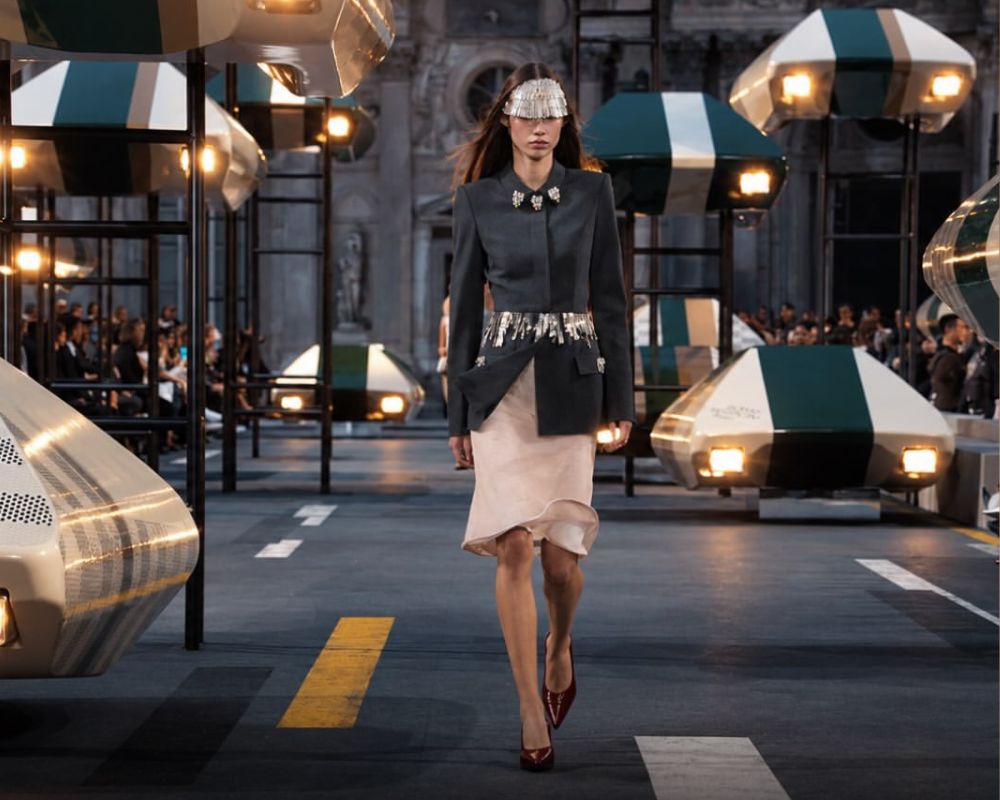

The show began at sunset. The Cour Carrée of the Louvre, one of the most photographed courtyards in the world, was still warm at 24 degrees Celsius on what should have been an autumn evening in Paris. Above the runway, 34 flying cars clad in Louis Vuitton’s signature Damier check pattern hovered on stilts, their tail lights glowing against the 17th-century stone facades. Below them, models walked as pedestrians through an imaginary city of the future. The Louis Vuitton SS27 word means ergonomics. It is the least glamorous word ever applied to a Louis Vuitton collection and possibly the most commercially intelligent.
Nicolas Ghesquière has been the creative director of Louis Vuitton womenswear since 2013. In thirteen years he has shown at the Bob Hope Estate in Palm Springs, the Miho Museum in Kyoto, the TWA Flight Center in New York and the apartments of Anne of Austria inside the Louvre. This is unlike anything he has built before.
The set told the future. The Damier tied it to the past.
Ghesquière called the Louis Vuitton SS27 set a modern urban jungle, the chaos of city life rendered in three dimensions above a runway. The 34 vehicles were each clad in the Damier check, the pattern the house has been printing since 1888. The most historic motif in the Louis Vuitton archive became the visual language of its most futuristic set piece.
That decision is the most specific brand statement at Paris Fashion Week this season. The Damier running from the flying cars overhead to a trailing scarf on the ground below is the house saying something direct: wherever we go, the founding visual language comes with us. The future carries the past with it. At Louis Vuitton, it wears it.
Crystal bead visors and amber goggle-style sunglasses completed the mood. Models walked as pedestrians in a city that feels imminent without quite existing yet. The Louis Vuitton SS27 guest was dressed for somewhere between The Jetsons and tomorrow morning’s commute.
Ghesquière said the world is getting warm. The clothes are his answer.
Look away from the Louis Vuitton SS27 flying cars for a moment and look at what is on the runway beneath them.
Composite chiffons. Carré silks. Silk and cashmere scarf fabrics. Airy white shifts. Reengineered tailoring. Trained satin evening tanks. The silhouettes work with the body rather than imposing on it. The fabrics were chosen for lightness above every other quality. The collection is called Ergonomie and it is the most quietly radical thing Ghesquière has done in thirteen years at the house.
After the show he explained it simply. “The world is getting warm,” he told reporters.
The evening outside the Louvre was 24°C, unusually warm for an October night in Paris. But the heat was more than a backdrop to Louis Vuitton’s SS27 show. It reflected a fundamental shift in how fashion must now think about seasons.
Ghesquière’s collection responded with clothes designed to move with the wearer: layers that could be shed, pieces made for walking rather than arriving, and silhouettes built around comfort rather than the expectations of a fashion calendar.
Reuters reported this week that longer, hotter summers are disrupting traditional seasonal assumptions and putting higher-margin autumn sales under pressure. Louis Vuitton’s response was remarkably direct: let the woman decide when she needs the coat.
Ergonomie: The most unexpected word in luxury fashion this season
The word ‘Ergonomie’ is making its first appearance in a luxury fashion show title. It belongs in industrial design briefs and engineering textbooks. Ghesquière chose it deliberately and the choice is worth sitting with.
The Louis Vuitton SS27 Ergonomie word comes from a science of designing things to fit the people who use them rather than asking people to adapt to the design. Applied to the Louis Vuitton SS27 collection, it means every fabric choice and every structural decision starts from a single question: what does the woman actually need this garment to do?
For a house associated with spectacle, status and the kind of aesthetic difficulty that announces itself, this is a significant creative pivot. Ergonomie is Ghesquière’s most accessible collection in thirteen years at Louis Vuitton and the accessibility is presented as a conviction rather than a compromise. The Louis Vuitton SS27 flying cars are the spectacle. The clothes beneath them are the argument.
The most expensive show set in Paris Fashion Week
Thirty-four custom-built flying cars, each clad in Damier check, suspended above a runway at the Louvre at sunset on the closing night of Paris Fashion Week. The Louis Vuitton SS27 production budget is among the most significant investments in show spectacle by any brand this season and the commercial logic behind it is straightforward.
The Louis Vuitton SS27 flying cars are the most photographed and most shared image of the Paris Fashion Week season. The Damier pattern applied to a futuristic vehicle at a 17th-century monument has generated more earned media coverage than any other show moment this week. For a brand facing significant commercial pressure in China in 2026, the global cultural return on that investment is the most rational available argument for spectacular production at precisely the moment when conservative caution might seem more prudent.
The show is Louis Vuitton telling the world that its cultural authority is larger than its commercial difficulties in any single market. The Louis Vuitton SS27 flying cars are the proof of that claim.
Zendaya wore a jacket she had already worn and it said everything
Zendaya attended in a ruffled organza jacket she had already worn on her Odyssey press tour. A celebrity at a Louis Vuitton show, on the closing night of Paris Fashion Week, in a piece the cameras had already captured once before.
It was, intentionally or otherwise, the most perfect illustration of everything Ghesquière was saying beneath those flying cars. Attachment over novelty. Rewearing over replacing. The idea that the most important thing about a garment is whether it remains worth wearing after the first occasion has passed.
The Louis Vuitton SS27 flying cars hovered above the Cour Carrée and gave the world its image of the season. Below them, the clothes made a quieter and more durable argument about what luxury fashion is actually for.
Ghesquière has been making the Louis Vuitton SS27 argument for thirteen years. This season, with 34 Louis Vuitton SS27 flying cars above him and the Louvre at his back, he made it more loudly than ever. And then dressed the woman beneath it all in something she could actually wear home.
Read next on The Pillar Edit: Louis Vuitton took a local tea maker in China to court and triggered a cultural backlash.
(Image credit: louisvuitton/Instagram)