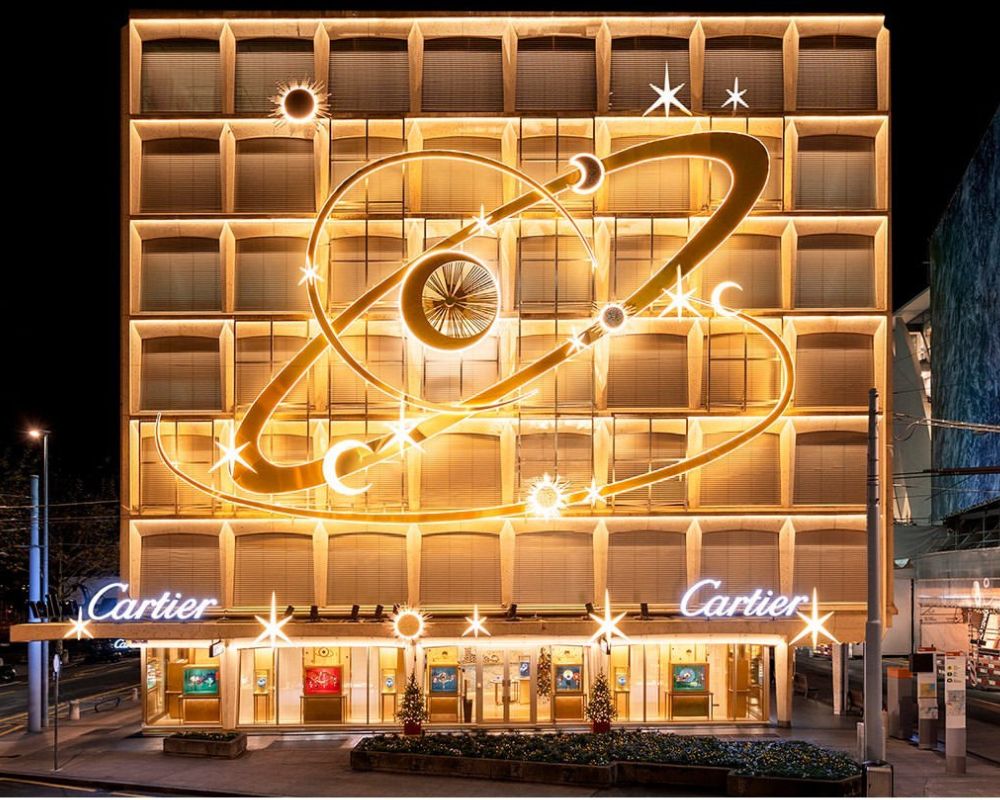

For nearly two decades, luxury retail has spoken one dominant architectural language. Sleek glass facades, floor-to-ceiling windows, translucent skins that catch the light, and interiors flooded with sunshine through vast atriums. Louis Vuitton, Hermès, Chanel, Prada, Tiffany, and every other major luxury house has built its flagship strategy around variations of this design vocabulary. So the biggest story in the sector right now is that the glass cathedral era is ending, and the design language replacing it, which industry insiders are starting to call climate-responsive luxury retail.
But in the last two weeks, as Europe has experienced the worst heatwave on record, with temperatures in France hitting 43.8°C, more than 1,300 excess deaths recorded across the continent, and Land Surface Temperatures exceeding 50°C in central France and northern Spain, the limitations of this design language have become visible in ways the industry can no longer politely ignore.
As Europe heats up, Bond Street, Faubourg, and the wider luxury retail landscape are undergoing a subtle transformation. Architects and luxury brands are already designing for climate reality, a shift that is poised to define the flagship stores of the next decade.
The 2026 Europe heatwave is forcing the shift to climate-responsive luxury retail
To understand the shift, you first need to understand the temperatures. In the third week of June 2026, France recorded its hottest day on record, with an average national temperature of 30.0°C and a peak of 43.8°C in the town of Pulluau in western France. More than 58 French departments were placed under red alert, the highest possible warning level. The Louvre and Eiffel Tower closed early.
The Uffizi in Florence shut during a heat-related power cut, Paris hospitals hit heatwave breaking point and beyond the immediate crisis, the World Meteorological Organization confirmed that Europe is the world’s fastest warming continent, having warmed by approximately 2°C since 1976 and continuing to accelerate. So this is the operating environment that climate-responsive luxury retail is now being designed for.
The implications for luxury flagship stores are structural. A Bond Street flagship built with a fully glazed south-facing facade, an atrium designed to flood the space with natural light, and interior climate control calibrated to a European summer of 25°C to 28°C, is now operating under climatic conditions it was never designed to handle. The heat load through the glass alone can push interior surface temperatures far beyond guest comfort.
Air conditioning systems that were designed as a background service now run at maximum capacity for weeks at a time. Merchandising displays, leather goods, and fine textiles all suffer degradation from prolonged heat exposure. So the entire operational model of the glass flagship is being tested in real time, which is why climate-responsive luxury retail has moved from an academic conversation to a boardroom priority.
The design language before climate-responsive luxury retail
Step back, and the story of the glass cathedral era is worth understanding in its own right. The dominant luxury flagship architecture of the past two decades emerged from a specific moment. The early 2000s saw an explosion of iconic flagship openings by celebrity architects, driven by the belief that luxury brands should own their most important stores as architectural statements. Think Prada’s Fifth Avenue Epicenter by Rem Koolhaas. Louis Vuitton Ginza by Jun Aoki. Hermès Ginza by Renzo Piano. Chanel Ginza and Louis Vuitton’s Champs-Élysées Maison by Peter Marino. For decades, luxury’s most iconic flagships have doubled as architectural landmarks where fashion, culture, and design converge.
The design vocabulary that emerged was unmistakable. Enormous glass facades, translucent or semi-translucent skins, interiors flooded with natural light, atriums that connected retail floors visually and physically, and materiality choices that emphasised polished surfaces, mirrors, and metal. The Prada Fifth Avenue flagship even uses a moiré-like scaffolding effect that changes as pedestrians move past it, creating a dynamic link between viewer and building. The Tiffany & Co. Beijing flagship by MVRDV wraps the entire building in curving translucent glass fins that shimmer with shifting reflections throughout the day. The Louis Vuitton Beijing flagship by Jun Aoki uses layered geometry and luminous surfaces to create a monumental yet delicate architectural statement.
The design language was brilliant for its moment. It positioned luxury retail as urban theatre. It made every flagship an architectural landmark. And it worked commercially because it drew crowds, generated Instagram content, and gave every luxury brand a physical anchor that could stand up to the aspirational imagery of its advertising campaigns. But the design vocabulary was built for a European climate that no longer exists, which is why the shift to climate-responsive luxury retail has become inevitable.
What climate-responsive luxury retail actually looks like in 2026
The shift is already visible in the most recent luxury flagship openings, and in the buildings that architects are quietly designing for the second half of the decade. Three principles are emerging as the defining language of climate-responsive luxury retail.
The first principle is the climate-responsive facade. Rather than fully glazed skins that flood the interior with sunlight, the new flagship stores are being designed with facades that regulate solar gain. Foster + Partners pioneered this thinking on a large commercial scale with the Bloomberg European headquarters in London, which uses a breathable facade with automated bronze louvers that open and close throughout the day to provide natural ventilation.
Combined with a central atrium, the design reduces energy use by approximately 35 percent compared to a typical office. The same firm designed the newly opened Hermès Maison Bond Street in London, which launched on June 16, 2026, and is the largest Hermès store in Europe. The property occupies six buildings across 55 rooms and represents the most consequential climate-responsive luxury retail commission to open in Europe this year.
The second principle is heritage preservation over glass expansion. Rather than knocking down existing buildings to build new glass cathedrals, the most sophisticated climate-responsive luxury retail projects of 2025 and 2026 have increasingly focused on adaptive reuse. The Imperial Hotel Kyoto opened its first new Kyoto property in three decades inside the historic Yasaka Kaikan, a 1936 cultural building, preserving 16,387 original tiles using a traditional Japanese technique. This same instinct is showing up across luxury retail. Preserving historic facades reduces embodied carbon dramatically, retains the thermal mass advantages of thick masonry walls, and integrates the flagship into the surrounding urban fabric rather than dominating it.
The third principle is biophilic and passive cooling integration. The next generation of climate-responsive luxury retail is incorporating natural ventilation, green walls, water features, and material choices that support passive cooling. Warm earthy palettes, natural stone, clay plaster, and real wood are replacing the polished mirrored surfaces of the previous era. According to the WGSN Future Retail Report, more than 70 percent of new considered luxury flagships now incorporate sustainable materials or advanced architectural systems specifically calibrated for climate performance.
Why climate-responsive luxury retail matters more than any other retail category
Step back further, and the reason climate-responsive luxury retail matters more than mass market retail architecture becomes clear. Luxury flagships are the physical anchors of brand equity. A Louis Vuitton flagship on Bond Street is the physical embodiment of the brand for anyone who walks past it, whether they buy something or not. So the architecture of luxury retail carries disproportionate strategic weight. When a flagship fails structurally under climate pressure, the failure damages not just the immediate operational metrics but the entire brand equity built around the store.
This is why the brands that invest in climate-responsive luxury retail first will have a competitive advantage that compounds. A Bond Street or Faubourg flagship that remains cool, comfortable, and beautifully lit through a 43°C European summer will draw tourists who are actively avoiding baking outdoor environments. A Milan or Madrid flagship with a cooling atrium, natural ventilation, and biophilic interior design will become the physical sanctuary that affluent travellers seek out.
The affluent traveller of 2026 makes different decisions about where to spend the middle of the day than the affluent traveller of 2015 did. And the flagships that recognise this early will own the London, Paris, Milan, and Madrid tourism dollar for the next decade.
What the future of climate-responsive luxury retail actually looks like
Taken together, the trend is unmistakable. The climate-responsive luxury retail of the next ten years will look meaningfully different from the flagship architecture of the last ten. The dominant materials will shift from polished glass and mirrored surfaces to natural stone, clay plaster, real wood, and climate-responsive facade systems. The dominant lighting language will shift from natural light through vast atriums to carefully controlled daylight, warmer artificial illumination, and interior gardens. The dominant thermal strategy will shift from mechanical air conditioning as the primary defence to passive cooling as the first line, with mechanical systems reserved for the hottest hours. And the dominant relationship between the flagship and its context will shift from architectural statement to embedded urban presence.
The specific brands that lead this shift will vary by region and category. Foster + Partners is already positioning itself as the leading firm for climate-responsive luxury retail at scale. MVRDV, Herzog & de Meuron, Peter Marino, and Jun Aoki continue to define the reference points. And the individual houses that commission these designs, whether Hermès, Louis Vuitton, Chanel, Tiffany, or emerging luxury names, will each set their own pace. But the direction is now clear.
Luxury has always reflected the world it inhabits. As that world grows hotter, its architecture must evolve with it. The next icon will be the store the one that remains elegant, comfortable and enduring even in 40-degree heat. In the decade ahead, climate-responsive design will become one of its most powerful expressions.
FAQ
What is climate-responsive luxury retail?
Climate-responsive luxury retail refers to the deliberate design of luxury flagship stores and boutiques for extreme climate conditions, particularly the rising temperatures reshaping the European retail environment. It combines climate-responsive facades that regulate solar gain, heritage preservation over new glass construction, and biophilic elements that support passive cooling. The category is emerging as the design language replacing the glass cathedral era that has defined luxury flagship architecture for two decades.
Why is climate-responsive luxury retail becoming urgent in 2026?
Climate-responsive luxury retail has moved from an academic conversation to a boardroom priority because Europe is experiencing significant and sustained climate warming. In June 2026, France recorded its hottest day on record at 43.8°C, more than 1,300 excess deaths were linked to the heatwave across the continent, and major landmarks including the Louvre and Eiffel Tower closed early. The traditional luxury flagship of vast glass facades and light-flooded atriums is no longer thermally viable in a European summer that regularly exceeds 40°C.
Which architects are leading the shift to climate-responsive luxury retail?
Foster + Partners is one of the most prominent firms leading the shift, having designed the newly opened Hermès Maison Bond Street and pioneered climate-responsive facade design at the Bloomberg European headquarters in London. MVRDV designed the Tiffany Beijing flagship with a translucent glass fin skin. Jun Aoki continues to shape Louis Vuitton’s flagship design language. Peter Marino, Herzog & de Meuron, and other established firms are also active in redefining climate-responsive luxury retail for the next decade.