


Why sustainable luxury travel was overdue for a reinvention
To understand why 1 Hotels landed the way it did, we have to understand the problem it was solving. Sustainable luxury travel existed before 2015, but it had a serious image problem. Green hotels were associated with dim lighting, scratchy linens, and the kind of earnest environmental messaging that made guests feel guilty rather than inspired. Sustainability and luxury occupied separate corners of the market, and there was an unspoken assumption that they needed to stay that way.
Sternlicht saw it differently. As he put it directly: green had been done before, but green luxury had not. That single observation became the founding logic of 1 Hotels. The brand launched in 2015 with properties in Miami’s South Beach and Manhattan’s Central Park, and it has since expanded to include London’s Mayfair, Melbourne, Copenhagen, Seattle, Nashville, Toronto, and properties now in development across Riyadh, Paris, and Tokyo. The growth matters because it proves the thesis. Sustainable luxury travel, done properly, is not a niche. It is a direction.
The design philosophy that changed how sustainability feels
Why biophilic design is at the heart of the 1 Hotels experience
Most hotels communicate their sustainability credentials through signage. A small card by the sink or a note about towel reuse. 1 Hotels took a fundamentally different approach. The sustainability at 1 Hotels is not something you read about but walk into.
At 1 Hotel Melbourne, the design includes over 2,000 living plants, a reception desk crafted from fallen trees, reclaimed timber salvaged from abandoned local rail bridges and wharfs, and nearly 2,000 bluestone pavers reinstalled as pathways throughout the property. At 1 Hotel Brooklyn Bridge, 36,000 ivy plants blanket the exterior of the building, each one working to produce oxygen, absorb greenhouse gases, reduce surface temperatures in summer, and insulate the building in winter. At 1 Hotel San Francisco, the lobby floor is made from 7,000 square feet of reclaimed barn wood, with elevator landings reclaimed from the old Bay Bridge.
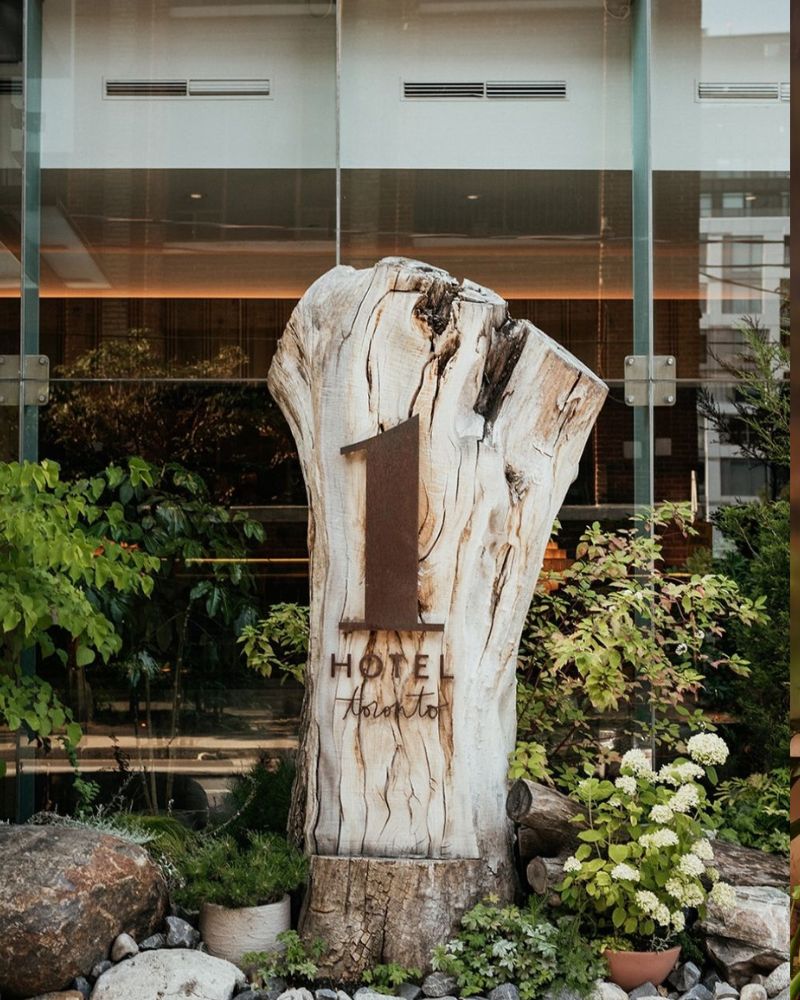
This is what biophilic design actually looks like when it is taken seriously. It is not a green wall in the lobby and a recycled paper notepad on the desk. It is a complete visual and material vocabulary built around the idea that nature is not decoration but structure. The guest does not need to be told the hotel cares about the environment. They can feel it in the materials under their feet and the air moving through the living facade above their heads.
How 1 Hotels turns sustainability into storytelling, not a lecture
Here is where 1 Hotels does something genuinely clever. Sternlicht understood early on that sustainability only creates an emotional connection when it makes people feel something other than guilt. His approach was to build what he calls educational moments directly into the experience, small, unexpected details that reframe the way guests think about the objects around them.
The hangers in the guest rooms are made from recycled materials. Rather than stamping a recycling symbol on them, they carry messages like “This is made out of love letters” or “This is made out of homework.” It is a tiny detail. But it lands. Instead of a sustainability lecture, the guest has a moment of surprise and warmth that stays with them long after checkout. That emotional specificity is what separates 1 Hotels from every eco-hospitality brand that came before it. Guilt does not build brand loyalty. Delight does.
This philosophy carries all the way through to the food programme. The brand’s partnership with Copia has allowed 1 Hotels to donate over 13.6 million pounds of food and serve over 54,000 meals to vulnerable communities through local nonprofits across Nashville, Toronto, Miami, and beyond. Elsewhere, rooftop chef’s gardens, lobby farmstands, and menus built around locally sourced and sustainably grown produce turn every meal into a quiet argument for why sustainable luxury travel does not mean giving anything up.
The operational infrastructure behind the mission
LEED certification as a standard, not a headline
Beyond the design, the 1 Hotels sustainability strategy runs deep into the operational infrastructure of every property. Several hotels across the portfolio hold LEED Gold certification, including 1 Hotel San Francisco and 1 Hotel Toronto. LEED-certified buildings use on average 26 percent less energy, emit 33 percent less carbon dioxide, and use 30 percent less indoor water than non-certified equivalents. For 1 Hotels, certification is not a headline. It is a baseline.
At 1 Hotel Toronto, an intelligent Energy and Building Management System saves roughly 17 percent of annual energy consumption and delivers 167 tonnes of CO2 reduction since opening. The in-room thermostats are integrated with occupancy and lighting sensors to adjust automatically, and the hotel operates a fleet of fully electric house cars for guests exploring the city. These are not exceptional measures. At 1 Hotels, they are simply the way things are done.
Mission Membership and the reinvention of luxury loyalty
In December 2025, 1 Hotels launched Mission Membership, arguably the most interesting loyalty programme in luxury hospitality right now. And it is interesting precisely because it is not really a loyalty programme in any conventional sense.
Traditional hotel loyalty programmes reward transactional behaviour. Stay enough nights, earn enough points, unlock a status tier. Mission Membership does away with all of that. Instead, it is built around a relationship-driven model where members receive curated perks and exclusive opportunities from sustainability-aligned partners including Everlane, Remedy Place, HigherDOSE, and Alo Wellness Club. From 2026, that list also includes on-demand classes in yoga, meditation, and mindfulness. Every new member who joins triggers a tree planted in their honour through the Arbor Day Foundation. And guests choose, with every stay, which environmental cause they want to support, whether that is protecting endangered species with NRDC, restoring ocean health with Oceanic Global, or greening underserved communities through Green Our Planet.
Why this model of sustainable luxury travel matters in the Middle East and Asia
The timing of 1 Hotels’ global expansion is not accidental. The fastest-growing luxury travel audiences in 2026 are not in traditional western markets. They are in India, the Middle East, and Southeast Asia, and they are younger, more purpose-driven, and more digitally connected than any luxury travel cohort that came before them.
For this generation, sustainable luxury travel is not a niche interest or a feel-good add-on. It is increasingly a deciding factor in where they choose to stay. Consumer data consistently shows that a significant majority of global travellers prefer accommodations with visible sustainability credentials, and among younger affluent travellers that preference is even more pronounced. 1 Hotels already has a property in development in Riyadh, with projects also moving forward across Asia including Tokyo. The brand’s expansion map follows the direction of luxury travel’s next major wave of growth almost exactly.
Interestingly, the biophilic design philosophy that underpins every 1 Hotels property also resonates particularly well in these markets. Nature-connected design, locally sourced materials, and spaces that feel genuinely rooted in their environment align closely with cultural values around harmony, heritage, and connection to place that carry real weight in markets from the Gulf to Southeast Asia.
(Image credit: 1hotels/Instagram)FAQ
What makes 1 Hotels a leader in sustainable luxury travel?
1 Hotels integrates sustainability into every layer of the guest experience, from biophilic architecture and reclaimed materials to LEED-certified operations, zero-waste food programmes, and purpose-driven loyalty through Mission Membership. The brand was founded on the premise that luxury and sustainability are not opposites, and its global expansion across 15-plus properties has proven that case commercially.
Is 1 Hotels expanding in Asia and the Middle East?
Yes. 1 Hotels has properties in development in Riyadh, Tokyo, Paris, and other key global markets. The brand’s expansion reflects the growing demand for sustainable luxury travel among younger, purpose-driven affluent travellers in the Middle East, India, and Southeast Asia.
What is biophilic design and how does 1 Hotels use it?
Biophilic design is an architectural approach that integrates natural elements, living plants, reclaimed materials, and organic forms into built environments to create spaces that feel genuinely connected to nature. At 1 Hotels, it is the primary design language across every property, from tens of thousands of living plants on building facades to reception desks made from fallen trees and lobby floors built from reclaimed barn wood.