


I want to tell you about a place you’ve probably never visited. At first glance, it seems unremarkable. But it became the setting for one of the most powerful decisions a luxury brand has ever made.
Tain sits on the southern shore of the Dornoch Firth in the Scottish Highlands, about an hour north of Inverness. It is Scotland’s oldest Royal Burgh, granted its charter by King Malcolm III in 1066, older than the Magna Carta, and older than many of the institutions we consider ancient today.
Yet for all its history, Tain is a small town of just 3,500 people. Its high street is modest. Its winters are long. And like so many communities across the Highlands, its greatest challenge is one shared by small towns everywhere: its young people keep leaving.
Just outside Tain, where the Dornoch Firth opens into the North Sea, stands the Glenmorangie distillery. At first glance, it looks like any other historic Scottish distillery. But for more than 180 years, it has been doing something far more remarkable than making whisky.
Since 1843, Glenmorangie has remained deeply rooted in the place it calls home. It sources barley from farms within 75 miles, employs generations of local families, protects 650 acres of surrounding land, restores ancient oyster reefs in the neighbouring waters, and leases farmland to a community project that helps young people build a future without leaving Tain.
This is the story of the Glenmorangie distillery that has called Tain home for more than 180 years. It is also the story of one of the most important shifts happening in luxury today: the return to place, community and long-term stewardship. It has unfolded quietly, far from the headlines. Yet it may prove more consequential than many of the industry’s biggest campaigns.
How Glenmorangie distillery became the heartbeat of a town of 3,500
Picture a Scotland that rarely appears in travel brochures. Not the Edinburgh of castle tours and tartan shops. Not the Highlands framed through drone shots and Instagram filters. Travel a little farther, beyond the places visitors photograph, and you arrive somewhere else entirely.
Small towns where the high street falls silent before dusk. Schools with fewer children than they had a generation ago. Young people who leave for Glasgow or London, promising to return one day, but rarely do.
That is the Scotland Tain lives in.
Rural depopulation is one of the defining crises of the Scottish Highlands right now. The Highland Council has said it plainly. Issues around social care, affordable housing, transport and quality employment are all interconnected factors in a depopulation crisis facing rural Scotland. Young people leave for cities and older populations remain. The working-age population shrinks, services contract, the cycle deepens and nobody at the top of the country seems to have a clean answer for it.
Tain sits right in the middle of that story. Of its 3,500 residents, only a fraction are of working age. The town functions as a rural service centre for the surrounding agricultural area with modest retail, some hospitality, and a handful of larger employers holding the whole thing together.
According to the Understanding Scottish Places database, the Glenmorangie distillery, alongside Highland Fine Cheeses and Bannerman Seafoods, is one of the anchors keeping Tain economically alive. Tourism helps too. Tain sits on the North Coast 500 route, which has brought real visitor traffic to the Highlands in recent years. But tourism alone does not anchor a community the way a single employer can. What anchors a community is when the same family works somewhere for three generations and the fourth one is already in training.
That is exactly what the Glenmorangie distillery has been building for 180 years.
The men and women of Tain
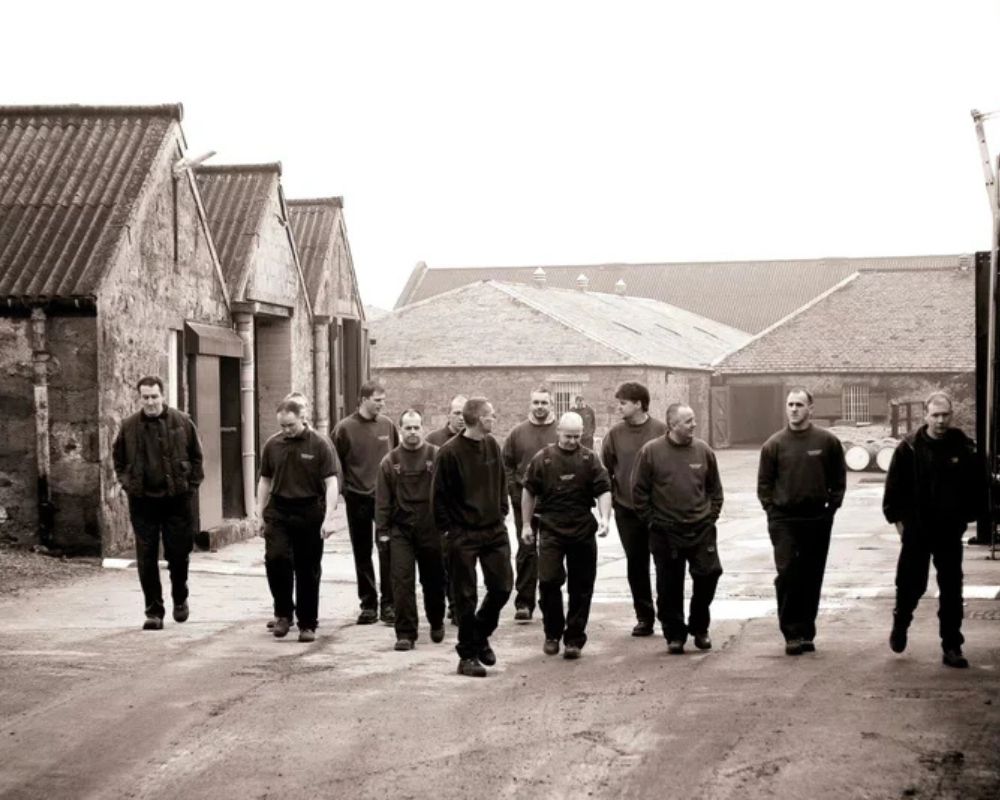
For most of its history, the entire production of Glenmorangie was entrusted to exactly sixteen people. They were known as the Sixteen Men of Tain. It was a name born from fact, not folklore. Those sixteen craftspeople became inseparable from the Glenmorangie distillery itself, with knowledge handed down through generations of local families until the number became part of Glenmorangie’s identity.
Their reputation spread far enough that jazz musician Allan Holdsworth named his 2000 album after them. That is the kind of cultural footprint a workforce leaves when they have been doing something with complete dedication for long enough.
The team has grown since then. An expansion in 2008 increased the workforce to 24, and today the Glenmorangie distillery employs men and women from Tain and the surrounding communities across distillation, maturation, visitor experiences and research.
That commitment reached a new chapter in 2021 with the opening of The Lighthouse, Glenmorangie’s 20-metre, glass-walled experimental distillery. More than an architectural landmark, it created highly skilled scientific and craft roles in a town where opportunities of that kind are rare, giving talented people another reason to build their futures close to home.
The headcount is only part of the story. What matters is the kind of employment Glenmorangie distillery has created. Skilled, permanent, generational roles have given families a rare sense of continuity in a town where long-term opportunities are increasingly scarce.
Walk through the Glenmorangie distillery today and the story of craftsmanship feels tangible. It lives in the people who make the whisky, many of whom come from families that have worked here for generations. Their history is woven into the history of Glenmorangie itself.
The 650 acres the Glenmorangie bought to protect its future
In 1989, developers were eyeing land around the Tarlogie Springs.
The springs sit in the hills about a mile above the Glenmorangie distillery, fed by rainwater that has spent close to a century filtering through alternating layers of limestone and sandstone, picking up minerals slowly and patiently as it descends. That mineral-rich water is the reason the Glenmorangie distillery produces a whisky that tastes like nothing else. It is the only Highland distillery that uses hard water in production and it is entirely irreplaceable.
So when that land came under threat, the company did something that had nothing to do with marketing and everything to do with identity. It purchased 650 acres of surrounding woodland to ensure the landscape, and the water source that defines its whisky, would remain protected for generations to come.
Six hundred and fifty acres of Highland land were preserved, free from development and commercialisation. It was a decision rooted in long-term stewardship rather than short-term returns, safeguarding the quality of a whisky that would not be ready to drink for at least another decade after the purchase was made.
The executives who made that call would never taste the whisky it protected. They were investing in the future of a place they would not live to see. And at a time when most brands cannot see past the next financial quarter, that kind of thinking feels almost radical.
Meanwhile, the barley tells its own quiet version of the same story. The Glenmorangie distillery uses 100% Scottish barley, with roughly 85% sourced from farms within a 75-mile radius of Tain. That is not a label claim or a provenance sticker. It is an ongoing, season-by-season economic relationship with the farming families of Easter Ross. Real money, staying in the region, year after year.
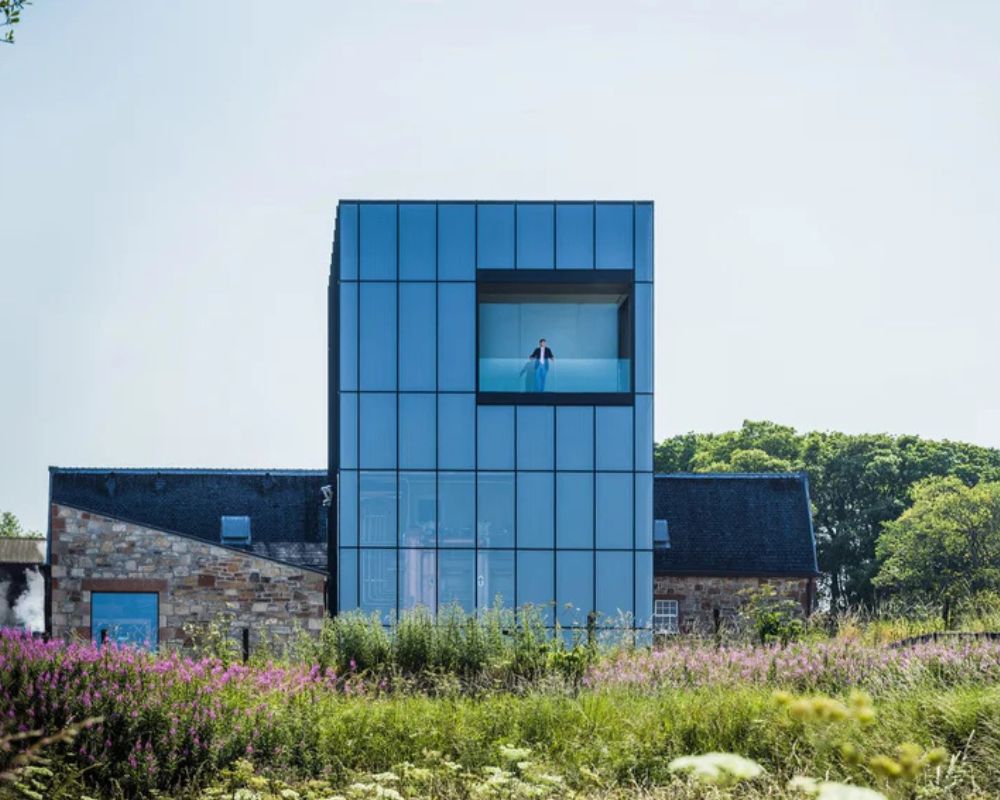
The firth Glenmorangie has spent more than a decade helping to restore
This next detail does not appear in any whisky review. It has not featured in a campaign. Glenmorangie has barely talked about it publicly at all. And it is probably the most revealing thing about what kind of company this actually is.
For the last ten years, Glenmorangie has been working with the Marine Conservation Society and Heriot-Watt University to restore the Dornoch Firth’s historic reef of native oysters, right on the doorstep of Tain.
Here is the backstory. The Dornoch Firth, which runs directly beside the Glenmorangie distillery, was once home to one of Scotland’s largest native oyster reefs. The reef filtered the water and supported marine biodiversity. It was part of the ecological fabric of this coastline for generations. Then centuries of overfishing and dredging wiped it out completely.
The Glenmorangie distillery played no part in that destruction. Yet more than a decade ago, it chose to help reverse it, partnering with scientists and conservationists to restore the waters that have shaped the distillery’s home for generations.
The work has continued patiently, year after year. It is a long-term ecological commitment to a firth the people of Tain have lived beside all their lives. The Dornoch Firth is a Special Area of Conservation and a Ramsar wetland, home to ospreys, seals, dolphins and countless seabirds. By helping restore its ancient oyster reefs, the Glenmorangie has become an active steward of the landscape that has sustained the distillery for more than 180 years.
The farmland Glenmorangie distillery quietly gave to a community
This is the detail that stopped me completely when I found it.
Outside Tain, on the A9 heading north, a community initiative called the Gro For You Community Innovation Campus is taking shape. The campus will house geodesic domes for research and aquaponic growing, a training centre with a kitchen and café, sensory gardens, wildflower meadows, a rewilding zone and outdoor teaching spaces. When fully open, it is expected to attract 26,000 visitors per year, create 24 full-time jobs and provide apprenticeships for 240 local young people. It will specialise in food technologies, hospitality, business and employability. Exactly the skills a town like Tain needs to give its young people a credible reason to stay.
The campus is built on arable farmland leased by arrangement from The Glenmorangie Company.
Glenmorangie is listed as a project partner. The land belongs to the distillery, which leased it to a community initiative created to address youth migration from the very town it has called home for 180 years. Alongside Glenmorangie, the project brings together the Scottish Government, Social Investment Scotland, SSE Renewables, Firstport and Highlands and Islands Enterprise.
The partnership unfolded quietly, without a publicity campaign or a headline-grabbing announcement. It reflected a simple belief: when a company has been part of a place for generations, its future is inseparable from the future of the community around it.
What the luxury industry can actually learn from this
Too often, the relationship between luxury brands and the places they occupy is transactional. A brand arrives, draws on a region’s land, labour, heritage or identity, and returns only what is necessary while extracting as much value as the market will bear.
The story of the Glenmorangie distillery is different. Over 180 years, it has recognised that a luxury brand and the place that shapes it cannot thrive independently of one another. The true source of its value extends beyond the whisky itself. It lies in the people, the landscape and the community that make the whisky possible. When those foundations flourish, so does the brand. When they decline, the brand inevitably follows.
The water that becomes Glenmorangie today fell as rain on the Hill of Tain a hundred years ago. The barley in every bottle was grown by Highland farming families within 75 miles. The skills that shape the spirit have been passed between generations of people from a town of 3,500 souls. The firth running beside the distillery is being restored, reef by reef. And the farmland beside the A9 is being turned over to young people who might otherwise have left.
A closing thought
I kept coming back to this story before I finally sat down to write it. Glenmorangie’s relationship with Tain doesn’t fit the way we usually talk about luxury.
It begins with a distillery founded in a converted brewery in 1843, grows through a town of 3,500 people, 650 acres of protected woodland and more than a decade of oyster reef restoration, before arriving at a field leased to a community project and 240 apprenticeships that have given young people a reason to stay.
Glenmorangie takes its name from the Gaelic Gleann Mòr na Sìth, meaning “Valley of Tranquillity.” Over 180 years, those words have become more than a name. They have become a promise, kept through generations of investment in the people and the place that shape its whisky.
The luxury industry continues to ask what responsibility to place should look like. Tain has been living the answer for generations.
Until next time, keep it considered.
Read next: How LVMH Gaïa and Parfums Christian Dior are protecting water, luxury’s most precious ingredient .Water is at the heart of what makes Glenmorangie extraordinary. And it turns out, it is at the heart of one of luxury’s biggest sustainability stories too.
(Image credit: glenmorangie.com)