




For decades, the luxury industry has told itself a comfortable story about sustainability. That environmental responsibility is meaningful, but it costs money, drags margins, and mostly competes with the growth imperative that public shareholders demand. Pandora, the Copenhagen-based jewellery brand that is now the world’s largest by volume, has just spent five years proving that story wrong.
Since 2019, the company’s revenue has grown by 49 percent while its total CO₂ emissions have dropped by 17 percent. And in January 2026, the Corporate Knights Global 100 ranking named Pandora the world’s most sustainable consumer brand and the second most sustainable company overall, out of more than 8,000 assessed globally. So the Pandora lab-grown diamonds decision and the broader sustainability strategy behind it are one of the clearest proof points in luxury that sustainability, done properly, actually compounds revenue rather than competes with it.
So this is the decoder. What the Pandora lab-grown diamonds strategy actually delivered in commercial terms, the specific decisions that made the turnaround possible, why the recycled metals rebuild mattered as much as the diamond shift, and what the wider luxury industry should be learning from the Copenhagen jeweller’s climb.
How the Pandora lab-grown diamonds strategy proved sustainability grows revenue
Between 2019 and the start of 2026, Pandora grew its revenue by 49 percent while reducing its total CO₂ emissions by 17 percent. This is a genuine decoupling of business growth from environmental impact, and it is unusually clean by industry standards. Most luxury companies that claim sustainability progress either grew revenue modestly while emissions climbed, or reduced emissions during periods of business contraction. Pandora did both at the same time, and it did so at genuine scale.
Pandora is the world’s largest jewellery brand by volume, selling more than 100 million pieces per year through 6,800 points of sale across more than 100 countries, and employing 37,000 people. So the decoupling of growth from emissions is a working proof point that a very large operating business can execute a genuine sustainability transformation without sacrificing commercial performance. Q1 2026 sales reached DKK 7,109 million, and the company is targeting DKK 34 to 36 billion in revenue for full-year 2026, which would represent approximately $5.11 billion, roughly 33 percent higher than the 2023 baseline.
The Pandora lab-grown diamonds strategy sits at the centre of the story, but so does the recycled metals rebuild, the shift to 100 percent renewable electricity across every crafting facility, and the packaging and product design changes that reduced material waste. Together, these initiatives allowed Berta de Pablos-Barbier, who became President and CEO on January 1, 2026, to inherit a company that had already done the operational hard work of aligning growth with genuine environmental progress.
Inside the 2021 decision behind Pandora lab-grown diamonds
To understand how Pandora got here, we need to go back to the strategic pivot that started everything. In 2021, under then-CEO Alexander Lacik and his Phoenix strategy, the company decided to phase out mined diamonds entirely and shift to exclusively lab-grown diamonds. At the time, very few major jewellers had made a comparable commitment. Most of the industry was still positioning lab-grown stones as a lower-tier alternative to mined diamonds rather than as a mainstream product. So the Pandora lab-grown diamonds decision was a genuine early bet, and it required significant supplier development, brand messaging investment, and consumer education.
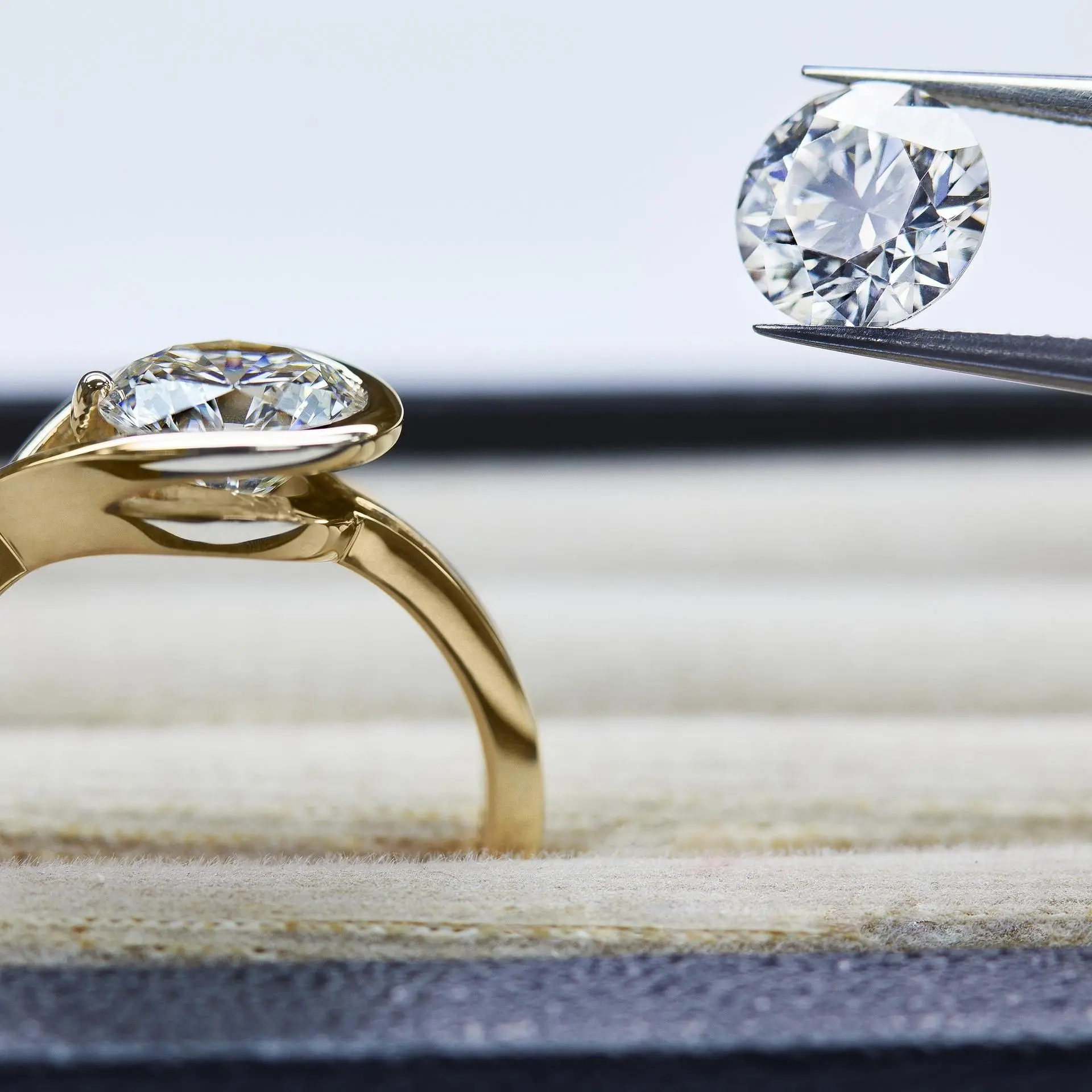
The strategic logic was sharp. A one-carat polished Pandora lab-grown diamond has a carbon footprint of approximately 12.58 kg CO₂e, which is about 90 percent lower than the equivalent mined diamond, based on a 2019 study by the Diamond Producers Association. For context, a Pandora 14-carat gold Infinite ring with a one-carat lab-grown diamond has a total carbon footprint of just 14.5 kg CO₂e, which is comparable to the carbon footprint of a single pair of jeans. So the environmental case for Pandora lab-grown diamonds is not marginal. It is a genuine order-of-magnitude reduction in the environmental cost of every diamond piece the company sells.
The commercial case has proven equally strong. Since August 2022, all Pandora lab-grown diamonds are grown, cut, and polished using 100 percent renewable electricity, and set in jewellery crafted with 100 percent recycled silver and gold. The Pandora lab-grown diamond Signature collection is now available in over 700 stores across North America, the UK, and Australia, and Pandora expects the category to generate over 100 million dollars in sales by 2026.
And in early 2026, the company introduced carbon footprint as the “5th C” of diamond quality, joining the traditional four Cs of cut, colour, clarity, and carat, and displaying the carbon footprint of every diamond piece on its website. Berta de Pablos-Barbier described the move as introducing “a new measure of brilliance,” giving consumers greater transparency about what they are wearing and how it is made.
Why 100% recycled metals mattered as much as Pandora lab-grown diamonds
The Pandora lab-grown diamonds story is the more widely discussed part of the turnaround, but the recycled metals rebuild is arguably the more operationally significant piece. By mid-2024, Pandora completed its transition to using 100 percent recycled silver and gold in all its jewellery, achieving the milestone ahead of its own 2025 target. This is the operational commitment that avoids approximately 58,000 tonnes of CO₂ per year for the company, equivalent to taking about 6,000 gasoline-powered cars off the road annually.
The complexity of the rebuild is worth understanding. Silver accounts for approximately 81 percent of the material in a typical Pandora piece, and yet less than 20 percent of the world’s silver supply comes from recycled sources. So Pandora had to audit more than 40 supplier sites, convince multinational metals refiners to change their processing operations, install new furnaces and separate production lines to keep recycled and virgin materials apart, and certify the entire chain under the Responsible Jewellery Council’s Chain of Custody standard. The additional annual cost of using recycled metals is approximately $10 million, which Pandora’s sustainability leadership described as “the necessary and right thing to do.”
The strategic ripple effect is where Pandora’s recycled metals transformation becomes truly significant for the wider industry. Its purchasing scale was large enough to justify suppliers investing in entirely new recycled processing infrastructure. As a result, those suppliers can now offer certified recycled silver and gold to other jewellery houses. Together, Pandora’s shift to lab-grown diamonds and its parallel transition to recycled metals have effectively unlocked a scalable supply chain for the broader luxury jewellery sector. Any luxury brand looking to follow Pandora’s lead can now tap into the certified recycled infrastructure that Pandora spent five years and mobilised roughly 200 employees to build.The Corporate Knights ranking proved Pandora lab-grown diamonds work commercially
The Corporate Knights Global 100 ranking is one of the most rigorous corporate sustainability assessments in the world, screening more than 8,000 publicly listed companies annually across 25 quantitative metrics. In January 2026, Pandora climbed from position number 48 in 2025 to number 2 in 2026, and was named the single most sustainable consumer brand globally.
The company scored 100 percent on each of the three equally weighted metrics that Corporate Knights uses in its consumer brand assessment. First, the proportion of total revenues classified as sustainable. Second, the proportion of total investments classified as sustainable. And third, “sustainable revenue momentum,” defined as the annualised growth in sustainable revenue between 2022 and 2024. The introduction of this third metric in the 2026 methodology is what reshuffled the entire rankings and put Pandora at the top of its category.
The significance of this ranking lies in what Pandora has accomplished: something the wider luxury industry has aspired to for decades but rarely achieved – sustainable growth at genuine scale. Its shift to lab-grown diamonds, alongside the transition to recycled metals, renewable electricity, and redesigned packaging, has created a business that continues to grow by offering products consumers can verify are less environmentally damaging than conventional alternatives.What Pandora lab-grown diamonds prove to the wider luxury industry
Taken together, the Pandora lab-grown diamonds strategy and the wider sustainability turnaround it anchors are the clearest current proof points that the traditional luxury industry story about sustainability was wrong. Sustainability at scale does not necessarily reduce revenue growth. It can, when properly designed and operationally executed, actively increase it. Pandora’s 49 percent revenue growth alongside 17 percent emissions reduction, combined with the world’s number two Corporate Knights ranking, is the working demonstration that this thesis is genuinely possible in the luxury and premium consumer category.
The implications for other luxury brands are significant. If Pandora can rebuild its entire recycled metals supply chain, phase out mined diamonds entirely, and grow revenue by 49 percent while cutting emissions by 17 percent, then similar transformations are possible across the wider luxury industry. The infrastructure Pandora built is now available to other jewellery brands. The supplier relationships are established. The consumer acceptance of lab-grown diamonds and recycled metals has been demonstrated at genuine scale. So the barriers to replication that other luxury companies have cited for years are now measurably lower than they were five years ago.
For luxury brands that continue to frame large-scale sustainability as commercially unrealistic, Pandora offers a compelling counterargument. The business that Berta de Pablos-Barbier now leads, built over the past five years under Alexander Lacik and his leadership team, demonstrates that environmental ambition and commercial performance do not have to exist in opposition.
Rather than treating sustainability as a constraint on growth, Pandora embedded it into its operating model and proved that responsible sourcing, supply chain transformation, and financial success can reinforce one another. In doing so, the company has provided one of the clearest commercial blueprints yet for what the future of luxury can look like.Read next: The Lab-Grown Diamonds Resale Value Question Reshaping Luxury Jewellery, because the same strategic shift that made Pandora the world’s number two most sustainable company is now reshaping how the entire luxury jewellery industry thinks about long-term value and material provenance.
(Image credit: pandoragroup.com)
FAQ
What are Pandora lab-grown diamonds?
Pandora lab-grown diamonds are diamonds that have been created above ground using cutting-edge innovation rather than mined from the earth. Since 2021, Pandora has used exclusively lab-grown diamonds in its jewellery. Since August 2022, all Pandora lab-grown diamonds are grown, cut, and polished using 100 percent renewable electricity, and set in jewellery crafted with 100 percent recycled silver and gold. A one carat polished Pandora lab-grown diamond has a carbon footprint of approximately 12.58 kg CO₂e, which is about 90 percent lower than the equivalent mined diamond.
Why did Pandora switch to lab-grown diamonds?
Pandora shifted to lab-grown diamonds in 2021 as part of the Phoenix strategy under then-CEO Alexander Lacik. The decision was driven by both environmental logic (lab-grown diamonds have around 90 percent lower carbon footprint than mined equivalents) and commercial logic (lab-grown diamonds are now expected to generate over 100 million dollars in sales for Pandora by 2026). The Pandora lab-grown diamond Signature collection is available in over 700 stores across North America, the UK, and Australia.
How much has Pandora grown since making its sustainability commitments?
Since 2019, Pandora has grown its revenue by approximately 49 percent while reducing its total CO₂ emissions by 17 percent. The company is now the world’s largest jewellery brand by volume, selling more than 100 million pieces per year through 6,800 points of sale across more than 100 countries, and targeting DKK 34 to 36 billion in revenue for full-year 2026. Q1 2026 sales reached DKK 7,109 million.
What is Pandora's Corporate Knights ranking?
In January 2026, Pandora was named the world’s most sustainable consumer brand and the second most sustainable company overall in the Corporate Knights Global 100 ranking. Pandora climbed from position 48 in 2025 to number 2 in 2026, out of more than 8,000 publicly listed companies assessed globally. Pandora scored 100 percent on each of the three equally weighted metrics used to assess consumer brands.