

If you have never heard of Loro Piana, you are not the target audience. And that, in a nutshell, is the entire Loro Piana marketing strategy.
There are no billboard campaigns, no celebrity endorsements, and no splashy runway shows or hype-driven collaborations. There is just extraordinarily expensive wool, a logo so small most people miss it, and a customer who would rather you did not notice what they are wearing. It sounds like a terrible business plan but it has turned out to be one of the best in fashion history.
In January 2026, LVMH, the French luxury giant behind Louis Vuitton, Dior and Givenchy, quietly confirmed it had raised its ownership stake in Loro Piana to 94 percent, paying €1 billion for an additional 9 percent of shares. That single transaction placed the brand’s total value at €11 billion. To put that number in perspective, when LVMH first bought an 80 percent stake back in 2013, the entire company was valued at €2.7 billion. In roughly a decade of doing almost no traditional marketing whatsoever, Loro Piana had become worth four times as much.
This is the story of how that happened and what it says about the way the world’s wealthiest consumers actually think about status, money and what they choose to wear.
What is Loro Piana, the luxury brand fashion people whisper about?
Loro Piana is an Italian fashion house founded in 1924 in Quarona, a small town in northern Italy. The family behind it had been wool merchants since the early 1800s, trading raw textiles long before anyone thought about branding or advertising. That origin story matters more than it might seem.
For most of its early life, Loro Piana was not a fashion brand at all. It was a supplier, making fabric for other people’s clothes rather than its own. It was Sergio and Pier Luigi Loro Piana, the fourth generation of the family, who invested heavily in fibre sourcing and built the vertically integrated supply chain that still defines the brand today. Furthermore, it was not until 1985 that the house launched its first ready-to-wear clothing line. By fashion industry standards, it was spectacularly late to its own party.
Even so, that background shaped everything that came after. Decades of obsessing over raw materials rather than image meant that when Loro Piana finally started selling directly to consumers, it already had a century’s worth of textile expertise that no competitor could replicate overnight. The product came first, and the brand identity grew around it almost as an afterthought.
The Loro Piana marketing strategy: Why “No Marketing” is actually the marketing
Here is the part that sounds counterintuitive. Loro Piana’s decision not to advertise is itself a form of advertising, and an extremely effective one at that.
Think about it from the customer’s perspective. When you buy a product plastered with logos, you are essentially paying to advertise the brand to everyone around you. You are doing their marketing for them, and the brand is using your body as a billboard. For a certain kind of buyer, specifically one who is extremely wealthy, values privacy and does not need external validation, that arrangement feels a little undignified.
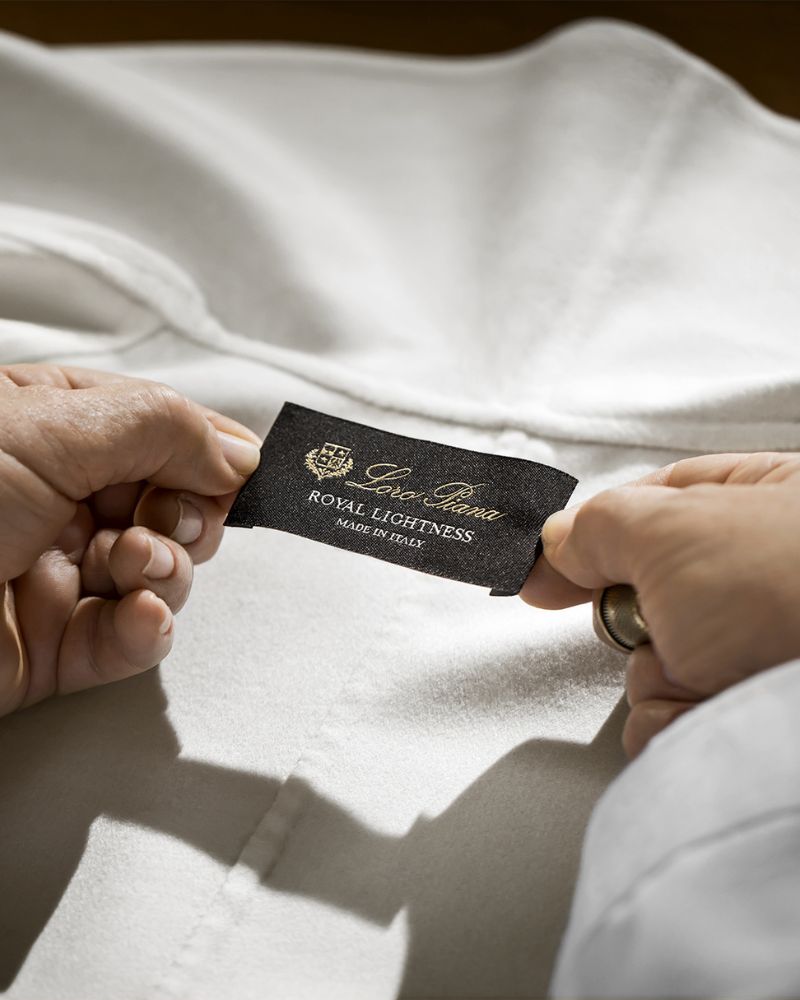
Loro Piana figured this out early and, as a result, built its entire strategy around it. Its logo is tiny, its stores are quiet and understated, and the brand does not seed celebrities with free products or pay influencers to post about it. Instead, it avoids limited-edition hype drops and viral streetwear collaborations altogether. Consequently, the brand has almost no presence in the kind of loud cultural conversation that dominates fashion media.
What it does instead is let the product do the talking. A Loro Piana cashmere coat costs several thousand euros and will last for decades. The person wearing it knows exactly what it is and what it cost. If you do not know, that is perfectly fine. In fact, that is the point. This is what fashion insiders call quiet luxury, which is essentially status dressing for people who find visible status slightly embarrassing.
The fibre obsession behind the €11 billion valuation
The Loro Piana marketing strategy would be completely meaningless without a product that genuinely justifies the price tag. This is where the brand gets truly interesting, even for people who have never spent €3,000 on a jumper and never plan to. Loro Piana’s entire business is built around sourcing the rarest natural fibres on the planet. Three of them are worth understanding in detail.
Vicuña is the crown jewel. Vicuña are wild animals that live in the Andes mountains of South America, and their fleece, measuring just 12 to 13 microns in diameter or roughly one fifth the width of a human hair, is considered the finest natural fibre in the world. For centuries, only Incan royalty were permitted to wear it. The animals were nearly hunted to extinction in the twentieth century, and today they can only be shorn during a once-a-year community event called the chaku, a traditional ceremony that dates back to the Incas. Loro Piana is among the world’s largest buyers of sustainably harvested vicuña, and a coat made from it can cost upwards of €30,000.
Baby Cashmere is not regular cashmere. It is combed from the underbelly of young Hircus goats in Mongolia and northern China, and the fibres measure under 13.5 microns. Only the very first combing of a young goat yields fibres fine enough to qualify, because after that the goat’s fleece becomes too coarse. The supply is therefore tiny, which is precisely why a Baby Cashmere sweater costs significantly more than a standard cashmere one.
The Gift of Kings is Loro Piana’s trademarked name for an ultra-fine merino wool, sourced through exclusive long-term partnerships with farmers in Australia and New Zealand. The wool is so fine that it feels more like silk than wool when you touch it.
What makes all of this commercially powerful is not just the rarity of the materials themselves. It is that Loro Piana controls the entire supply chain, from the source all the way to the finished garment. The brand is not buying these fibres on the open market and hoping for the best. Instead, it has invested in the farms, the relationships and, in some cases, the land itself to ensure a level of consistent quality that competitors simply cannot match. As a result, the Loro Piana marketing strategy is built as much on control and scarcity as it is on aesthetics.
The numbers that prove the Loro Piana marketing strategy works
Loro Piana reported revenue of €1.6 billion in 2024. Beyond that, market sources estimate the true run-rate is closer to €2.5 billion when all channels are counted, which would make it the third-largest brand inside LVMH’s fashion and leather goods division, sitting behind only Louis Vuitton and Dior. For a brand that does not advertise in any conventional sense, that is a remarkable position to occupy.
The valuation trajectory tells an even cleaner story. LVMH paid €2 billion for 80 percent of the company in 2013, implying a total enterprise value of €2.7 billion at the time. Bernard Arnault then confirmed at LVMH’s January 2026 results presentation that Loro Piana is now worth approximately €10 to €11 billion. Moreover, the brand’s annual profits today are reportedly at the same level as its total revenues when LVMH first bought in, meaning the profitability of the business has grown just as dramatically as the valuation. All of that growth happened with virtually no traditional advertising spend.
The mid-2020s also gave the strategy a significant cultural tailwind. HBO’s Succession, for example, essentially became an unofficial Loro Piana advertisement, because characters wore the brand specifically to signal that they were the kind of rich that does not need to prove anything. In turn, that only strengthened the Loro Piana marketing strategy further, making understatement itself feel aspirational.
What the “If You Know, You Know” exhibition reveals about how Loro Piana thinks
In 2024, to mark its centennial, Loro Piana did something that captures its entire worldview in a single gesture. Rather than staging a major runway show, it commissioned a book through Assouline that took nearly three years to complete, and mounted an exhibition at the Museum of Art Pudong in Shanghai.
The exhibition was called: “If You Know, You Know.”
That title is not accidental. It is a direct signal to a very specific kind of customer, namely the person who already understands what Loro Piana is, what its materials mean and why the absence of a logo is itself a statement of taste. The exhibition made the brand feel even more exclusive to anyone who stumbled across it.
This is a marketing approach that most brands would never dare attempt. You cannot build a business this way unless you have the product quality to back it up, the heritage to make it credible and the patience to grow slowly enough that exclusivity is never compromised. In many ways, that is the entire Loro Piana marketing strategy: sell less visibility, create more desire.
What comes next: Frédéric Arnault and the quiet luxury playbook under new leadership
In June 2025, Frédéric Arnault, who is Bernard Arnault’s youngest son and previously served as CEO of LVMH’s watch division, took over as CEO of Loro Piana. His appointment is significant on two levels.
First, it signals how seriously LVMH takes the brand’s long-term potential. Frédéric Arnault is one of the Arnault family’s most strategically placed next-generation leaders, and placing him at Loro Piana suggests the group sees it as a platform for substantial future growth rather than a brand to be maintained at its current size.
Second, and perhaps more importantly, his appointment raises the question of how that growth is managed without diluting what makes the brand worth growing in the first place. Frédéric Arnault’s tenure at TAG Heuer was defined by elevated positioning and a sharper brand identity. The question now is whether he can apply a similar logic to Loro Piana while still scaling the brand carefully and avoiding the kind of visibility that erodes exclusivity. After all, the Loro Piana marketing strategy has never been about becoming the loudest luxury brand in the room. Instead, it has always been about remaining the one insiders quietly recognise instantly.
For now, the Loro Piana marketing strategy remains one of the most fascinating case studies in modern business. In an industry that runs entirely on noise, that might be the most sophisticated move of all.
(Image credit: Loro Piana/Instagram)
FAQ
What is Loro Piana known for?
Loro Piana is an Italian luxury brand known for producing clothing and accessories made from the world’s rarest natural fibres, particularly vicuña, baby cashmere and ultra-fine merino wool. It is considered one of the defining brands of the quiet luxury movement.
Why is Loro Piana so expensive?
Loro Piana’s prices reflect the extraordinary rarity of its raw materials, the brand’s vertically integrated supply chain which it controls from fibre sourcing to finished garment, and decades of expertise in textile manufacturing. A vicuña coat, for example, can cost upwards of €30,000 because the fibre itself is among the rarest in the world.
Who owns Loro Piana?
Loro Piana is owned by LVMH, the French luxury conglomerate, which holds a 94 percent stake. The founding Loro Piana family retains the remaining 6 percent. Frédéric Arnault, son of LVMH chairman Bernard Arnault, became CEO in June 2025.