


In the hills above Rimini, on 520 hectares of vineyards, orchards, and ateliers, sits one of the most important workshops in the entire Italian luxury industry. It is called the San Patrignano Design Lab, and the people working inside it are 200 young people in active recovery. They work in the design lab’s wallpaper, textile, leather, and metalwork ateliers, learning a craft alongside their treatment. The work they produce is then commissioned by names like Chanel, Brunello Cucinelli, and Rocco Forte Hotels and the proceeds flow back into the community that is rebuilding their lives. That is the story of the San Patrignano wallpaper workshop.
Decoded properly, it is also one of the most meaningful case studies in luxury today.
So here’s what the San Patrignano wallpaper workshop actually is, which luxury brands and hotels it actually works with, and why this is the model the rest of the industry should be studying.
What the San Patrignano wallpaper workshop actually is
To understand the workshop, you first need to understand the community around it. San Patrignano was founded in 1978 by Vincenzo Muccioli in the countryside near Coriano, in Italy’s Emilia-Romagna region. Over the past 47 years, more than 26,000 people have completed the recovery programme, which makes San Patrignano the largest residential addiction treatment community in Europe.
The model is unusual with no therapists in the traditional sense, no substitute drug treatments, no 12-step programmes, and no religious framework. Instead, the community treats addiction as a problem to be resolved through work, dignity, and belonging. Residents stay for an average of three to four years, free of charge, and spend their time training in one of 52 different trades on the grounds.
The San Patrignano wallpaper workshop is one of the most celebrated of those trades. It began more than 30 years ago, when the legendary Italian architect and stage designer Renzo Mongiardino, often called the Architect of Illusion, agreed to work with the community on Muccioli’s own house.
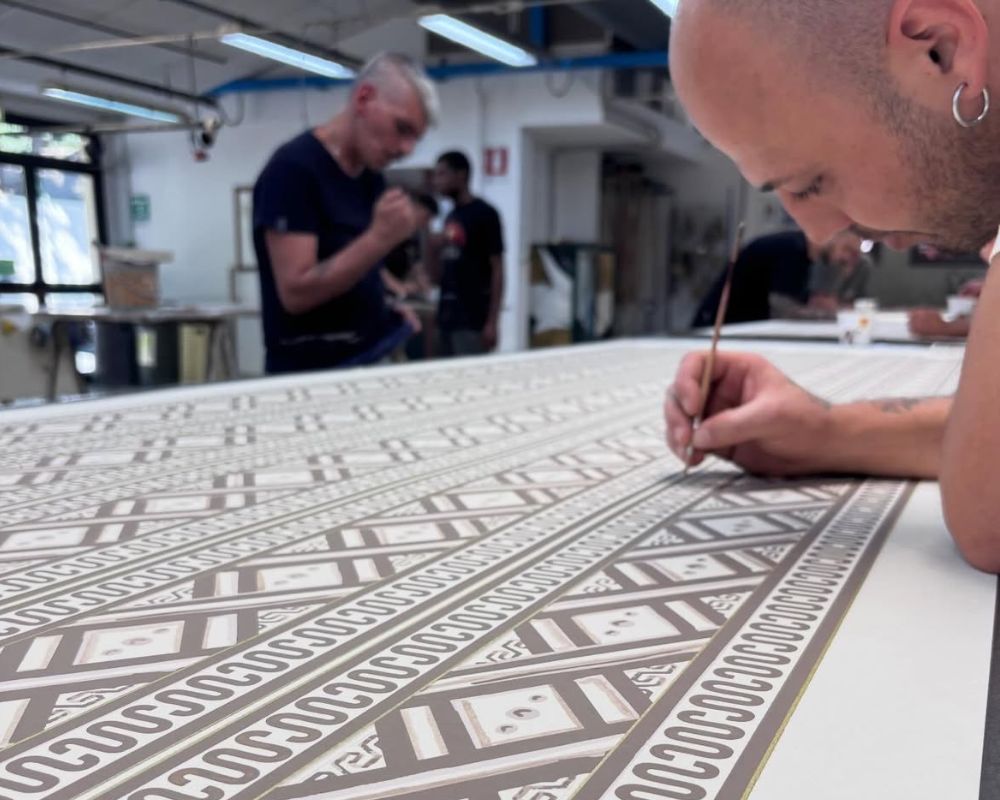
Mongiardino brought a stage designer’s love of trompe l’oeil and a deep archive of decorative techniques. Out of that collaboration, the wallpaper workshop was born. Today the atelier is led by Sandro, the master craftsman who trained directly with Mongiardino and who still oversees every project that leaves the studio. Every paper is entirely handmade. Some are silk-screened after curing, some are stencilled, and some are painted by hand from start to finish.
So the San Patrignano wallpaper workshop is a fully professional luxury atelier that has been trusted by Italy’s most demanding interior commissions for three decades.
Why luxury houses commission San Patrignano wallpaper
The luxury industry commissions San Patrignano for three reasons, and the order of those reasons matters. First, the craft itself is genuinely exceptional. The atelier specialises in techniques that have nearly disappeared elsewhere in Europe, including trompe l’oeil imitations of wood, marble, and semi-precious stones, hand-painted damasks, and bespoke decorative finishes built to brief. So when a luxury house or a five-star hotel wants something no other workshop can produce, San Patrignano is one of the very few options left.
Second, the work is fully customisable. Every project is produced to the specific brief of the commissioning brand or designer, which means a Chanel campaign, a Brunello Cucinelli boutique, or a Rocco Forte suite can have wallpaper that exists nowhere else in the world. So the San Patrignano wallpaper becomes part of the brand’s identity rather than a stock decorative element.
Third, the story behind the work elevates the product. When a luxury hotel commissions a hand-painted wallpaper made by recovering addicts working through a 47-year-old community model, the wallpaper carries meaning that no industrial substitute can offer. This is the rare luxury input where the human story behind the material genuinely matters, and where the more discerning client actively wants to know the provenance.
So the San Patrignano wallpaper workshop sits at a unique intersection of craft, customisation, and meaning. Few other ateliers in the world can credibly claim all three.
The verified luxury commissions for San Patrignano wallpaper and textiles
The San Patrignano workshops have built a client list that few independent ateliers can match. The community’s weaving and textile sector is commissioned regularly by Chanel, Brunello Cucinelli, Ferragamo, and Ermenegildo Zegna, with the work ranging from hand-stitched garments to bespoke fabrics and decorative pieces. The wallpaper workshop has separately produced pieces for Rocco Forte Hotels, which has confirmed on its own sustainability page that San Patrignano residents hand-painted and printed wallpapers, made bedspreads, and crafted wooden furniture across multiple Rocco Forte properties.
The atelier has also worked on commissions for the contemporary artist Jeff Koons, who commissioned hundreds of metres of hand-painted wallpaper for his New York penthouse, and for Bethany Williams, the London College of Fashion designer whose sustainable collection was produced in collaboration with the community. The London-based interior design firm Paolo Moschino Ltd. now stocks an exclusive Mongiardino Boiserie Collection of nine hand-painted wallpapers produced in partnership with San Patrignano, which means the workshop’s pieces are also available through the broader UK and European interior design market.
So the client list is a steady, multi-decade pattern of luxury houses, hotels, designers, and artists choosing San Patrignano specifically because the craft and the story together are genuinely irreplaceable.
How the San Patrignano wallpaper proceeds support recovery
The financial model is the part that most readers find most moving when they first encounter the story. San Patrignano offers its rehabilitation programme to residents completely free of charge. There is no fee for treatment, no fee for housing, and no fee for the years of training and care a resident receives during recovery. The community’s running costs are met through a combination of two sources. The first is the revenue generated by the workshops, the vineyards, the bakery, the dairy, the wine production, the leather and textile ateliers, and the wallpaper studio itself. The second is donations from private supporters and partners who believe in the model.
According to San Patrignano’s own public materials, the production activities meet roughly 50 percent of the community’s operating needs. So when Chanel commissions a piece of textile work, or Rocco Forte commissions a custom wallpaper for a hotel suite, or Brunello Cucinelli commissions a craft project, the proceeds flow back into the community that gives the residents their recovery. The model is therefore not is a dignity model. Residents are asked to contribute work of genuine professional value, and that work is what funds the community that supports them.
This is the part of the San Patrignano wallpaper story that the luxury industry should sit with the longest. Because what this community has built is essentially a working alternative to the typical “luxury versus social impact” tension that dominates most ESG conversations. At San Patrignano, the craftsmanship and the recovery are the same activity.
What the San Patrignano wallpaper workshop tells us about the future of luxury
Step back, and the strategic decode is sharp. The luxury industry spends enormous amounts of money on sustainability reports, certification programmes, and corporate social responsibility communications. Most of those efforts are sincere, and a few are genuinely effective. But almost none of them produce the kind of compounding human transformation that one wallpaper workshop in the hills above Rimini has produced for 30 years. So the San Patrignano wallpaper model is a case study in a deeper kind of impact, where the act of making the luxury product is itself the social good.
The implications for the rest of the industry are significant. If a hand-painted wallpaper studio can rebuild lives at scale, then other luxury supply chain partners can do the same. Leather workshops can train at-risk youth, embroidery ateliers can employ refugees and stone-cutting studios can integrate prison rehabilitation programmes. The model is genuinely replicable, and The Pillar Edit believes the houses that take this seriously over the next decade will build the most defensible brand equity in the industry.
So the next time you see a hand-painted wallpaper in a Chanel campaign image, or stay in a Rocco Forte suite with intricate decorative walls, or walk into a Brunello Cucinelli space that feels warmer than the average luxury boutique, pay attention to where the work came from. There is a chance, a meaningful one, that it was made by hands that were rebuilding themselves at the same time as they were rebuilding a wall.
Read next: Inside Brunello Cucinelli’s humanistic capitalism, the philosophy behind a $7.8 billion luxury empire, because the same dignity-first principles that built Cucinelli’s empire are the principles that built the San Patrignano wallpaper workshop, and the same principles will define the next decade of luxury.
(Image source: wallpaper_sanpatrignano/Instagram)
FAQ
What is the San Patrignano wallpaper workshop?
The San Patrignano wallpaper workshop is part of the San Patrignano Design Lab, the artisan arm of the largest residential addiction recovery community in Europe. Located on the community’s 520-hectare campus near Coriano in Italy’s Emilia-Romagna region, the workshop has been hand-producing decorative wallpapers for more than 30 years. The atelier is led by master craftsman Sandro, who trained directly with the Italian architect Renzo Mongiardino, the workshop’s original collaborator.
Which luxury brands commission San Patrignano wallpaper and textiles?
The San Patrignano workshops are commissioned by Chanel, Brunello Cucinelli, Ferragamo, and Ermenegildo Zegna for textiles, and by Rocco Forte Hotels for hand-painted wallpapers, bedspreads, and wooden furniture. The workshop has also produced commissions for the contemporary artist Jeff Koons and the designer Bethany Williams, and partners with the London-based interior design firm Paolo Moschino Ltd. on the exclusive Mongiardino Boiserie Collection.
How does the San Patrignano wallpaper workshop support recovery?
The San Patrignano rehabilitation programme is provided completely free of charge to all residents. The community’s running costs are met through a combination of revenue from its workshops (including the wallpaper studio, textiles, leather, vineyards, bakery, dairy, and wine production) and private donations. According to the community’s public materials, the production activities meet roughly 50 percent of the operating needs, with donations covering the remainder.