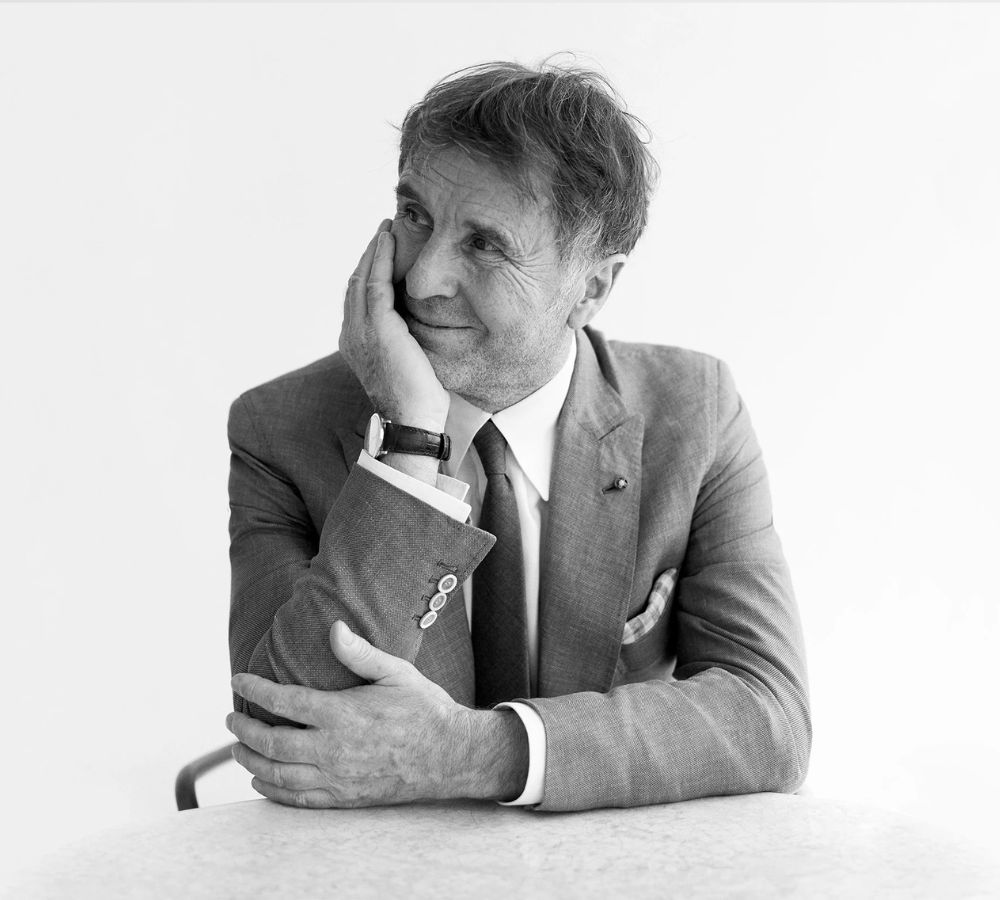





The Brunello Cucinelli Humanistic Capitalism philosophy is what happens when a $7.8 billion luxury house decides that dignity matters more than overtime.
In luxury, late nights are often treated as part of the job description. Atelier teams work until midnight before a show, marketing teams answer emails on Sundays, and founders post from yachts at 2 AM. So when I learned that one of Italy’s most successful luxury houses sends every employee home at 5:30 PM and forbids work beyond that hour, I assumed it must be a small operation that the rest of the industry had long since outpaced.
Turns out, the reality is quite the opposite. The brand is Brunello Cucinelli. Its market capitalisation stands at roughly $7.8 billion, and its founder has built the company around a philosophy he calls Humanistic Capitalism. Within that framework, the 5:30 PM rule is the clearest expression of the company’s philosophy, a principle that informs every aspect of the business.
What follows is how it works, why it works, and why Oscar-winning director Giuseppe Tornatore has just released a film about the Brunello Cucinelli Humanistic Capitalism philosophy the world is about to see.
What Brunello Cucinelli Humanistic Capitalism philosophy actually means
In simple terms, Brunello Cucinelli Humanistic Capitalism is a philosophy rests on five interconnected ideas: fair profit, giving back, stewardship, human dignity and truth. He has spent more than four decades refining and advocating this framework, even presenting it to G20 leaders in 2021. So when I hear him describe it as “a great harmony within which profit, giving back, guardianship, human dignity and the ethics of truth coexist and enrich each other,” it feels less like corporate rhetoric and more like the culmination of a philosophy he has been building since founding the company in 1978.
What makes the idea compelling is its practical application. Inside the company, Brunello Cucinelli Humanistic Capitalism philosophy translates into wages that are reportedly around 20 percent higher than the industry average, a workday that ends firmly at 5:30 PM, a culture that discourages employees from carrying work into their evenings, and sustained investment in Solomeo, the medieval Umbrian village that Cucinelli has spent decades restoring.
Rather than existing as an abstract set of principles, it is embedded in a series of deliberate operational choices, many of which remain rare in the luxury industry.
How the numbers validate Brunello Cucinelli Humanistic Capitalism philosophy
What makes the story remarkable is that most companies that champion dignity, work-life balance and employee wellbeing are often perceived as making a trade-off with growth. Brunello Cucinelli has managed to challenge that assumption. The company has expanded at an extraordinary pace, commands a market capitalisation of roughly $7.8 billion, and has elevated its founder into one of Italy’s most influential business voices, admired by everyone from Hollywood celebrities to Silicon Valley executives.
The numbers tell a compelling story. Brunello Cucinelli Humanistic Capitalism philosophy has evolved into one of the luxury sector’s most successful business models, built on principles that conventional wisdom has long suggested would hinder growth: fair wages, restrained working hours, respect for human dignity and sustained investment in community. Yet the company’s performance points in the opposite direction. Rather than limiting ambition, these values appear to have strengthened the brand’s long-term resilience, creating a business that is both ethically grounded and commercially formidable.
Solomeo: Where Brunello Cucinelli Humanistic Capitalism philosophy comes to life
A fair question is whether any of this is genuine or simply an exceptionally well-crafted brand narrative. The answer, I think, lies in a small Umbrian village called Solomeo.
As a child, Brunello Cucinelli watched his father return home each evening from factory work. What stayed with him was not the physical exhaustion or the modest pay, but the humiliation. Years later, Cucinelli would recall the pain of seeing a good man made to feel small by his work. That memory never left him. Instead, it became the foundation upon which he built his company.
When success arrived, he did something few entrepreneurs would consider. Rather than creating a gleaming corporate campus or relocating to a financial capital, he invested in restoring Solomeo, a medieval village perched among the Umbrian hills. What emerged was far more than a headquarters. It was a physical expression of the values he had spent decades talking about: dignity, beauty, culture and respect for human beings.
Walk through Solomeo today and you find a village brought back to life. There is a theatre filled with music and conversation, schools dedicated to preserving craftsmanship, libraries, academies, foundations and public spaces designed to be enjoyed rather than merely admired. The surrounding countryside has been carefully restored with vineyards, olive groves, orchards and wheat fields, creating a landscape that feels less like a corporate estate and more like a community reclaiming its soul.
That, perhaps, is what makes the story compelling. Solomeo exists first and foremost as a place for people. It is where employees come to work each day, where ideas are shaped, garments are created and livelihoods are sustained. In a luxury industry often associated with spectacle, Solomeo feels unusually sincere: proof that businesses can create value beyond products, leaving behind places that enrich the lives of those who inhabit them.
The Tornatore documentary bringing Brunello Cucinelli Humanistic Capitalism philosophy to the world stage
The news hook that makes this story urgent right now is that Oscar-winning director Giuseppe Tornatore (Cinema Paradiso, Ennio) released a feature-length docufilm titled “Brunello: The Gracious Visionary,” which is his follow-up to the acclaimed Ennio Morricone documentary and which pairs him with another Oscar winner, composer Nicola Piovani (Life Is Beautiful), to chronicle Cucinelli’s rise from being a farmer’s son to becoming one of the most influential figures in Italian luxury.
The film has already had a remarkable run, having premiered at Rome’s Cinecittà Studios and at Lincoln Center in New York, after which Tornatore received the Golden Globes Prize for Documentary at Italy’s Taormina Film Festival, with Cucinelli accepting on his behalf in the ancient Greek amphitheatre in the shadow of Mt. Etna. The film then opened the Shanghai International Film Festival earlier this month, and on July 24, 2026, it will be released theatrically in the United States, Canada, the United Kingdom, and Ireland, with more than a dozen international territories to follow.
The film uses a hybrid format that combines documentary footage and interviews with reenacted scenes in which the young Cucinelli is played by Saul Nanni, which means audiences will get both the practical story of Brunello Cucinelli Humanistic Capitalism philosophy and the personal arc of the man who built it. Cucinelli has insisted that his own voice never be dubbed in any of the sixteen language versions, because “we will miss out on some of the narrative nuances,” and so the world is about to spend two hours with this idea, which makes the timing of any decoder piece particularly significant.
From Solomeo to the world: the Tornatore documentary showcasing Brunello Cucinelli’s Humanistic Capitalism
When you step back, the lesson Brunello Cucinelli Humanistic Capitalism philosophy offers the rest of the industry is sharper than most coverage of the brand suggests. The luxury sector in 2026 is in a soft-growth phase, with Q1 results from LVMH, Kering, and even Hermès underwhelming analysts, Gen Z aspirational buyers pulling back, and the post-pandemic luxury supercycle having formally ended. Every major house is therefore now asking the same question, which is how to grow when the standard playbook has stopped working.
Cucinelli’s answer is deceptively simple: stop optimising for the next quarter and start building for the next century. Pay people with dignity, give them their evenings back, invest in the community that makes the work possible, build a brand on truth rather than aspiration and then step aside and allow those choices to compound over generations.
In a world obsessed with speed, Solomeo offers a different idea: that the most enduring businesses are built slowly, with patience, respect and an unwavering belief that people matter as much as profit.
There is one story that Brunello Cucinelli returns to repeatedly. His father would come home from the factory and rarely complain about the wages or the cold. What troubled him most was the loss of dignity. As Cucinelli has recalled: “He would never complain about his wages or the fact that it was cold in the factory; what he did complain about was that he was being belittled. That really killed me. You see, human beings need dignity even more than they need bread.”
That single belief became the foundation of everything that followed. It shaped the culture of a company, the restoration of a village and a business philosophy that places human dignity alongside profit rather than in opposition to it.
As the luxury industry enters a new chapter, Brunello Cucinelli Humanistic Capitalism philosophy stands out as a powerful reminder that enduring success is built on more than products and profits. In Solomeo, dignity, craftsmanship, community and performance exist in harmony, offering a vision of business that is as sustainable as it is successful.
Read next: From Birkin to Lady Dior: meet the firms that actually make your bag’s leather, because the supply chain Cucinelli has refused to outsource is the same one most other houses have spent decades trying to control.
(Image credit: brunellocucinelli.com)
FAQ
What is Brunello Cucinelli humanistic capitalism?
Brunello Cucinelli humanistic capitalism is a business philosophy developed by Italian luxury designer Brunello Cucinelli over more than four decades. It is built on five interrelated principles: fair profit, giving back, guardianship of the past, human dignity, and the ethics of truth. In practice, it shows up as wages roughly twenty percent above industry average, a workday that ends immovably at 5:30 PM, a refusal to allow after-hours work, and ongoing investment in the medieval Umbrian village of Solomeo.
How does Brunello Cucinelli treat its employees?
Cucinelli pays his employees wages that are roughly twenty percent higher than the industry average for the same roles, the workday ends at 5:30 PM, and workers are not allowed to take their jobs home in the evenings. The company has also run initiatives like Solomeo Togetherness, a programme that brought roughly 600 employees from around the world to the Italian headquarters after the pandemic to reaffirm the company’s values.
Where is Solomeo, and why is it important to Brunello Cucinelli?
Solomeo is a 14th-century medieval village in the Umbrian countryside of Italy, not far from Assisi. Cucinelli bought the village in the early years of his company and has spent decades restoring it, and it now houses the company’s headquarters, the School of Arts and Crafts, a Palladio-style theatre, the Universal Library, the Foro delle Arti, the Aurelian Neohumanistic Academy, the Brunello and Federica Cucinelli Foundation, and the surrounding “Project for Beauty” park system.
What is the Tornatore documentary about Brunello Cucinelli?
Brunello: The Gracious Visionary is a feature-length docufilm by Oscar-winning director Giuseppe Tornatore, which chronicles Cucinelli’s rise from being a farmer’s son in Umbria to becoming the creative director and executive chairman of a luxury brand with a market capitalisation of around 7.8 billion dollars. It premiered at Rome’s Cinecittà Studios and Lincoln Center in New York, received the Golden Globes Prize for Documentary at the Taormina Film Festival, opened the Shanghai International Film Festival in 2026, and will be released theatrically on July 24, 2026 in the United States, Canada, the United Kingdom, and Ireland.