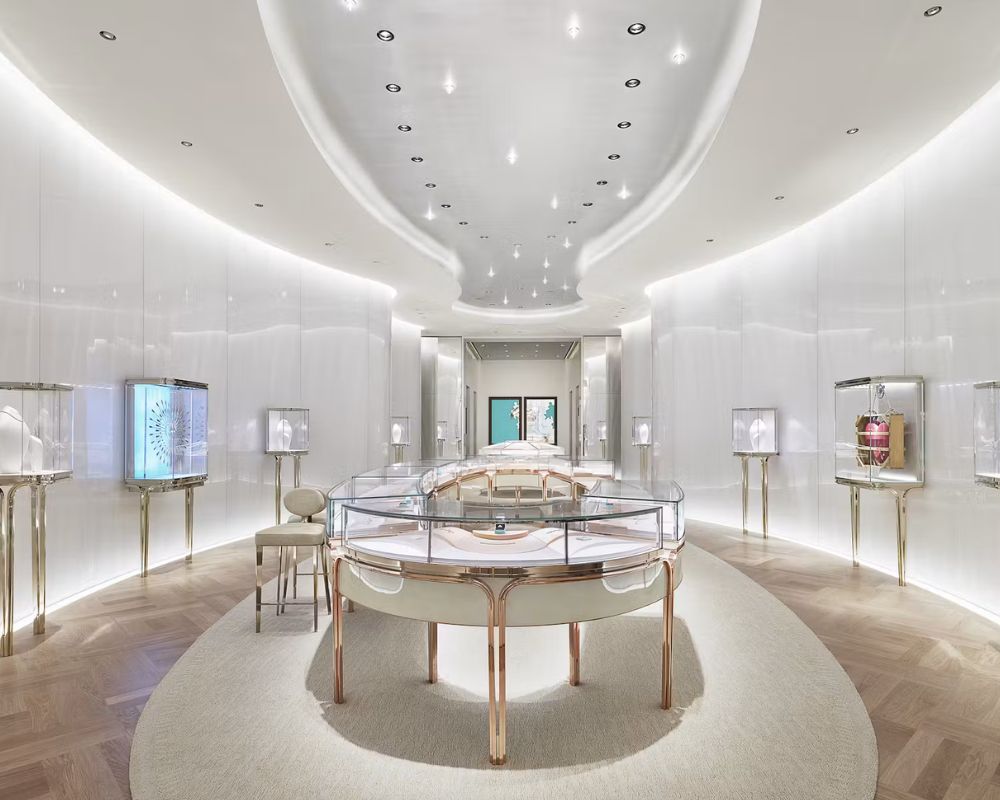

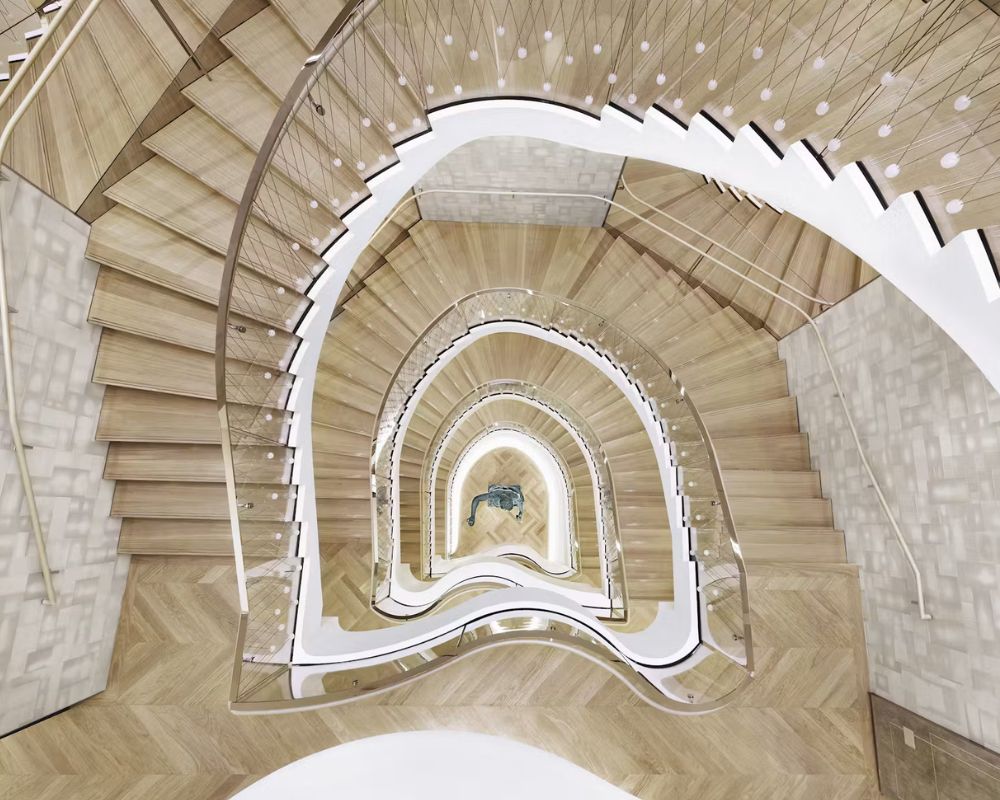
There is a Jean-Michel Basquiat painting above the elevators at Tiffany’s Fifth Avenue flagship, and it is genuinely the real thing: Equals Pi, rendered in Tiffany Blue, greeting every client who walks into what the brand now calls The Landmark before they have looked at a single piece of jewellery. On the staircase, there is a Daniel Arsham sculpture. On floors eight and nine, there is a dedicated museum with a rotating programme of storytelling exhibitions.
In February 2026, Tiffany opened the Culture of Creativity exhibition there, featuring nearly 70 works by 26 artists including pieces that had been kept from public view until that moment. In April 2026, the Hidden Garden high jewellery collection from the 2026 Blue Book launched at The Landmark before it launched anywhere else on earth.
This is the Tiffany Landmark New York model in action, and it is one of the most commercially deliberate moves in luxury retail right now. The question worth asking about what the Tiffany Landmark in New York represents is whether its extraordinary scale is designed to achieve commercially, and why LVMH, having acquired Tiffany & Co. for $15.8 billion in January 2021, chose to invest so heavily in a physical retail experience at a time when luxury’s biggest conversations revolve around digital transformation and e-commerce growth.
A Basquiat, a Boulud restaurant and a dedicated museum: what Tiffany put on all ten floors
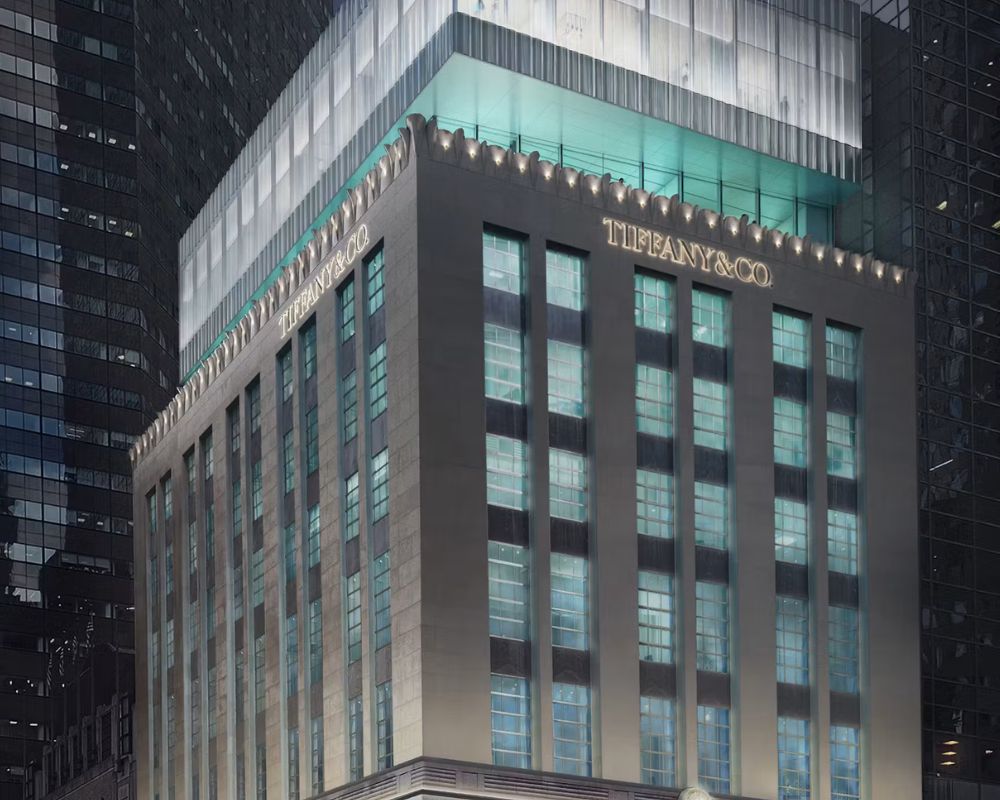
The Tiffany Landmark New York is the clearest expression of this strategy available and the building that makes the commercial argument most explicitly. The redesign, the first holistic renovation of the store since it opened in 1940, was led by architect Peter Marino, who reimagined the interior architecture across ten floors, and OMA New York, led by Shohei Shigematsu, who spearheaded the renovation of the building’s core and circulation infrastructure and added a new three-story glass volume above the existing building. The result is now one of the largest stores in Manhattan, and it operates on a fundamentally different commercial logic from any conventional luxury retail space.
The Landmark integrates nearly 40 artworks across its ten floors, including Tiffany-commissioned pieces shown for the first time. It houses a dedicated museum and exhibition spaces on floors eight and nine that offer what the brand describes as a rotation of compelling concepts and unique storytelling experiences. It has a Blue Box Café on its own floor with 61 seats, serving sweet delights developed by Michelin-starred chef Daniel Boulud. It has a high jewellery workshop where clients can observe and commission the craft behind the product. And above the elevators, the Basquiat announces immediately and unambiguously that this is a building where art and commerce are operating on equal terms.
Anthony Ledru, President and Chief Executive Officer of Tiffany, described the Tiffany Landmark New York with a precision that reveals exactly what this strategy is designed to achieve. The Landmark is the Foreign Office, he said, and this is where everything starts, with Tiffany’s global stores functioning as embassies that carry what The Landmark generates outward into every other market. The Landmark is where the brand’s authority is created and where its cultural position is established, and that authority then radiates outward to every other Tiffany address in the world.
Five stores, five cities, one Dutch architecture firm: the global design strategy nobody is talking about
This philosophy is most legible inside the Tiffany Landmark New York, but it is most visible globally through the ongoing architectural collaboration with Dutch studio MVRDV, which has now designed five consecutive flagship facades for Tiffany across some of the most significant luxury retail addresses in the world.
While the Tiffany Landmark New York remains the origin point of the whole model, the Beijing flagship in Taikoo-Li Sanlitun, which opened in January 2026, is the fifth and most technically ambitious of the MVRDV collaborations. Its 20-metre-high facade is crafted from curving, translucent, frosted glass fins in a blue hue calibrated specifically to Tiffany’s signature colour. The design was inspired by the Bone Cuff, one of the most iconic pieces created by jewellery designer Elsa Peretti for the brand, with the fluid, organic curves of the facade translating the sculptural language of a piece of jewellery into an architectural scale that reshapes an entire city block.
MVRDV founding partner Jacob van Rijs described the effect: when viewed from an angle, the layering effect of the dense glass fins amplifies the light and highlights the facade’s shape. The light filtering through and reflecting off the translucent glass creates a delicate interplay that is constantly changing as one moves past the building. At night, integrated lighting modules illuminate the glass from within, transforming the building into what MVRDV describes as a radiant Tiffany Blue lantern.
The facade is also fully demountable, with the individual glass fins and brackets designed to be easily removed and repurposed at the end of their useful lifespan, making this one of the most sustainability-conscious pieces of luxury retail architecture built at this scale in 2026. Across five buildings in five cities, from Singapore and Shanghai to Stuttgart and now Beijing, the MVRDV collaboration has accumulated into something far more significant than a series of store designs.
Why a store with a Basquiat above the elevators is winning
Luxury brands are facing a structural challenge in physical retail: the aspirational consumer who once drove footfall through flagship stores has been priced out of the market, with the total number of luxury shoppers globally contracting from 400 million in 2022 to approximately 340 million in 2026. The consumer who remains is older, wealthier and far more demanding about what a physical retail experience has to offer beyond anything a digital one can provide.
The museum store model is the most direct available response to that challenge. A client who visits The Landmark to see the Culture of Creativity exhibition, to have lunch at the Blue Box Café and to walk past a Basquiat on the way to look at high jewellery is having an experience that stands entirely apart from any digital equivalent. The dwell time is longer and the emotional investment is deeper.
Anthony Ledru articulated this with characteristic precision when he described artistry as luxury’s highest level of differentiation in a recent interview with WWD China. At the Tiffany Landmark New York, artistry means creating experiences with cultural weight rather than simply commercial function. A store that houses a Basquiat, a Boulud restaurant and a museum-grade exhibition programme has moved beyond competing with e-commerce and is instead competing with cultural institutions themselves.
Louis Vuitton and Dior are moving beyond retail, and Tiffany has made it the centrepiece
The Tiffany Landmark New York model is significant beyond Tiffany itself because it represents the clearest and most fully realised version of a direction that every major luxury brand is being pulled toward by the same commercial logic. Loewe has its Casa Loewe spaces with rotating art installations. Louis Vuitton has its Fondation Louis Vuitton in Paris and art-integrated flagships globally. Dior has its dedicated museum in Granville. But the Tiffany Landmark New York has done something that few others have managed at this scale: it has made the museum-quality cultural experience the central feature of its flagship retail operation rather than an adjacent one.
The difference between these two approaches matters commercially. A brand foundation or standalone museum sits alongside the retail business. Tiffany has done something much more interesting: it has brought culture right into the store. Art runs through the shopping floors, there’s a Michelin-starred restaurant, and the museum sits above the jewellery rather than somewhere next door. The message is simple: the product is worth its price because the world around it is too. The five MVRDV facades taking the Tiffany Landmark New York concept around the world take this idea even further. The building itself becomes the first piece of design the client encounters. When the exterior is a sculptural object inspired by an Elsa Peretti jewellery piece, the jewellery inside enters a world that already feels designed, considered and culturally significant.Foreign offices and embassies: Tiffany’s long game in architecture
What the Tiffany Landmark New York programme has produced is something genuinely difficult for competitors to replicate quickly: a global network of physical retail spaces that function simultaneously as cultural destinations, luxury hospitality venues, architectural landmarks and commercial environments. The Tiffany Landmark New York is the Foreign Office, the origin point of the brand’s cultural authority. The MVRDV facades in Beijing, Shanghai, Singapore and Stuttgart are the embassies, each one carrying the same brand DNA into a different cultural context through a piece of architecture specific to its location and its moment.
The commercial logic underneath all of this is elegant in its simplicity, even if the execution is extraordinarily ambitious and genuinely difficult to replicate. In a market where the most valuable luxury consumers are increasingly choosing experience over acquisition, the brand that builds a Tiffany Landmark New York, that makes its flagship the most compelling cultural destination available, wins both the relationship and the transaction.
With the Basquiat above the elevators at the Tiffany Landmark New York and MVRDV’s Tiffany Blue lantern lighting up a Beijing crossroads at night, Tiffany is making a bold bet: that turning the flagship into a cultural destination may be one of the strongest positions luxury retail can take in 2026. So far, the strategy looks compelling. The Tiffany store museum model has become one of the clearest examples of how a physical flagship can do far more than sell products when culture, architecture and commerce are designed to work as one.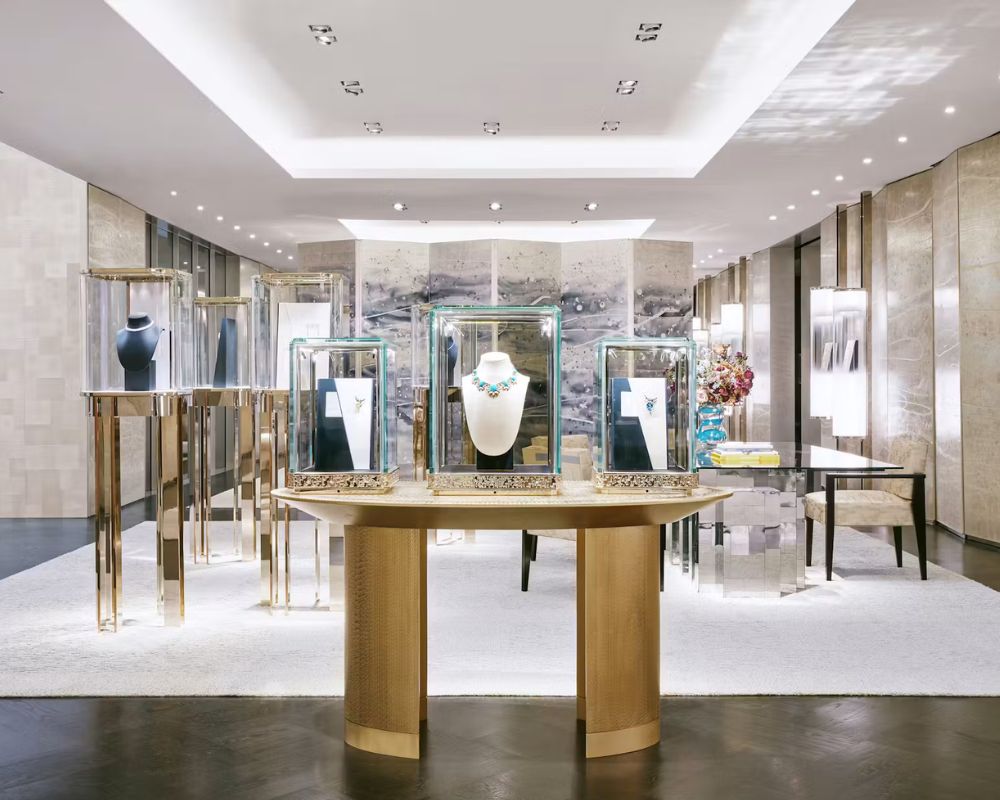
Read next: If the Tiffany Landmark New York tells us where the brand is going creatively and commercially, the numbers behind why Tiffany is the most searched luxury brand of 2026 tell us exactly how far it has already come and why the world is paying attention.
(Image credit: lvmh.com)