



So, there I was, huddled over my laptop with an iced latte, logging into another module of the Inside LVMH/Certificate program. To be completely honest, I was fully prepared for some standard, corporate-speak slides on “sustainability metrics” and “carbon neutrality by 2030.” Instead, a statistics popped up on my screen that completely stopped my scrolling: 8 million metric tons of plastic dump into our oceans every single year. Not exactly the eco-luxury fashion mic-drop moment I was expecting on a Friday afternoon.
But then came the plot twist. The behind-the-scenes footage of the Dior x Parley for the Oceans capsule. Even through a pixelated screen, I could see the way the beachwear fabric caught the light. When they explained how they actually felt in person, liquid heaven, cool to the touch, with that unmistakable, heavy drape usually reserved for raw Italian silk, I looked down at my own synthetic athleisure and had a total epiphany.
It was upcycled marine trash. They had literally taken the fishing nets killing the reefs and spun them into a high-fashion textile. It hit me right then, staring at my browser window: the future of eco-luxury isn’t about wearing a scratchy burlap sack to prove you care. It’s a full-blown Material Revolution, and it’s happening right on our screens.
What eco-luxury fashion actually means
Eco-luxury fashion is not a mood board or a green logo on a shopping bag. It is the technically demanding process of engineering materials and supply chains that actively reduce environmental harm, without compromising the aesthetic standards that luxury consumers pay for. That distinction matters, because for the past decade, the fashion industry has been drowning in greenwashing. In 2023, the European Commission found that 53% of green claims made by fashion brands were vague, misleading, or completely unsubstantiated. This is precisely why the Dior x Parley collaboration deserves a case study of its own. It does not simply claim to be sustainable. It shows its working.
The origin story: when haute couture met the high seas
Who is Parley for the Oceans?
Founded in 2012 by Cyrill Gutberlet, Parley for the Oceans is built around one central insight: the ocean plastic crisis is a design flaw. Plastic was engineered to last forever in applications used for seconds. Parley’s answer is its AIR Strategy, Avoid, Intercept, Redesign. Avoid eliminates virgin plastic at source. Intercept means physically collecting marine debris from coastlines and remote islands before it breaks down into microplastics. Redesign engineers that intercepted material into a high-performance alternative to conventional synthetic fibres. To date, Parley has worked with over 40 island nations, intercepting and upcycling the equivalent of over one billion plastic bottles, with partners including Adidas producing over 30 million pairs of shoes from Parley Ocean Plastic between 2016 and 2022.
How the Dior x Parley collaboration came to life
The partnership did not emerge from a marketing brief. It grew from Christian Dior’s own foundational relationship with the natural world. Monsieur Dior famously said that after women, flowers are the most divine of all creations, and the House has maintained a nature-referencing archive of embroideries and silhouettes since 1947. Maria Grazia Chiuri deepened that connection by weaving environmental consciousness into Dior’s creative identity. The first capsule launched in 2021, comprising swimwear, cover-ups, tote bags, and ready-to-wear, produced using Parley Ocean Plastic yarn woven and finished to Dior’s atelier-grade specifications. Subsequent seasons expanded the range and deepened the technical collaboration, which is an achievement that should not be underestimated given how demanding luxury textile production actually is.
Shop the eco-luxury fashion collection here.
Inside the material: how ocean plastic becomes Dior fabric
The Parley Ocean Plastic process
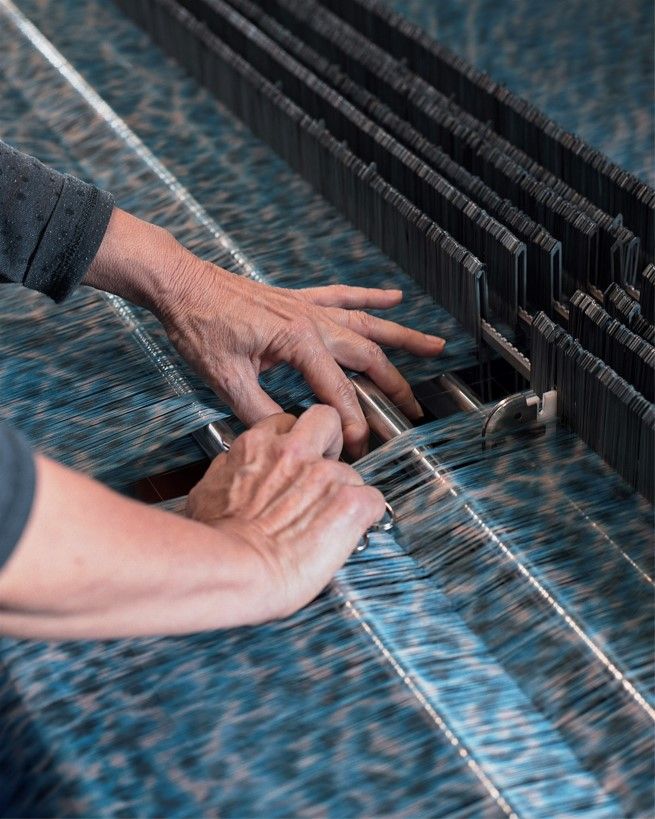
The process begins with collection. Parley’s community partners across the Maldives, Haiti, and Chile intercept plastic waste before it degrades beyond material use, targeting high-density polyethylene from fishing nets and hard plastic debris. That plastic is cleaned, sorted, mechanically processed into pellets, and spun into a yarn technically comparable to virgin nylon, but with a verified chain of custody from ocean source to finished fibre. From a performance standpoint, the yarn meets luxury swimwear requirements across UV resistance, chlorine resistance, stretch retention, and colourfastness. Crucially, it accepts Dior’s high-fidelity print processes and embellishment techniques.
The data behind the crisis driving eco-luxury fashion forward
The ocean plastic crisis is not a future problem. According to research published in the journal Science, approximately 11 million metric tonnes of plastic enter the world’s oceans each year, up sharply from the 8 million tonne figure cited in the mid-2010s, and projected to triple by 2040 without systemic intervention. Abandoned fishing gear alone accounts for roughly 46% of the mass of the Great Pacific Garbage Patch, according to a 2018 study in Scientific Reports, trapping and killing an estimated 136,000 marine mammals annually. Meanwhile, synthetic textiles shed approximately 500,000 tonnes of microplastic fibres into waterways each year through domestic washing, according to the IUCN, and the fashion industry as a whole accounts for roughly 10% of annual global carbon emissions.
The greenwashing question
I want to be direct here, because most eco-luxury fashion coverage avoids this section and it should not be. Dior is owned by LVMH, which posted 2025 revenues of €80.8 billion, down 5% on the prior year but still the world’s largest luxury conglomerate by a significant margin. The Dior x Parley capsule represents a fraction of Dior’s total output. The wider business continues producing conventional synthetic fabrics within a model predicated on seasonal volume.
However, LVMH’s LIFE 360 environmental strategy sets legally disclosed, time-bound targets across biodiversity, climate, and traceability, audited by third parties. The Parley collaboration sits within that framework, not as a standalone publicity exercise. Furthermore, the fabric development involved genuine R&D investment that goes well beyond a marketing swing tag. The partnership has also scaled and deepened across multiple seasons rather than appearing once for a press cycle. Is it enough? Not yet. But it is materially different from a green logo on tissue paper.
What this means for fashion’s future
By 2026, the EU Green Claims Directive makes greenwashing legally expensive, and by 2030, everything sold in Europe needs to be durable, repairable, and recyclable. So the standard Dior x Parley already operates at is not the gold star anymore. It is about to be the bare minimum. Add to that a generation of consumers who grew up watching Blue Planet II and are now the ones with the credit cards, and you start to see where eco-luxury fashion is heading. The material revolution is not a trend cycle you can sit out. It is already here, woven into a resort cover-up, catching the light on a runway in Paris.
A closing thought
I finished that LVMH module, closed my laptop, and sat with my iced latte for a long minute. I looked down at my leggings, still very much synthetic, still very much not ocean plastic, and felt the particular discomfort of someone who has just learned something they cannot unlearn. That is, I think, exactly the point. The Dior x Parley story is not asking you to throw out your wardrobe or suddenly afford a resort capsule that costs more than a flight to the Maldives. It is asking you to raise your standard for what a good reason looks like. Because if a house that has been hand-embroidering silk since 1947 can look at a ghost net rotting on a reef and see fabric worth wearing, the rest of the industry has absolutely no excuse. Neither, frankly, do the rest of us.
Until next time, keep it conscious, keep it considered.
(Image source: Christian Dior)
FAQ
What is the Dior x Parley for the Oceans collaboration?
A luxury fashion partnership that transforms intercepted marine plastic waste, primarily discarded fishing nets and ocean debris, into high-performance, couture-grade textiles. The collection launched in 2021 and has continued across multiple seasons under Dior Creative Director Maria Grazia Chiuri.
What is Parley Ocean Plastic?
A yarn and material system developed from plastic waste intercepted from coastlines and marine environments using Parley’s AIR (Avoid, Intercept, Redesign) strategy. It meets performance standards equivalent to virgin nylon and polyester across UV resistance, stretch retention, and colourfastness.
Is the Dior x Parley collaboration greenwashing?
More credible than most eco-luxury fashion claims because its material provenance is specific, auditable, and verifiable through a documented chain of custody. It operates within LVMH’s LIFE 360 environmental strategy with third-party auditing. Legitimate criticism remains around capsule scale relative to total output, but the technical rigour of the material development distinguishes it from purely cosmetic sustainability claims.