



For ten years, the Birkin resale price was the single most reliable line in luxury. You bought one at boutique, you carried it, you sold it at auction for almost double, and you walked away. So the bag became less an accessory and more a private currency, with collectors trading it the way watch enthusiasts trade Rolex sport models or Patek Philippe references. Now the math has changed.
The Birkin resale price has softened for the first time in a decade, and according to according to Bernstein Research’s Secondhand Pricing Tracker, which tracks auction resale premiums for Hermès Birkin and Kelly bags relative to their original retail prices, average resale premiums have fallen from 2.2x retail in 2022 to 1.4x in late 2025. So, a Birkin that once doubled in three years now adds closer to forty percent. That is still extraordinary by any handbag standard but it is not what the market got used to.
We got you the decoder model by model, leather by leather, with the real numbers and what is actually driving them in 2026.
Where the Birkin resale price actually sits in 2026
First, let us address the headline. Hermès raised retail prices again in January 2026. So before we get into resale, here are the boutique starting points to anchor the math against. A Birkin 25 in Togo leather now retails for 13,500 US dollars in the United States, the Birkin 30 for 14,900, the Birkin 35 for 16,300, and the Birkin 40 for 20,300. In Europe, the same bags are roughly 25 percent cheaper, which is why so many wealthy Americans now route Birkin purchases through Paris or Milan.
The Birkin resale price tracks those retail prices with a six-to-twelve month lag, according to Sotheby’s. So when a boutique number rises in January, the auction floor catches up by late summer or early autumn. The actual resale figures, drawn from Sotheby’s marketplace data for 2025 and 2026, state that Pristine Birkin 25 and Birkin 30 models trade between 28,000 and 30,000 US dollars. Meanwhile, a pristine Birkin 35 sits closer to 20,000 dollars. So the smaller bag costs more on the secondary market than the larger one, which is one of the more counterintuitive truths of the entire category.
So how does that translate into premium-over-retail? At Sotheby’s, the Birkin 25 currently runs a 2.4 times premium. That figure is still strong, but it is well below the 2.2 times tournament-wide average of 2022, and on broader resale platforms the premium has compressed further. So the Birkin resale price reset is real, even if Sotheby’s specific tier of the market is holding firmer than the average.
Birkin resale price, model by model
So let us walk through the actual bags.
Birkin 25
Here’s the twist: the smallest Birkin often delivers the biggest flex.
In 2026, a Birkin 25 in Togo leather retails for around US$13,500. On the resale market, however, pristine examples routinely fetch between US$28,000 and US$30,000. That’s more than double the retail price for a bag small enough to tuck under your arm.
The reason is simple. The Birkin 25 has become the poster child of modern luxury. It’s the size you’ll spot on celebrities leaving fashion week shows, on the arms of influencers documenting their latest haul, and across the social feeds of a younger generation of luxury buyers. Compact, versatile and instantly recognisable, it sits at the sweet spot between practicality and status.
As a result, demand for the Birkin 25 consistently outpaces supply. And in the Hermès universe, scarcity has a way of becoming its own currency.Birkin 30
If there is a definitive Birkin, this is it. The Birkin 30 remains the reference point for the entire category, with a Togo leather version retailing for US$14,900 in 2026. For Birkin 30, the numbers tell an interesting story. According to Sotheby‘s, the average Birkin 30 in Togo leather sold for US$22,300 in 2025, up 6 per cent year-on-year and 9 per cent compared to 2023. In an era when much of luxury is grappling with slowing demand, the Birkin continues to behave less like a handbag and more like an asset class.
So the absolute Birkin resale price is still rising, but the premium-to-retail ratio is compressing because retail is rising faster than resale. Pristine examples can still hit 28,000 to 30,000 dollars on Sotheby’s. The Birkin 30 is the bag most people picture when they think of a Birkin, and it continues to be the benchmark size in the resale market.
Birkin 35
The Birkin 35 is the value play of the family. In 2026, it retails for around US$16,300, while pristine examples on the resale market typically trade at roughly US$20,000. That leaves it with the slimmest premium among the standard Birkin sizes, often only modestly above retail. Part of the reason is changing tastes. As fashion shifted towards smaller, more compact silhouettes in the mid-2010s, the Birkin 35 gradually fell out of favour with younger buyers. While it remains a practical and highly functional bag, it has never quite regained the cultural cachet of its smaller counterparts. For buyers looking for the most accessible entry point into the Birkin resale market, however, that is not necessarily a drawback. The Birkin 35 tends to offer lower downside risk and greater price stability. The trade-off is that it is also the least likely to deliver outsized appreciation.Birkin 40
The Birkin 40 retails for 20,300 dollars in 2026, crossing the symbolic 20,000-dollar threshold for the first time. The Birkin 40’s resale market is small and inconsistent. So the bag is generally a buy-and-carry choice rather than a buy-and-flip one. Unlike the Birkin 25, which thrives on visibility and social currency, the Birkin 35 appeals to a more niche audience. Think seasoned travellers, long-time collectors and buyers who value utility as much as status. As a result, its resale performance reflects a smaller, more selective pool of demand.
Sellier Birkin
The Sellier construction (with exposed stitching and a more structured silhouette) commands a meaningful premium over the standard Retourné Birkin. According to Rebag’s 2025 Clair Report, the Sellier Birkin resold at 183 percent of retail across the year. So if you can find a Sellier at boutique, you are buying into one of the stronger value-retention silhouettes in the Hermès stable.
Exotic Birkins
The Birkin resale price for exotic-skin examples sits in an entirely different universe. Crocodile, alligator, and ostrich Birkins routinely run from 50,000 dollars at the entry to well past 200,000 for rarer skins, colours, and hardware. The Himalaya Birkin, made from light Niloticus crocodile shaded to mimic snowy peaks, regularly trades at auction for 200,000 to 400,000 dollars. So this is the tier where the bag actually does behave like a financial asset, and where the 2022-to-2025 compression has been least visible.
Kelly resale price, model by model
The Kelly’s resale story has been more bullish than the Birkin’s. Sotheby’s reports that Kelly sales grew 10 percent in 2025, and the smaller Mini Kelly has been the standout performer in the entire Hermès category.
Mini Kelly II
This is the bag that has rewritten the Kelly resale market. According to FashioNica data cited by Business Insider, the Mini Kelly II returned more than 300 percent from 2022 to 2025, rising from 9,200 dollars to 36,980 on the resale market. According to Rebag, the Mini Kelly II sold at 282 percent of retail across 2025. Sotheby’s reports that leather Mini Kelly resale prices have held between 30,000 and 36,000 dollars through the January 2026 boutique hikes. If the Birkin tells the broad story of luxury resale, the Mini Kelly tells its most extraordinary chapter.
Kelly 25
The Kelly 25 currently trades at 28,000 to 33,000 dollars on Sotheby’s, which is roughly 2.5 times retail. So the premium aligns closely with the Birkin’s, and the bag is broadly considered the more elegant, more wearable alternative to the Birkin in the same size. Demand is strongest in classic neutral leathers like Etoupe and Noir.
Kelly 28
The Kelly 28 trades in a similar range to the Kelly 25, also around 28,000 to 33,000 dollars at Sotheby’s. So the premium is approximately 2.5 times retail. Buyers tend to choose between the 25 and the 28 based on personal preference for everyday wearability, which has kept both sizes competitive.
What actually drives the Birkin resale price in any given year
Now, this is where things get interesting. A Birkin’s resale value is not a fixed number stamped onto a price guide. It is the result of several variables working together, and the collectors who consistently make the smartest purchases know exactly what to look for.
In reality, six factors determine how much a Birkin is worth on the secondary market, and each one can move the price significantly. First, the material. Leather Birkins form the foundation of the resale market, while crocodile and alligator versions occupy the highest tier of value. Ostrich appeals to a more selective collector base. Then comes colour. Etoupe, Gold and Noir remain the holy trinity of Birkin resale, consistently attracting strong demand. Rare shades and limited-edition combinations can command remarkable premiums when scarcity meets desirability. Next is hardware. Gold hardware often enjoys a premium over palladium, though regional preferences add their own nuances. Size plays an equally important role. In the Hermès universe, compact silhouettes often command the strongest demand and the highest premiums. Then, condition is another powerful value driver. Pristine examples complete with their original box, dust bag and documentation consistently achieve the strongest results at resale. And finally, provenance because in luxury, stories create value. The ultimate example came in 2025, when Jane Birkin’s original prototype sold for US$10.1 million, transforming a handbag into a piece of fashion history.Why the Birkin resale price has compressed in 2026
So what changed? Three forces converged at once. First, the post-pandemic luxury boom cooled, bringing an end to the speculative buying that pushed Birkin premiums to record highs in 2022. Second, inflation reshaped spending habits among younger aspirational buyers, reducing demand at the entry end of the resale market. Third, Hermès expanded production through new factories while maintaining tighter controls on quota bags, gradually increasing supply. The result is simple: Birkin resale price compression is less about fashion and more about economics.What the Birkin resale price means for buyers in 2026
Step back, and the practical advice is clearer than the headlines suggest. If you are buying a Birkin in 2026, you are no longer buying primarily for the flip. So the right question is whether you actually want to carry the bag. The Birkin resale price will still reward you over the long run, particularly if you choose a smaller size in a classic neutral leather. But the era of doubling your money in three years is over for the standard sizes.
If you are selling, the timing is more nuanced than it was. Sotheby’s expects secondary prices to adjust gradually rather than dramatically through the rest of 2026. So waiting six to twelve months for the lag effect to catch up with January’s retail hike may produce a higher gross price. But the premium-to-retail ratio is unlikely to return to 2022 levels in this cycle.
The Birkin resale price has become luxury’s most closely watched scoreboard. It reveals who is buying, who is spending and where confidence is heading. Which is why every shift in the Birkin market sends ripples far beyond Hermès.
Read next: Read next: One QR code now reveals your luxury bag’s secrets, because the next chapter of Birkin resale price is being written in code, not leather.
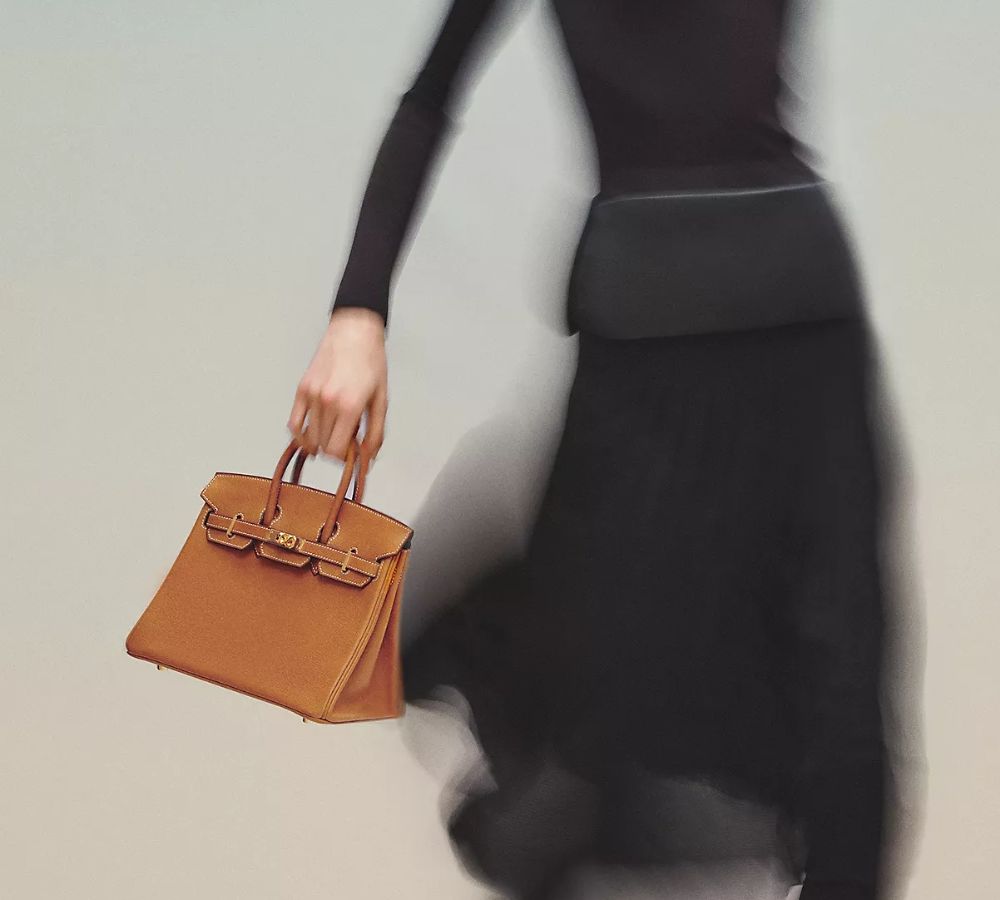
(Image credit: Hermes.com)
FAQ
What is the average Birkin resale price in 2026?
The average Birkin resale price runs at roughly 1.4 times retail in late 2025 and early 2026, according to Bernstein Research. So a Birkin 30 in Togo leather that retails for 14,900 US dollars typically resells for around 20,000 to 22,000 dollars, while pristine examples on Sotheby’s marketplace can reach 28,000 to 30,000 dollars.
What is the most valuable Birkin on the resale market?
Jane Birkin’s personal original prototype sold for 10.1 million US dollars at Sotheby’s Paris in July 2025, making it the most expensive handbag ever auctioned. Beyond that, the Himalaya Birkin in Niloticus crocodile routinely trades between 200,000 and 400,000 dollars at major auctions.
Which Birkin holds its resale price best?
The Birkin 25 holds its resale price strongest among the standard leather sizes, commanding the highest premium over retail. The Sellier Birkin construction also outperforms standard Retourné models. And among exotics, Niloticus crocodile dominates the high-value tier.