


How Tiffany & Co. became the default maker of sporting greatness
To understand why FIFA called Tiffany, we first need to understand how long this has been going on. The tradition of awarding trophies for athletic victory was revived in the late 1870s, and almost immediately, organizers of major sporting events turned to Tiffany & Co. to create them. That may seem like a coincidence, but Tiffany had already built a reputation as the house that made things feel permanent, prestigious and worth remembering.
The baseball connection came first. In 1888, Tiffany created the first ever world championship baseball trophy, known as the Hall Championship Cup. From there, the portfolio grew steadily across every major American sport. Today, a Tiffany & Co. sports trophy sits at the peak of the NFL, the NBA, MLB, the WNBA, the US Open in tennis, and the PGA Tour. Over 65 varieties of trophies are produced every single year out of Tiffany’s hollowware workshop in Cumberland, Rhode Island, alongside hundreds of other custom designs.
That workshop, by the way, is closer to an atelier. Skilled silversmiths and metal spinners work by hand, heating sterling silver to over 1,000 degrees Fahrenheit before molding, shaping and carving each piece. The Vince Lombardi Trophy alone takes four months to complete and requires 72 hours of labour from six specialist craftspeople. That is the level of commitment that sits behind every Tiffany & Co. sports trophy handed to a champion.
The cocktail napkin story behind the world’s most famous sports trophy
Before we get to FIFA, there is one story you need to know because it perfectly captures what a Tiffany & Co. sports trophy really represents. The Vince Lombardi Trophy, the award handed to the Super Bowl champion every year, was not born in a design studio. It was sketched on a cocktail napkin by a Tiffany & Co. vice president during a 1966 meeting with NFL Commissioner Pete Rozelle. That napkin became one of the most recognised objects in sport.
Since 1967, Tiffany has crafted that trophy every single year without interruption. And crucially, each Super Bowl winning team receives its own trophy rather than a shared one, which means Tiffany has produced and delivered a fresh Lombardi Trophy every year for nearly six decades. That kind of consistency is a long-running creative partnership between a luxury house and a sport that wanted to feel like it mattered. And that is exactly the feeling that FIFA has now decided to buy into.
Why FIFA finally wanted a Tiffany & Co. sports trophy for the Club World Cup
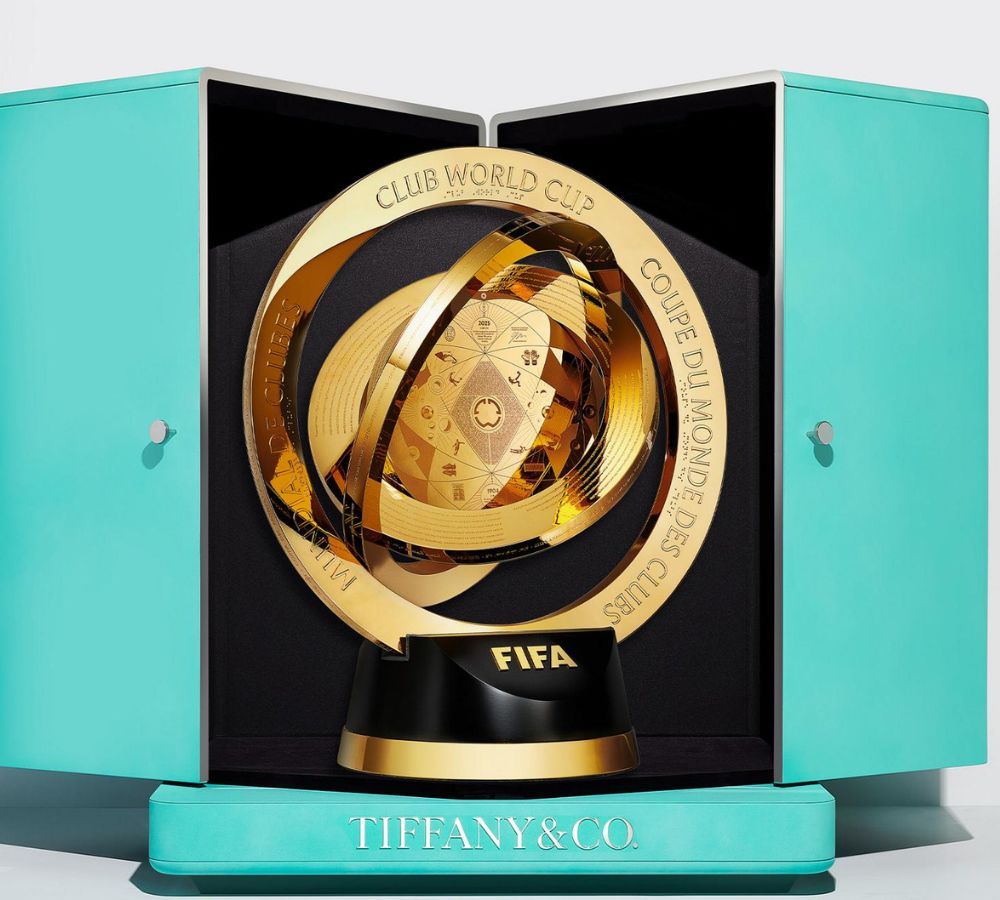
In 2025, FIFA launched the expanded 32-team Club World Cup in the United States. It was a controversial competition, criticised by players, leagues and fans. Crowds at some matches were sparse. But one thing FIFA got unambiguously right was the trophy. The FIFA Club World Cup trophy was conceived by FIFA and crafted in collaboration with Tiffany & Co., and it is genuinely one of the most technically ambitious sports trophies ever made.
Here is what makes it extraordinary. A key can physically unlock the trophy and transform it from a flat, shield-shaped structure into a multifaceted orbital form. When the rings open, they represent the alignment of the planets at two specific moments in history: the founding of FIFA on May 21, 1904, and the opening match of the 2025 tournament. That level of conceptual thinking is is exactly what you expect from the house that has been making the world’s most meaningful trophies for 160 years.
The design references are just as interesting. FIFA drew inspiration from the Voyager Golden Records sent into deep space by NASA in the 1970s, from the periodic table, from maps of pioneering journeys, and from astronomy. The trophy is engraved with the names of all 211 FIFA member associations, inscribed in 13 languages including Braille. It weighs approximately 5 kilograms and is estimated to be worth around $230,000, though FIFA and Tiffany & Co. have not officially disclosed the commission cost. And the inscription on it reads: “To those who hold this trophy, history belongs to you. You are witness to a moment in time that represents the pinnacle of club football, bestowed upon few but celebrated by many.”
Chelsea were the first club to lift it in 2025, making them the inaugural owners of a Tiffany & Co. sports trophy in football history.
What winners actually keep and why the contrast matters
Here is where the story gets genuinely interesting from a luxury perspective. When Chelsea lifted the Club World Cup trophy at MetLife Stadium in 2025, they received an exact replica of the official Tiffany & Co. sports trophy, complete with bespoke engravings marking their victory, their club crest and the dates of their triumph. They actually get to keep it. That replica goes back to Stamford Bridge with the team.
Now compare that to the FIFA World Cup. When Argentina lifted the trophy in Qatar in 2022, they lifted an 18-karat gold original standing 36.5 centimetres tall with a raw gold value of around $550,000. However, they did not take it home. The real World Cup trophy lives permanently in a vault in Zurich. What the winning nation actually receives is a gold-plated bronze replica worth somewhere between $15,000 and $30,000. So the biggest prize in football sends you home with a copy, while the newer, smaller, more controversial tournament hands you a Tiffany-crafted object estimated at around $230,000 that you genuinely own.
That gap tells you something important about where luxury is moving in sport. A Tiffany & Co. sports trophy is a statement about permanence, about craft, and about which competitions are serious enough to commission the best.
Why every sport wants in on the Tiffany effect
So what exactly does a sport gain by commissioning a Tiffany & Co. sports trophy? The answer goes well beyond aesthetics. When Shaun White launched The Snow League, a new professional snowboarding competition, he partnered with Tiffany to create the championship trophy. His reason was remarkably direct. He said that partnering with Tiffany & Co. brings a sense of permanence, prestige and history that his sport had long deserved, and that the athletes competing at the highest level deserved a trophy that reflected the same level of excellence and craftsmanship.
That quote is worth sitting with because it captures something that goes beyond marketing. A Tiffany & Co. sports trophy signals to sponsors, broadcasters, luxury partners and high net worth audiences that a competition is operating at the top tier. It is a visual shorthand for seriousness. And in a world where sports are increasingly competing for the same pool of sponsorship dollars and premium attention, that shorthand is genuinely valuable.
There is also a layering effect happening. The Larry O’Brien Championship Trophy, itself a Tiffany creation, was presented to the LA Lakers in a bespoke Louis Vuitton trunk. So now you have two luxury houses operating on the same moment of sporting triumph, each amplifying the other. That is the direction sport is moving in. The trophy is becoming a luxury brand event in its own right, not just the end point of a competition.
The Tiffany & Co. sports trophy slot FIFA World Cup 2026 has left wide open
Here is the question that this entire story is building toward. The FIFA Club World Cup now has a Tiffany & Co. sports trophy. The Super Bowl, the NBA Finals, the World Series and the US Open all have one. But the FIFA World Cup, the single most watched sporting event on the planet with over 5 billion viewers and a $50 million prize for the winner, does not.
For 16 years, Swiss watchmaker Hublot served as FIFA’s official timekeeper and brought a layer of luxury credibility to the World Cup. In December 2025, Hublot ended that partnership. No luxury brand has stepped in to replace them. And the World Cup trophy itself, while made of 18-karat gold and worth over half a million dollars in raw materials, has no luxury house attached to its creation, no Tiffany stamp, no design story, no Voyager Golden Records inspiration.
That vacancy is the most interesting white space in luxury sport right now. The Tiffany & Co. sports trophy has become the gold standard across American sport and now football at club level. The World Cup, which dwarfs every other competition in terms of audience and cultural reach, is the one major prize that has not yet made that call.
By the time the final whistle blows at MetLife Stadium on July 19, 2026, someone will lift the most watched trophy in sport. The question is who will be making it when football finally decides to go all in on luxury craftsmanship.
(Image credit: tiffany.com)
FAQ
Did Tiffany & Co. make the FIFA World Cup trophy?
No. The FIFA World Cup trophy was designed by Italian sculptor Silvio Gazzaniga in 1971 and is made from 18-karat gold. Tiffany & Co. has not been involved in its production. However, Tiffany did craft the FIFA Club World Cup trophy, which was first awarded in 2025 and was lifted by Chelsea Football Club.
Who won the first FIFA Club World Cup trophy made by Tiffany & Co.?
Chelsea Football Club won the inaugural expanded FIFA Club World Cup in 2025, becoming the first club to lift the new Tiffany & Co. designed trophy at MetLife Stadium in New Jersey.
How much is the FIFA Club World Cup trophy worth?
The FIFA Club World Cup trophy designed by Tiffany & Co. is estimated to be worth around $230,000, though the exact commission cost has not been officially disclosed by FIFA or Tiffany & Co. It features a 24-carat gold-plated finish, laser-engraved inscriptions in 13 languages including Braille, and the names of all 211 FIFA member associations.