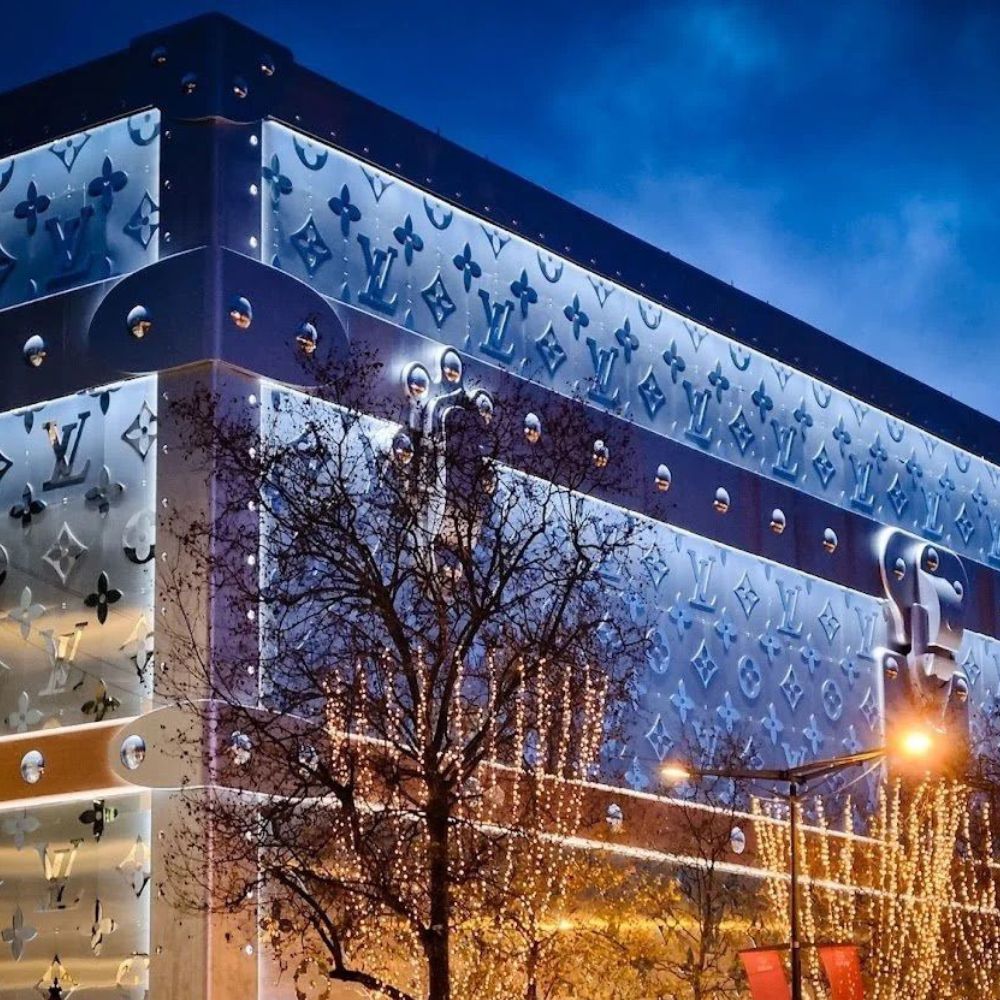

For two years, a building on the Champs-Élysées was wrapped to look like a giant Louis Vuitton trunk. Tourists posed in front of it. Travel magazines counted down the months. Everyone in luxury assumed the Louis Vuitton hotel was a matter of when, not if. Then Bernard Arnault, the most powerful man in luxury, killed the entire project in a single line. And here is the twist nobody is sitting with long enough. He might have just made the smartest decision. Let us back up a little, because the story is wilder than the headlines made it look.
The Louis Vuitton hotel that almost happened
The address sounds like a fantasy. 103 to 111 Avenue des Champs-Élysées. Roughly 6,000 square metres of Haussmann real estate sitting on the most photographed boulevard on earth. The building was originally the Hôtel Élysée Palace, a Belle Époque address that opened in 1899 as one of the city’s grandest hotels, and it later spent roughly two decades as HSBC France’s headquarters before LVMH took the site. When the conglomerate moved in, the industry filed the project under “obvious.”
The renderings did the rest. Travel publications reported around ten ultra-luxury suites, a panoramic restaurant, a spa of roughly 1,500 square metres and nightly rates that French press pegged at about €10,000. Better still, while the work was underway, Louis Vuitton wrapped the entire facade to look like one of its own monogrammed trunks. The image went viral and people queued to take photos of it. In a sense, the Louis Vuitton hotel was already doing free tourism marketing for Paris before a single guest had walked through the door.
Then, on 27 January 2026, during LVMH’s annual results presentation, Bernard Arnault took the obvious off the table. Speaking to analysts, he made the position unambiguous. Louis Vuitton, in his framing, is not really a fashion business in the way Dior is. It is fundamentally a leather goods house. And a leather goods house, he argued, has no business running hotels. Or, as the line was reported and repeated by international press afterwards: “Vuitton will not make a hotel. Vuitton concentrates rather than diversifies.”
That was when two years of speculation, killed in a single sentence.
The luxury hotel boom and the missing Louis Vuitton hotel
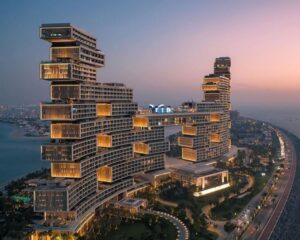
What makes the decision so striking is that virtually every major luxury house is moving in the opposite direction. Within LVMH itself, Bulgari Hotels already operates properties across Milan, London, Bali, Dubai, Beijing, Shanghai, Tokyo, Paris and Rome, with the Maldives and Miami Beach next in line. Armani has hotels in Milan and Dubai. Palazzo Versace is present in Dubai and Australia’s Gold Coast. Karl Lagerfeld has hotels in Macau and Marbella. Fendi runs its Private Suites in Rome. Roberto Cavalli has a hotel and resort in Dubai, while Missoni has expanded into Kuwait and Oman. Even Equinox, which began as a gym chain, is entering hospitality. In short, luxury’s biggest names are racing into hotels. The logic is simple. A boutique may capture a customer’s attention for ten minutes, but a hotel captures an entire weekend. Every touchpoint, from the sheets and menus to the service and surroundings, becomes part of the brand experience. Moreover, most hotel deals allow brands to collect management fees while real estate partners shoulder the development costs. As a result, the model offers both deeper customer engagement and attractive returns. By that measure, a Louis Vuitton hotel should have been an obvious next step. The brand commands unparalleled desirability, a global footprint and access to world-class hospitality expertise through Cheval Blanc, Belmond and Bulgari Hotels. Yet Bernard Arnault chose to walk away.So why did Louis Vuitton say no?
Here is the part Arnault said out loud, and it is worth taking seriously.
Louis Vuitton, in his framing, is not really a fashion business at all. It is a leather goods business with bags and trunks as the engine. Clothes, perfume, accessories and the rest are extensions. Take away the leather goods, and there is no Louis Vuitton. So the question becomes simple. Does running a Louis Vuitton hotel make the brand better at leather goods? Probably not.
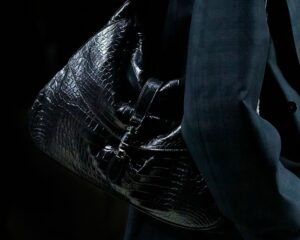
Think about a Louis Vuitton handbag for a second. It is a fully controlled object. It is made in a Louis Vuitton workshop, inspected by Louis Vuitton craftspeople, sold in a Louis Vuitton store, and used by a customer in private. If something goes wrong, the brand can fix it.
Now picture a hotel. It runs twenty-four hours a day. The people answering the phone, cleaning the rooms and serving the wine are largely not Louis Vuitton employees. The plumbing fails. The child in 304 cries through dinner. A bad review on TripAdvisor can do more damage in an afternoon than a year of advertising can repair. And once you open one hotel, you are expected to open more. One becomes three. Three becomes ten. The whole brand shifts from “leather goods house” to “lifestyle group.” That is the slow slide Arnault clearly wants to avoid.
The math behind killing the Louis Vuitton hotel
Now let us do the numbers behind the cancelled Louis Vuitton hotel, because they tell the same story.
Louis Vuitton is widely estimated to bring in somewhere between €20 and €25 billion a year, although LVMH does not report the brand’s revenue separately. Even more impressive, the maison is believed to operate at the highest profit margin in soft luxury, with analyst estimates putting operating margins broadly on par with Hermès, the only other house in that league. Almost nobody else gets close.
A hotel works at a completely different scale. Even a fully booked, sky-high property like the rumoured Champs-Élysées project would probably generate around €40 million in annual revenue, at margins meaningfully below what Louis Vuitton currently delivers in leather goods. Those would be excellent numbers for a hotel. However, would be pretty average numbers for Louis Vuitton.
In other words, opening the Louis Vuitton hotel would have made Louis Vuitton, as a business, slightly less profitable on every euro of sales. Even worse, scaling up to defend the investment would have pulled cash and management attention away from the leather goods engine that is, in Arnault’s own logic, the only thing the maison actually needs to be excellent at.
The decision becomes easy when you frame it that way. LVMH already has Cheval Blanc, Belmond and Bulgari Hotels for the hospitality narrative. What LVMH actually needs Louis Vuitton to do is just keep being Louis Vuitton.
What the Hermès playbook tells us
If you want to understand the call, look at Hermès. For more than a decade, Hermès has been the most consistently profitable luxury house on the planet. It has compounded revenue and profit at a pace nobody else has matched. And it has done all of that while refusing almost every expansion opportunity the industry has thrown at it be it hotels, streaming service or luxury car. The Hermès family historically blocks anything that monetises the brand at the cost of stretching it.
Meanwhile, the maison that overextended the hardest in the last cycle was Gucci, which spent the mid-2010s pushing its monogram onto everything from sneakers to pet accessories. Gucci is now in the middle of a brutal multi-year turnaround under Kering. The pattern is hard to miss. Expansion catches up with you.
What Arnault did, in effect, was tell the market to start benchmarking Louis Vuitton against Hermès rather than against Dior. The brand is trying to be the most disciplined luxury house in the world.
What 103 Champs-Élysées is becoming instead of a Louis Vuitton hotel?
Of course, the site is not being wasted. It is being turned into what LVMH executives have started calling the largest Louis Vuitton Maison in the world. Picture multiple retail floors, a destination restaurant, a permanent exhibition space dedicated to the brand’s craft, and a handful of private salons reserved for the maison’s biggest spenders.
Crucially, every single one of those functions is something Louis Vuitton already does well. The brand already runs cafes, including the Maxime Frédéric at Louis Vuitton Paris and chocolate boutique in central Paris, set above its LV Dream exhibition space facing the Seine. It runs restaurants in Saint-Tropez (with Arnaud Donckele and Maxime Frédéric), Osaka, Seoul and Chengdu. It runs museum-grade exhibitions, including the immersive Visionary Journeys experience aboard “The Louis” in Shanghai, designed by Shohei Shigematsu of OMA. So 103 Champs-Élysées is a concentration of what the brand already does into one address.
And suddenly that giant trunk-shaped construction wrap reads differently. It was never teasing a Louis Vuitton hotel, it was teasing the next evolution of the brand’s global flagship.
What the Louis Vuitton hotel story means for the rest of luxury
Here is why the cancellation of Louis Vuitton hoel matters way beyond Paris.
Every luxury house is looking at the same chart right now. The Chinese consumer is being pickier. The Western aspirational shopper is pulling back. LVMH itself reported revenue of €80.8 billion for 2025, down 1 percent organic, with the Fashion & Leather Goods division under particular pressure. In tough cycles, the temptation is always to stretch, add categories and chase revenue with more hotels, more partnerships and more licenses.
Arnault is making the opposite bet. In a tough cycle, restraint wins. The brand that survives is the one that refuses to dilute itself. The brilliance of the call is that it costs LVMH almost nothing. The Champs-Élysées site will still print money as a Maison. Cheval Blanc still gives the group its trophy Parisian hotel, in the former Samaritaine building on the Right Bank. The hospitality story across the wider portfolio is intact. The only thing LVMH has refused is the one extension that would have actually weakened the brand at the centre of the empire.
This is, by the way, the same logic LVMH is applying to Loro Piana, the Italian quiet luxury maison the group recently took to an €11 billion valuation with the same belief that scarcity, focus and discipline compound far harder than category extension.
Most luxury brands today are trying to manufacture desire by being everywhere. Louis Vuitton is betting the exact opposite.
The most anticipated Louis Vuitton hotel in Paris will never open. And that, it turns out, is exactly the point.
(Image credit: Jeremy Jauncey/LinkedIn)
Also read: How LVMH Is Reshaping Luxury Craftsmanship Through Autism Inclusion, another counterintuitive LVMH bet on what makes the group’s maisons unmistakable just like Louis Vuitton hotel abandonment.
FAQ
Why is there no Louis Vuitton hotel?
LVMH chairman Bernard Arnault confirmed at the group’s 2025 annual results presentation on 27 January 2026 that there will be no Louis Vuitton hotel. In his framing, Louis Vuitton is fundamentally a leather goods house, and a leather goods house should stay focused on what it does best rather than diversify into hospitality.
Does LVMH own any hotels?
Yes, plenty. LVMH operates a substantial hospitality portfolio through Cheval Blanc (Courchevel, Saint-Tropez, Saint-Barth, the Maldives and Paris, with London, Beverly Hills and the Seychelles in development), Belmond (a global collection of 40-plus hotels, trains and river cruises across more than 20 countries) and Bulgari Hotels & Resorts (nine properties open today across Europe, Asia and the Middle East). Dior also runs spas and selected hospitality projects. The “no hotel” decision applies only to the Louis Vuitton brand itself.
What is happening to 103 Champs-Élysées then?
Instead of a Louis Vuitton hotel, the 6,000 square metre site is being turned into the largest Louis Vuitton Maison in the world. It will house several floors of retail, a destination restaurant, exhibition space and private client salons, but no overnight rooms.